
Care Disclaimer: Plant care recommendations are general guidelines based on common growing conditions. Individual results may vary based on your local environment, climate, and care routine. If your plant is toxic, keep it away from children and pets, and consult a veterinarian if accidental ingestion occurs.
1.Mirabilis Jalapa — Overview
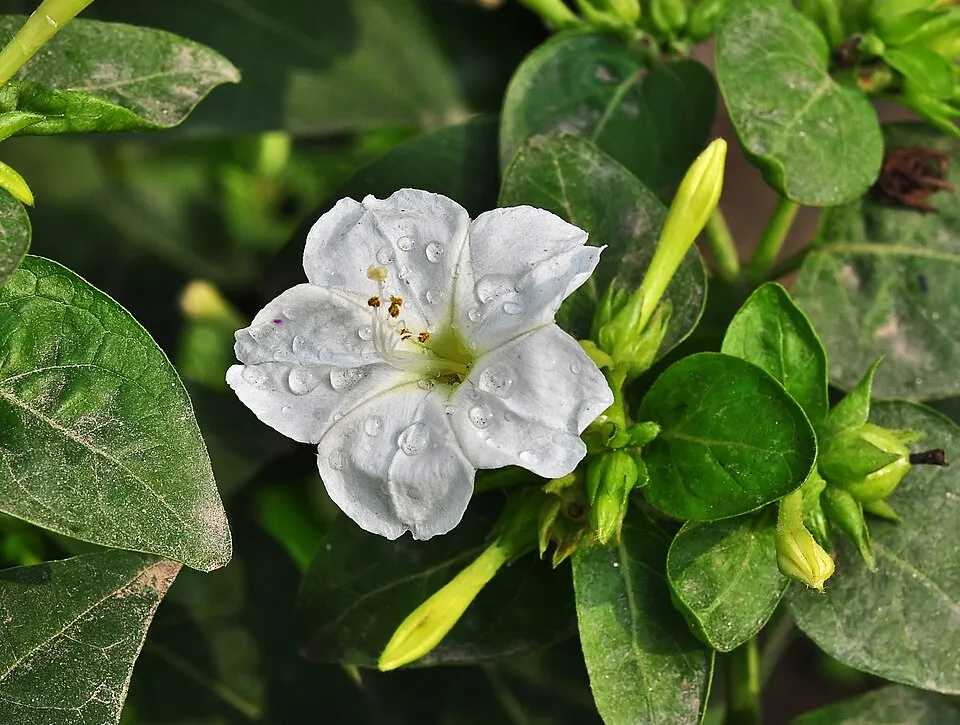
Mirabilis jalapa, commonly known as the Four O'Clock flower or Marvel of Peru, is a captivating ornamental and medicinal plant native to the tropical regions of South America, specifically Peru and Mexico. This herbaceous perennial, often cultivated as an annual in cooler climates, belongs to the Nyctaginaceae family.
It typically grows as a bushy plant, reaching heights of 60 to 90 centimeters (2-3 feet), characterized by its ovate, opposite leaves that are a vibrant soft green.
The plant is renowned for its distinctive trumpet-shaped flowers, which exhibit a fascinating nyctinastic behavior, opening in the late afternoon (around four o'clock, hence the common name) and remaining open through the night, releasing a sweet fragrance to attract nocturnal pollinators like moths. The blooms present an extraordinary spectrum of colors, including white, yellow, red, pink, and various bicolors or variegated patterns, often on the same plant, creating a visually stunning display.
Its robust nature and aesthetic appeal have made it a global garden favorite, easily adaptable to diverse environments. The plant develops tuberous roots, which serve as storage organs, allowing it to perennate in warmer zones or be overwintered in colder regions.
Trusted Scientific References
1. Authoritative external sources for Mirabilis jalapa
1.1 Wikipedia — Mirabilis jalapa
1.2 Kew POWO (Plants of the World Online)
1.3 PubMed — peer-reviewed research
1.4 NCBI Taxonomy Browser
1.5 GBIF — Global Biodiversity
1.6Mirabilis Jalapa should be interpreted through verified botanical identity, practical care, and responsible safety language. This recovery note adds the missing context needed for a complete profile: match light to the plant's habit, use well-drained soil, water according to season, and avoid unsupported medicinal or edible claims. For publishing, the plant can be presented as a source-backed garden plant with clear care guidance, common problem diagnosis, and conservative safety wording.
1.1.Mirabilis Jalapa — Key Features
- ✓ <strong>Nyctinastic Flowers</strong> — Blooms open in late afternoon and close in the morning.
- ✓ <strong>Diverse Flower Colors</strong> — Wide range of colors, often variegated on a single plant.
- ✓ <strong>Fragrant Blooms</strong> — Emits a sweet scent, attracting nocturnal pollinators.
- ✓ <strong>Tuberous Roots</strong> — Stores nutrients, allowing perennation or overwintering.
- ✓ <strong>Traditional Medicinal Uses</strong> — Employed in folk medicine for various ailments.
- ✓ <strong>Anti</strong> — inflammatory Properties — Leaf extracts show significant inflammation reduction.
- ✓ <strong>Purgative Action</strong> — Roots are traditionally used for their strong laxative effect.
- ✓ <strong>Antimicrobial Activity</strong> — Effective against certain bacteria and fungi.
- ✓ <strong>Ornamental Value</strong> — Highly prized for its beauty in gardens worldwide.
- ✓ <strong>Easy to Cultivate</strong> — Grows readily from seeds or tubers in suitable climates.
1.2.Mirabilis Jalapa — Quick Summary
- ✓ Mirabilis jalapa, or Four O'Clock flower, is a vibrant South American ornamental and medicinal plant.
- ✓ Known for its evening-blooming, colorful, fragrant flowers.
- ✓ Traditionally used for anti-inflammatory, purgative, and antimicrobial properties.
- ✓ Contains rotenoids, flavonoids, and triterpenes as key chemical constituents.
- ✓ Internal use, especially seeds, is toxic and strongly discouraged due to potent purgative effects.
- ✓ Primarily used topically for skin conditions and inflammation.
2.Mirabilis Jalapa — Scientific Identity
3.Mirabilis Jalapa — Quick Facts
4.Mirabilis Jalapa — Appearance & Identification
5.Mirabilis Jalapa — Native Habitat
6.Mirabilis Jalapa — Water Requirements
- ✓ Seed Propagation — Easily grown from seeds, which should be sown directly outdoors after the last frost or started indoors 6-8 weeks prior.
- ✓ Tuber Division — Established plants develop tuberous roots that can be dug up, divided, and replanted to propagate new plants.
- ✓ Soil Preference — Thrives in well-drained, fertile soil with a slightly acidic to neutral pH (6.0-7.0).
- ✓ Sun Exposure — Prefers full sun to partial shade; full sun promotes the most abundant flowering.
- ✓ Watering — Requires moderate watering, allowing the soil to dry out slightly between waterings; tolerant of some drought once established.
- ✓ Fertilization — Benefits from a balanced granular fertilizer applied sparingly during the growing season.
- ✓ Temperature — Best suited for warm climates; grown as an annual in temperate zones, as it is frost-sensitive.
- ✓ Pest and Disease Management — Generally robust, but watch for common garden pests like aphids or spider mites; rarely affected by serious diseases.
Reviewed by the Flora Medical Global Botanical Review Panel
Multi-disciplinary editorial group · Botany · Ethnobotany · Herbal-medicine literature
Who reviewed this: This page was checked by the Flora Medical Global Botanical Review Panel — an in-house editorial group of botany graduates, ethnobotany researchers, and horticulture practitioners who collectively maintain our 7,000+ plant encyclopedia. Meet the team.
Our 4-step verification process
1. Taxonomic verification
Scientific names and synonyms cross-checked against Kew POWO, World Flora Online, and The Plant List.
2. Phytochemical & medicinal cross-reference
Active compounds, traditional uses, and reported activities are cross-referenced with PubMed, USDA Dr. Duke's database, and peer-reviewed ethnobotanical literature.
3. Conservation & distribution check
Distribution, ecology, and conservation status confirmed against GBIF occurrence records and the IUCN Red List.
4. Editorial & safety review
Every entry passes an editorial pass for clarity, originality, and safety notices (toxicity, contraindications, dosage caveats) before publication.
Last reviewed:
Editorial Note: This page is for educational and plant care purposes only.
Written by: Flora Medical Global Editorial Team
Reviewed by: Flora Medical Global Botanical Review Panel
Last Updated: June 15, 2026






Mirabilis Jalapa — Comments & Community Reviews
Rate this plant