

Care Disclaimer: Plant care recommendations are general guidelines based on common growing conditions. Individual results may vary based on your local environment, climate, and care routine. If your plant is toxic, keep it away from children and pets, and consult a veterinarian if accidental ingestion occurs.
1.Mitella Diphylla — Overview
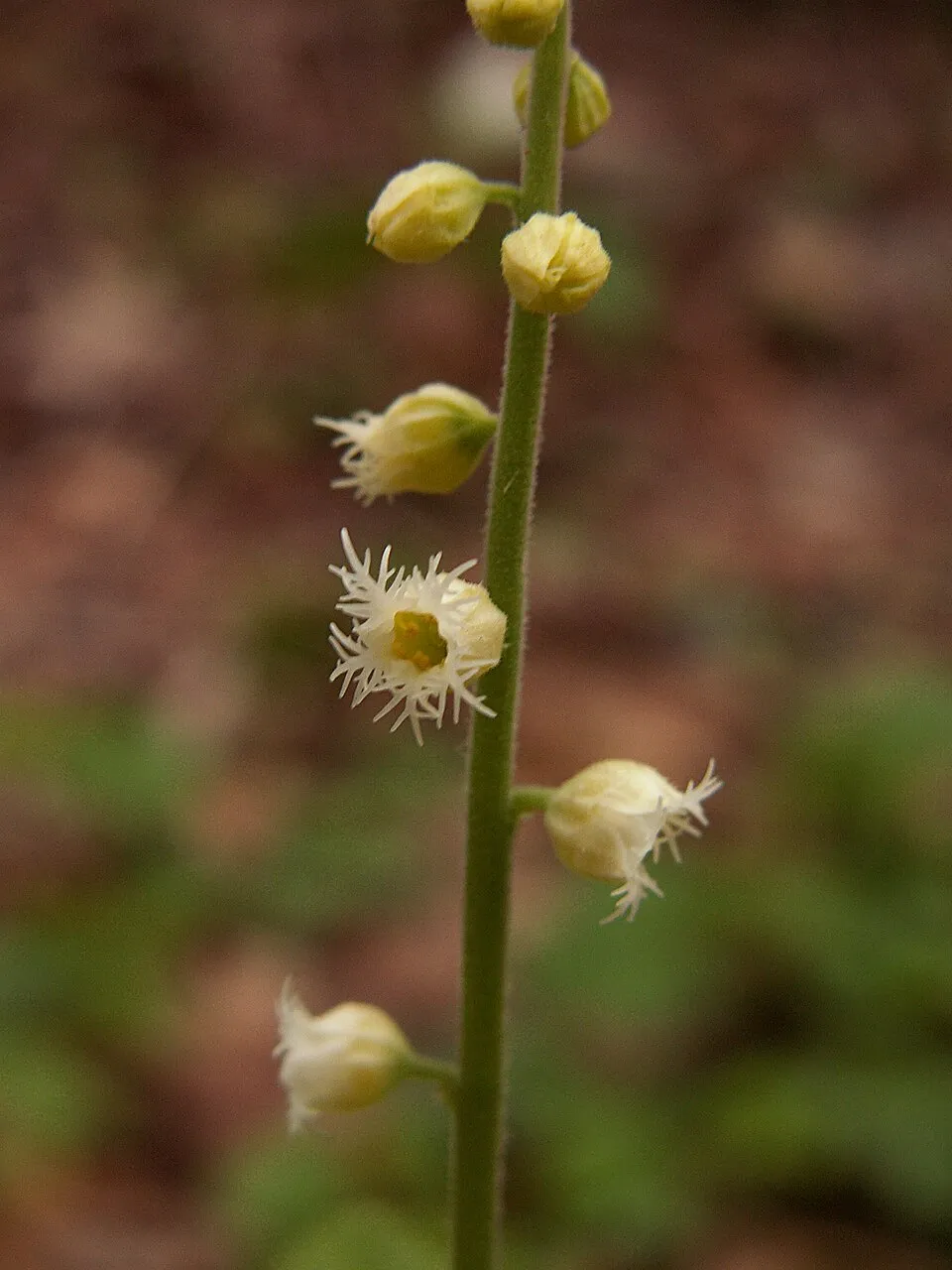
Mitella diphylla, commonly known as Two-leaved Miterwort or Bishop's Cap, is an enchanting perennial herb belonging to the Saxifragaceae family. This delicate woodland plant is native to the cool, moist, and often alkaline soils of rich deciduous forests across eastern North America, spanning from southeastern Canada and most of the eastern U.S., excluding Maine and Florida. It typically attains a height of 4 to 24 inches, characterized by slender, finely hairy stems that may grow in multiple upright clusters from a rhizomatous root system. A distinctive feature is the pair of opposite, sessile or short-stalked, heart-shaped (cordate to ovate) stem leaves situated midway up the flowering stalk, measuring approximately 2-2.5 inches long and 1.25-1.5 inches wide, with coarsely toothed margins and three shallow lobes.
A basal rosette of larger, similarly shaped, hairy leaves with longer petioles emerges directly from the rootstock. In spring, from April to June, Mitella diphylla produces exquisite white, bell-shaped flowers, each less than a quarter-inch wide, arranged in loose, spikelike racemes. These intricate blossoms feature five deeply fringed, pinnatifid petals that evoke the appearance of miniature snowflakes, alongside a greenish-yellow calyx, ten yellow stamens, and a pistil with two styles. The generic name 'Mitella' derives from 'little mitre,' referring to the fruit's resemblance to a bishop's headdress, while 'diphylla' signifies 'two leaves,' highlighting its characteristic stem foliage.
The plant's fruit is a two-beaked capsule that splits open to release numerous small, black, ridged seeds, often dispersed by raindrops. Its preference for shady, damp environments makes it a captivating addition to woodland gardens.
Trusted Scientific References
1. Authoritative external sources for Mitella Diphylla
1.1 Wikipedia — Mitella Diphylla
1.2 Kew POWO (Plants of the World Online)
1.3 PubMed — peer-reviewed research
1.4 NCBI Taxonomy Browser
1.5 GBIF — Global Biodiversity
1.6Mitella Diphylla should be interpreted through verified botanical identity, practical care, and responsible safety language. This recovery note adds the missing context needed for a complete profile: match light to the plant's habit, use well-drained soil, water according to season, and avoid unsupported medicinal or edible claims. For publishing, the plant can be presented as a source-backed garden plant with clear care guidance, common problem diagnosis, and conservative safety wording.
1.1.Mitella Diphylla — Key Features
- ✓ <strong>Unique Fringed Flowers</strong> — White, bell-shaped, deeply pinnatifid petals resembling snowflakes.
- ✓ <strong>Distinctive Foliage</strong> — Two opposite, heart-shaped stem leaves midway up the stalk, plus basal leaves.
- ✓ <strong>Woodland Habitat</strong> — Thrives in moist, rich, shaded deciduous forests.
- ✓ <strong>Rhizomatous Growth</strong> — Spreads via thick rhizomes, forming clonal colonies.
- ✓ <strong>Ornamental Appeal</strong> — Highly prized for its aesthetic beauty in shade gardens.
- ✓ <strong>Native American Traditional Use</strong> — Anecdotal historical use for astringent and soothing purposes.
- ✓ <strong>Saxifragaceae Family</strong> — Member of the Saxifrage family.
- ✓ <strong>Bishop's Cap Fruit</strong> — Capsule resembles a bishop's mitre, releasing tiny black seeds.
- ✓ <strong>Early Spring Bloomer</strong> — Flowers appear from April to June.
- ✓ <strong>Pollinator Attractor</strong> — Attracts hoverflies and small carpenter bees.
1.2.Mitella Diphylla — Quick Summary
- ✓ Delicate woodland perennial with unique fringed white flowers.
- ✓ Native to eastern North American moist, shaded forests.
- ✓ Historically used by Native Americans for astringent and soothing properties.
- ✓ Known for its two distinct stem leaves and basal rosette.
- ✓ Primarily valued as an ornamental plant in shade gardens.
- ✓ Medicinal uses are largely anecdotal and lack scientific validation.
2.Mitella Diphylla — Scientific Identity
3.Mitella Diphylla — Quick Facts
4.Mitella Diphylla — Appearance & Identification
5.Mitella Diphylla — Native Habitat
6.Mitella Diphylla — Water Requirements
- ✓ Site Selection — Choose a shaded to partially shaded location, mimicking its natural woodland habitat.
- ✓ Soil Preparation — Ensure rich, well-draining soil with high organic matter content; prefers slightly alkaline to neutral pH.
- ✓ Moisture Requirements — Maintain consistently moist soil; avoid waterlogging but do not allow it to dry out completely.
- ✓ Planting — Plant rhizomes or seedlings in early spring or fall, spacing them about 6-12 inches apart.
- ✓ Propagation — Can be propagated by division of rhizomes in spring or fall, or by seed, though seed germination can be slow.
- ✓ Mulching — Apply a layer of leaf mold or other organic mulch to retain moisture, suppress weeds, and enrich the soil.
- ✓ Maintenance — Requires minimal care once established; protect from strong winds and intense direct sunlight.
- ✓ Pest and Disease — Generally resistant to most pests and diseases, thriving in its preferred conditions.
Reviewed by the Flora Medical Global Botanical Review Panel
Multi-disciplinary editorial group · Botany · Ethnobotany · Herbal-medicine literature
Who reviewed this: This page was checked by the Flora Medical Global Botanical Review Panel — an in-house editorial group of botany graduates, ethnobotany researchers, and horticulture practitioners who collectively maintain our 7,000+ plant encyclopedia. Meet the team.
Our 4-step verification process
1. Taxonomic verification
Scientific names and synonyms cross-checked against Kew POWO, World Flora Online, and The Plant List.
2. Phytochemical & medicinal cross-reference
Active compounds, traditional uses, and reported activities are cross-referenced with PubMed, USDA Dr. Duke's database, and peer-reviewed ethnobotanical literature.
3. Conservation & distribution check
Distribution, ecology, and conservation status confirmed against GBIF occurrence records and the IUCN Red List.
4. Editorial & safety review
Every entry passes an editorial pass for clarity, originality, and safety notices (toxicity, contraindications, dosage caveats) before publication.
Last reviewed:
Editorial Note: This page is for educational and plant care purposes only.
Written by: Flora Medical Global Editorial Team
Reviewed by: Flora Medical Global Botanical Review Panel
Last Updated: June 15, 2026







Mitella Diphylla — Comments & Community Reviews
Rate this plant