
Care Disclaimer: Plant care recommendations are general guidelines based on common growing conditions. Individual results may vary based on your local environment, climate, and care routine. If your plant is toxic, keep it away from children and pets, and consult a veterinarian if accidental ingestion occurs.
1.Myosotis Scorpioides — Overview
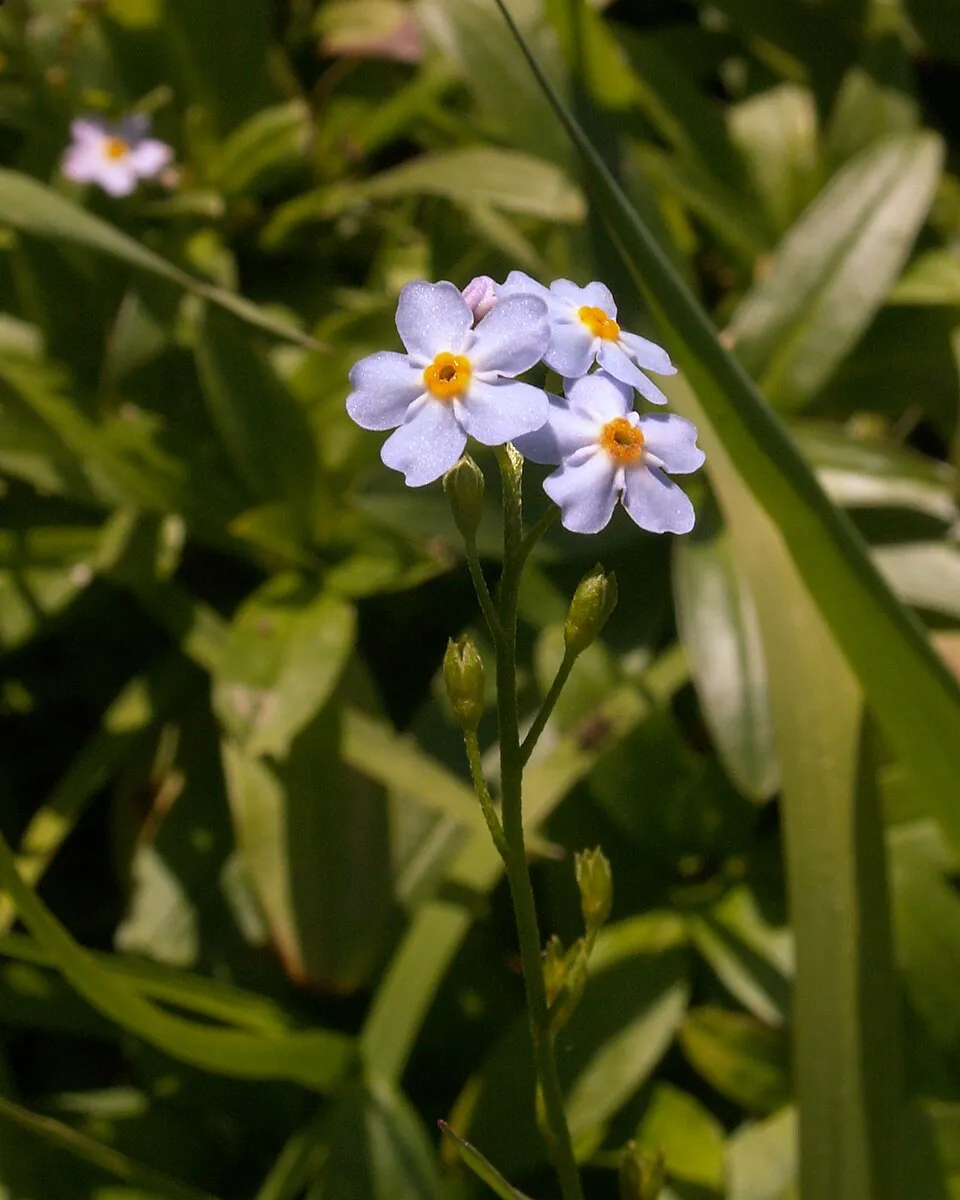
Myosotis scorpioides, commonly known as the True Forget-me-not or Water Forget-me-not, is an enchanting perennial herbaceous plant belonging to the Boraginaceae family. This species is indigenous to Europe and temperate regions of Asia, but its delicate beauty has led to its naturalization across many parts of the world, particularly in North America, where it flourishes in its preferred damp, cool environments. The plant typically grows to a height of 15-30 cm, occasionally reaching up to 60 cm, featuring slender, often subtly hairy stems.
Its leaves are ovate to lanceolate, with the larger basal leaves forming a distinct rosette and smaller alternate leaves along the stem. The hallmark of Myosotis scorpioides is its cluster of small, vibrant sky-blue flowers, each about 0.5 to 1 cm in diameter, uniquely marked with a bright yellow or white eye at its center. These blossoms are arranged in characteristic scorpioid cymes, an inflorescence type that coils like a scorpion's tail in bud, gradually unfurling as the flowers open—a feature that inspired its scientific epithet.
Myosotis scorpioides thrives in moist to wet soil conditions, making it a common sight along stream banks, pond edges, marshlands, and damp meadows. Its blooming period extends from late spring through summer, offering a continuous display of its iconic blue flowers. While widely cherished for its ornamental value and its powerful symbolic meaning of remembrance and enduring affection, the plant also holds a place in traditional folk medicine, albeit with limited modern scientific validation.
Trusted Scientific References
1. Authoritative external sources for Myosotis Scorpioides
1.1 Wikipedia — Myosotis Scorpioides
1.2 Kew POWO (Plants of the World Online)
1.3 PubMed — peer-reviewed research
1.4 NCBI Taxonomy Browser
1.5 GBIF — Global Biodiversity
1.6Myosotis Scorpioides should be interpreted through verified botanical identity, practical care, and responsible safety language. This recovery note adds the missing context needed for a complete profile: match light to the plant's habit, use well-drained soil, water according to season, and avoid unsupported medicinal or edible claims. For publishing, the plant can be presented as a source-backed garden plant with clear care guidance, common problem diagnosis, and conservative safety wording.
1.1.Myosotis Scorpioides — Key Features
- ✓ <strong>Iconic 'forget</strong> — me-not' sky-blue flowers with a distinctive yellow or white eye.
- ✓ <strong>Characterized by scorpioid</strong> — Characterized by scorpioid cymes, an inflorescence that coils like a scorpion's tail.
- ✓ <strong>Prefers consistently moist</strong> — Prefers consistently moist to wet soil conditions and thrives in partial shade to full sun.
- ✓ <strong>A herbaceous perennial plant, typically growing 15</strong> — 30 cm tall with slender, hairy stems.
- ✓ <strong>Widely cultivated for</strong> — Widely cultivated for its ornamental beauty and symbolic meaning of remembrance and enduring love.
- ✓ <strong>Flowers are edible</strong> — Flowers are edible and frequently used as a decorative garnish in culinary applications.
- ✓ <strong>Contains a range</strong> — Contains a range of phytochemicals, including flavonoids, phenolic acids, and anthocyanins.
- ✓ <strong>Belongs to the</strong> — Belongs to the Boraginaceae family, which is known for containing pyrrolizidine alkaloids.
- ✓ <strong>Relatively easy to</strong> — Relatively easy to cultivate through seeds or division in appropriate garden settings.
- ✓ <strong>Has a history</strong> — Has a history of traditional folk medicine uses, primarily topical or for mild internal ailments.
1.2.Myosotis Scorpioides — Quick Summary
- ✓ Iconic Myosotis scorpioides, the True Forget-me-not, is a perennial known for its delicate blue flowers with yellow eyes.
- ✓ Native to Europe and Asia, it thrives in moist, cool environments and is widely naturalized.
- ✓ Prized ornamentally, it also has traditional folk uses for minor skin issues and as a mild diuretic.
- ✓ Contains beneficial flavonoids and phenolics, but also hepatotoxic pyrrolizidine alkaloids (PAs).
- ✓ Edible flowers are used as a culinary garnish, but internal medicinal use is cautioned due to PA content.
- ✓ Cultivation is straightforward in suitable wetland-like garden settings.
2.Myosotis Scorpioides — Scientific Identity
3.Myosotis Scorpioides — Quick Facts
4.Myosotis Scorpioides — Appearance & Identification
5.Myosotis Scorpioides — Native Habitat
6.Myosotis Scorpioides — Water Requirements
- ✓ Site Selection — Choose a location with partial shade to full sun, ensuring consistently moist to wet soil conditions, ideal for its natural habitat.
- ✓ Soil Requirements — Prefers rich, loamy soil with good drainage, but can tolerate heavier clays if kept moist. A pH between 6.0 and 7.0 is optimal.
- ✓ Propagation — Easily propagated from seeds sown directly in late spring or early fall, or by division of established clumps in spring every 2-3 years.
- ✓ Planting Time — Seeds can be broadcast in spring after the last frost or in late summer for fall germination. Potted plants are best transplanted in spring.
- ✓ Watering — Requires consistent and ample watering, especially during dry spells, to mimic its natural wetland environment. Do not allow the soil to dry out.
- ✓ Fertilization — Generally low-maintenance; a light application of balanced organic fertilizer in spring or a layer of compost is usually sufficient.
- ✓ Pest and Disease Management — Myosotis scorpioides is relatively robust, but watch for powdery mildew in humid conditions and common garden pests like aphids.
- ✓ Maintenance — Deadheading spent flowers encourages further blooming and prevents excessive self-seeding. Pruning back leggy growth can promote bushier plants.
Reviewed by the Flora Medical Global Botanical Review Panel
Multi-disciplinary editorial group · Botany · Ethnobotany · Herbal-medicine literature
Who reviewed this: This page was checked by the Flora Medical Global Botanical Review Panel — an in-house editorial group of botany graduates, ethnobotany researchers, and horticulture practitioners who collectively maintain our 7,000+ plant encyclopedia. Meet the team.
Our 4-step verification process
1. Taxonomic verification
Scientific names and synonyms cross-checked against Kew POWO, World Flora Online, and The Plant List.
2. Phytochemical & medicinal cross-reference
Active compounds, traditional uses, and reported activities are cross-referenced with PubMed, USDA Dr. Duke's database, and peer-reviewed ethnobotanical literature.
3. Conservation & distribution check
Distribution, ecology, and conservation status confirmed against GBIF occurrence records and the IUCN Red List.
4. Editorial & safety review
Every entry passes an editorial pass for clarity, originality, and safety notices (toxicity, contraindications, dosage caveats) before publication.
Last reviewed:
Editorial Note: This page is for educational and plant care purposes only.
Written by: Flora Medical Global Editorial Team
Reviewed by: Flora Medical Global Botanical Review Panel
Last Updated: June 15, 2026







Myosotis Scorpioides — Comments & Community Reviews
Rate this plant