

Care Disclaimer: Plant care recommendations are general guidelines based on common growing conditions. Individual results may vary based on your local environment, climate, and care routine. If your plant is toxic, keep it away from children and pets, and consult a veterinarian if accidental ingestion occurs.
1.Myriophyllum Aquaticum — Overview
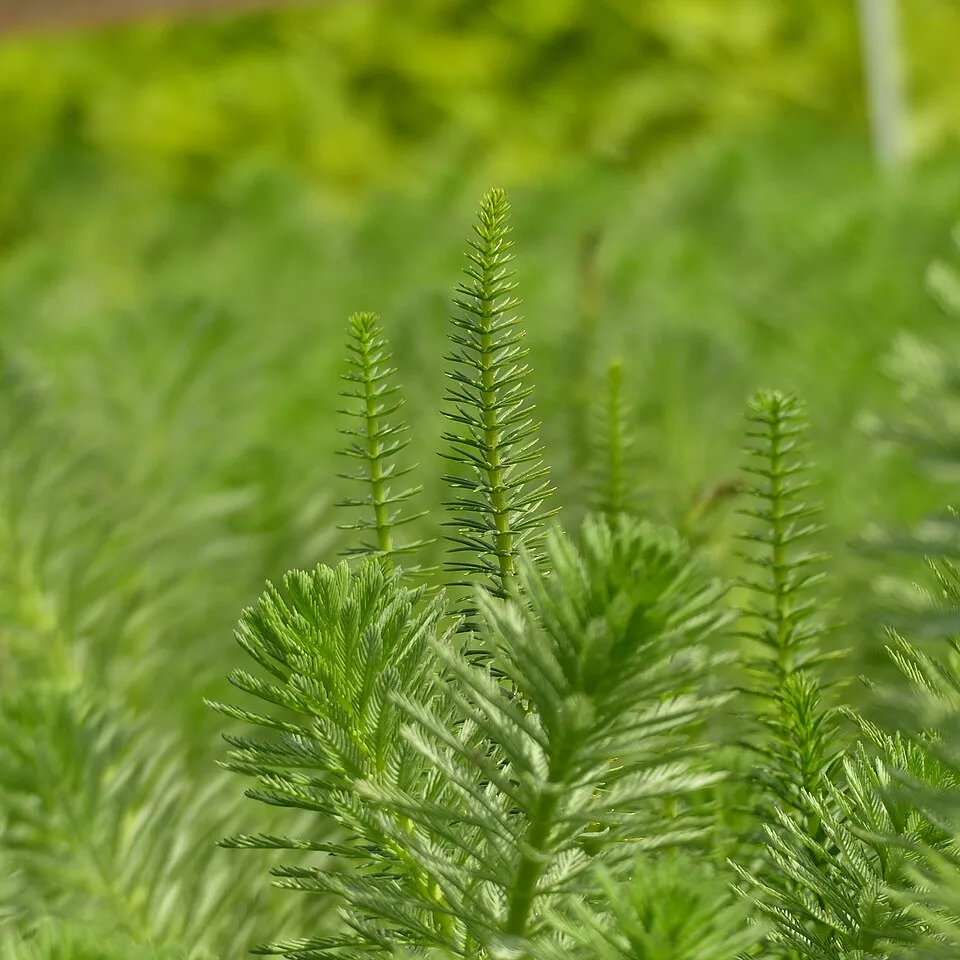
Myriophyllum aquaticum, commonly known as Parrot's Feather or Water Milfoil, is a remarkably vigorous perennial aquatic herb belonging to the Haloragaceae family. Native to the tranquil waters of the Amazon Basin in South America, particularly Brazil, this species has since naturalized and proliferated across numerous warm temperate and tropical regions globally, often becoming an invasive species due to its aggressive growth. Its distinctive morphology includes both submerged and emergent foliage. The submerged leaves are finely dissected and feathery, creating an intricate, fern-like appearance that contributes to underwater aesthetics.
Above the waterline, the emergent stems bear whorls of stiff, bright green leaves resembling miniature fir trees or stylized feathers, which can extend several inches to over a foot out of the water, forming dense, attractive mats. The plant anchors itself to the substrate via a robust rhizomatous root system, enabling it to form extensive colonies that can cover vast areas of pond bottoms or lake surfaces. While primarily valued for its ornamental appeal in aquariums and water gardens, Myriophyllum aquaticum also plays a significant ecological role. It provides vital habitat and shelter for various small aquatic organisms, aids in water oxygenation, and absorbs excess nutrients, thereby contributing to water clarity.
However, its rapid, unmanaged growth poses a substantial ecological challenge, as it can outcompete native aquatic vegetation, disrupt aquatic ecosystems, and obstruct waterways. Reproduction primarily occurs vegetatively through fragmentation, with small stem pieces readily developing new roots and establishing new plants, a key factor in its invasive success. Inconspicuous flowers may appear on emergent stems, but seed propagation is less common, especially outside its native range where most naturalized populations are female clones.
Trusted Scientific References
1. Authoritative external sources for Myriophyllum aquaticum
1.1 Wikipedia — Myriophyllum aquaticum
1.2 Kew POWO (Plants of the World Online)
1.3 PubMed — peer-reviewed research
1.4 NCBI Taxonomy Browser
1.5 GBIF — Global Biodiversity
1.1.Myriophyllum Aquaticum — Key Features
- ✓ <strong>Feathery, finely dissected</strong> — Feathery, finely dissected submerged leaves.
- ✓ <strong>Stiff, upright, emergent</strong> — Stiff, upright, emergent leaves resembling miniature fir trees.
- ✓ <strong>Bright green foliage</strong> — Bright green foliage color.
- ✓ <strong>Rhizomatous root system</strong> — Rhizomatous root system for anchoring and spread.
- ✓ <strong>Forms dense, mat</strong> — like colonies on water surfaces.
- ✓ <strong>Rapid and aggressive</strong> — Rapid and aggressive growth habit.
- ✓ <strong>Adaptable to various</strong> — Adaptable to various freshwater conditions.
- ✓ <strong>Primarily reproduces vegetatively</strong> — Primarily reproduces vegetatively via fragmentation.
- ✓ <strong>Inconspicuous, small flowers.</strong> — Inconspicuous, small flowers.
- ✓ <strong>Classified as an</strong> — Classified as an invasive species in many regions.
1.2.Myriophyllum Aquaticum — Quick Summary
- ✓ Vigorous aquatic perennial native to the Amazon Basin, known for feathery foliage.
- ✓ Widely cultivated ornamentally, but highly invasive in non-native environments.
- ✓ Offers ecological benefits like oxygenation and nutrient absorption in water.
- ✓ Young shoot tips are edible when cooked, but no known medicinal uses.
- ✓ Reproduces primarily by fragmentation, making control challenging.
- ✓ Requires careful management to prevent environmental harm and waterway obstruction.
2.Myriophyllum Aquaticum — Scientific Identity
3.Myriophyllum Aquaticum — Quick Facts
4.Myriophyllum Aquaticum — Appearance & Identification
5.Myriophyllum Aquaticum — Native Habitat
6.Myriophyllum Aquaticum — Water Requirements
- ✓ Water Depth — Thrives in shallow to moderately deep freshwater, typically 15-60 cm (6-24 inches), but can grow in several meters of water.
- ✓ Light Requirements — Prefers full sun to partial shade for optimal growth and vibrant foliage color.
- ✓ Substrate — Best anchored in a rich, muddy substrate or fine gravel, though it can also float freely.
- ✓ Temperature Tolerance — Adaptable to a wide range of temperatures, flourishing in tropical, subtropical, and warm temperate climates.
- ✓ Propagation — Easily propagated from stem cuttings; even small fragments can root and establish new plants quickly.
- ✓ Container Growing — Can be grown in submerged containers to manage its invasive spread in garden ponds.
- ✓ Nutrient Levels — Tolerates and even thrives in nutrient-rich waters, efficiently absorbing excess nitrates and phosphates.
- ✓ Maintenance — Requires regular pruning to control aggressive growth and prevent it from outcompeting other aquatic plants or clogging waterways.
Reviewed by the Flora Medical Global Botanical Review Panel
Multi-disciplinary editorial group · Botany · Ethnobotany · Herbal-medicine literature
Who reviewed this: This page was checked by the Flora Medical Global Botanical Review Panel — an in-house editorial group of botany graduates, ethnobotany researchers, and horticulture practitioners who collectively maintain our 7,000+ plant encyclopedia. Meet the team.
Our 4-step verification process
1. Taxonomic verification
Scientific names and synonyms cross-checked against Kew POWO, World Flora Online, and The Plant List.
2. Phytochemical & medicinal cross-reference
Active compounds, traditional uses, and reported activities are cross-referenced with PubMed, USDA Dr. Duke's database, and peer-reviewed ethnobotanical literature.
3. Conservation & distribution check
Distribution, ecology, and conservation status confirmed against GBIF occurrence records and the IUCN Red List.
4. Editorial & safety review
Every entry passes an editorial pass for clarity, originality, and safety notices (toxicity, contraindications, dosage caveats) before publication.
Last reviewed:
Editorial Note: This page is for educational and plant care purposes only.
Written by: Flora Medical Global Editorial Team
Reviewed by: Flora Medical Global Botanical Review Panel
Last Updated: June 15, 2026







Myriophyllum Aquaticum — Comments & Community Reviews
Rate this plant