
Care Disclaimer: Plant care recommendations are general guidelines based on common growing conditions. Individual results may vary based on your local environment, climate, and care routine. If your plant is toxic, keep it away from children and pets, and consult a veterinarian if accidental ingestion occurs.
1.Neomarica Gracilis — Overview
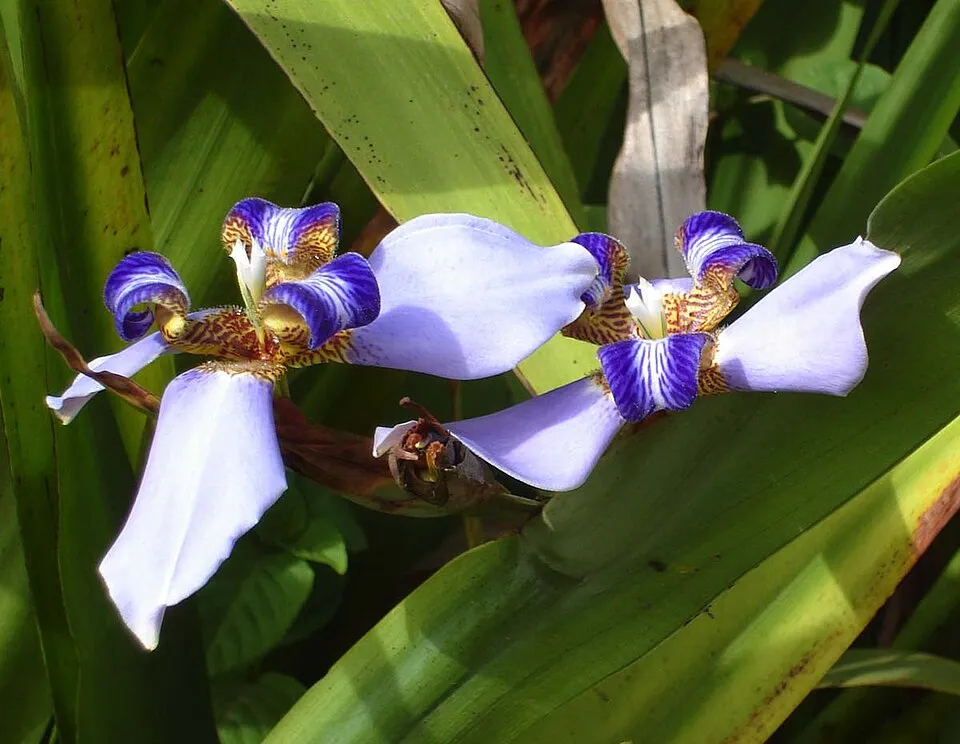
Neomarica gracilis, widely recognized as the Walking Iris or Apostle Plant, is a captivating herbaceous perennial belonging to the Iridaceae family, commonly known as the Iris family. Native to the tropical and subtropical regions of Central and South America, including Brazil and Mexico, this plant thrives in warm, humid environments. Its distinctive morphology includes flattened, sword-shaped leaves, botanically termed 'scapes,' which emerge in a fan-like arrangement from a central rhizome, typically reaching heights of 16 to 36 inches.
The plant produces exquisite, short-lived flowers that resemble miniature orchids, featuring three prominent outer tepals and three smaller, often recurved inner tepals, typically white with intricate brown, purple, or blue markings. Each delicate bloom lasts only a single day, but a succession of flowers ensures a prolonged display throughout the growing season. The most intriguing aspect of Neomarica gracilis is its unique reproductive strategy: after the flower fades, a new plantlet develops at the tip of the spent flower stalk.
This stalk gradually bends towards the ground, allowing the plantlet to root upon contact with the soil, thus giving the plant its common name, 'Walking Iris,' as it appears to slowly 'walk' or spread across the landscape. This natural propagation method makes Neomarica gracilis a fascinating botanical specimen and a popular, low-maintenance choice for ornamental gardening.
Trusted Scientific References
1. Authoritative external sources for Neomarica Gracilis
1.1 Wikipedia — Neomarica Gracilis
1.2 Kew POWO (Plants of the World Online)
1.3 PubMed — peer-reviewed research
1.4 NCBI Taxonomy Browser
1.5 GBIF — Global Biodiversity
1.6Neomarica Gracilis should be interpreted through verified botanical identity, practical care, and responsible safety language. This recovery note adds the missing context needed for a complete profile: match light to the plant's habit, use well-drained soil, water according to season, and avoid unsupported medicinal or edible claims. For publishing, the plant can be presented as a source-backed garden plant with clear care guidance, common problem diagnosis, and conservative safety wording.
1.1.Neomarica Gracilis — Key Features
- ✓ <strong>Common Names</strong> — Walking Iris, Apostle Plant, Fan Iris, Poor Man's Orchid.
- ✓ <strong>Botanical Family</strong> — Iridaceae (Iris Family).
- ✓ <strong>Native Range</strong> — Central America, South America (Brazil), Mexico.
- ✓ <strong>Unique Propagation</strong> — 'Walking' habit where plantlets form on spent flower stalks.
- ✓ <strong>Floral Characteristics</strong> — Delicate, tri-petaled, white flowers with brown/purple/blue markings, lasting one day.
- ✓ <strong>Foliage</strong> — Flattened, sword-shaped leaves (scapes) forming a fan-like clump.
- ✓ <strong>Growth Habit</strong> — Clumping herbaceous perennial, growing 2-5 feet tall.
- ✓ <strong>Ornamental Value</strong> — Highly prized for aesthetic appeal in shade gardens and indoors.
- ✓ <strong>Toxicity</strong> — Contains oxalates and iridals, making it toxic if ingested.
- ✓ <strong>Cultivation</strong> — Low-maintenance, prefers partial shade and moist, well-draining soil.
1.2.Neomarica Gracilis — Quick Summary
- ✓ Neomarica gracilis is a striking ornamental perennial known as Walking Iris or Apostle Plant.
- ✓ Features elegant, short-lived, orchid-like flowers and unique 'walking' propagation via plantlets.
- ✓ Primarily valued for its aesthetic appeal in gardens and as a houseplant.
- ✓ Contains compounds like oxalates and iridals, which are considered toxic if ingested.
- ✓ Requires partial shade, moist well-draining soil, and protection from frost.
- ✓ Lacks documented traditional or modern medicinal uses.
2.Neomarica Gracilis — Scientific Identity
3.Neomarica Gracilis — Quick Facts
4.Neomarica Gracilis — Appearance & Identification
5.Neomarica Gracilis — Native Habitat
6.Neomarica Gracilis — Water Requirements
- ✓ Light Requirements — Thrives in partial shade to bright indirect light; can tolerate some full sun if moisture is adequate, but prefers protection from intense midday sun.
- ✓ Soil Preferences — Prefers moist, rich, and well-draining soil; amend heavy soils with organic matter to improve drainage and aeration.
- ✓ Watering Schedule — Requires regular watering, ensuring the soil remains consistently moist but not waterlogged; allow the topsoil to dry slightly between waterings.
- ✓ Temperature and Frost Protection — Hardy in USDA Zones 8B-11; protect from frost in cooler climates, as it can freeze to the ground but often returns from roots.
- ✓ Propagation Techniques — Easily propagated by dividing mature clumps or by rooting the plantlets that form on spent flower stalks, giving it its 'walking' name.
- ✓ Container vs. Ground Planting — Suitable for both in-ground planting in garden beds or as an attractive container plant, including hanging baskets where its arching stems can be showcased.
- ✓ Fertilization — Benefits from a balanced, slow-release fertilizer applied during the active growing season (spring and summer) to support robust foliage and flowering.
Reviewed by the Flora Medical Global Botanical Review Panel
Multi-disciplinary editorial group · Botany · Ethnobotany · Herbal-medicine literature
Who reviewed this: This page was checked by the Flora Medical Global Botanical Review Panel — an in-house editorial group of botany graduates, ethnobotany researchers, and horticulture practitioners who collectively maintain our 7,000+ plant encyclopedia. Meet the team.
Our 4-step verification process
1. Taxonomic verification
Scientific names and synonyms cross-checked against Kew POWO, World Flora Online, and The Plant List.
2. Phytochemical & medicinal cross-reference
Active compounds, traditional uses, and reported activities are cross-referenced with PubMed, USDA Dr. Duke's database, and peer-reviewed ethnobotanical literature.
3. Conservation & distribution check
Distribution, ecology, and conservation status confirmed against GBIF occurrence records and the IUCN Red List.
4. Editorial & safety review
Every entry passes an editorial pass for clarity, originality, and safety notices (toxicity, contraindications, dosage caveats) before publication.
Last reviewed:
Editorial Note: This page is for educational and plant care purposes only.
Written by: Flora Medical Global Editorial Team
Reviewed by: Flora Medical Global Botanical Review Panel
Last Updated: June 15, 2026







Neomarica Gracilis — Comments & Community Reviews
Rate this plant