
Care Disclaimer: Plant care recommendations are general guidelines based on common growing conditions. Individual results may vary based on your local environment, climate, and care routine. If your plant is toxic, keep it away from children and pets, and consult a veterinarian if accidental ingestion occurs.
1.Ornithogalum Thyrsoides — Overview
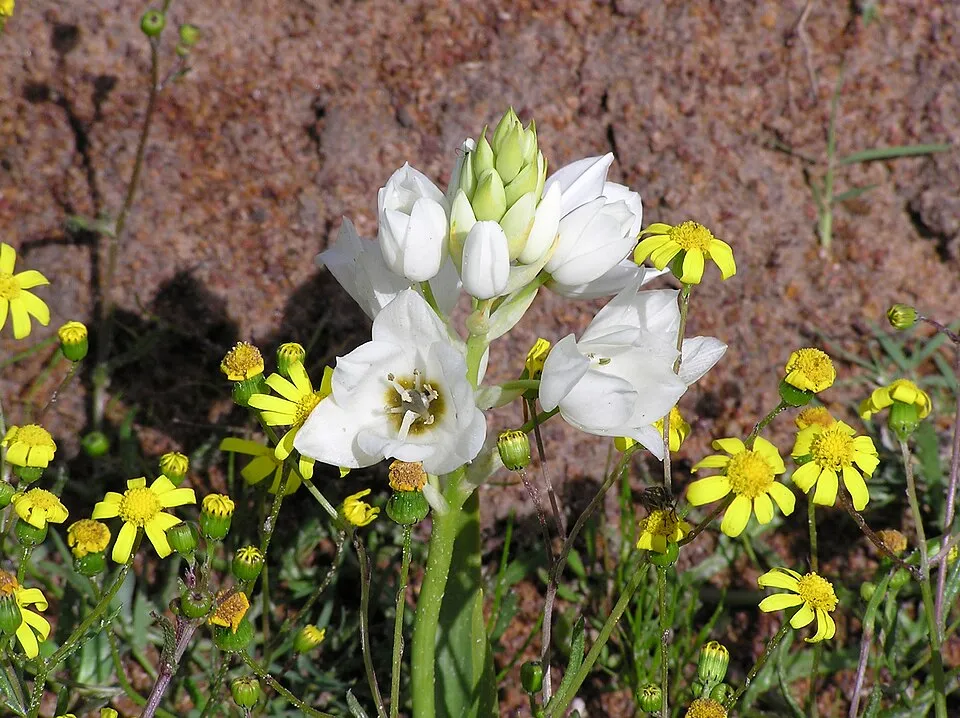
Ornithogalum thyrsoides, widely recognized as Chincherinchee, Cape Lily, Star-of-Bethlehem, or Wonder-flower, is a captivating perennial herbaceous plant indigenous to the Cape Provinces of South Africa. It thrives in the characteristic fynbos and renosterveld vegetation types, preferring well-drained sandy or loamy soils. Taxonomically, it belongs to the Asparagaceae family, specifically within the subfamily Scilloideae and tribe Ornithogaleae. This bulbous plant typically attains a height of 29 to 50 centimeters, entering a dormant phase during winter.
Its basal leaves are linear to lanceolate, measuring between 15 and 30 centimeters in length and 0.5 to 1.5 centimeters in width, exhibiting a smooth, soft texture before dying back post-flowering. The most striking feature of Ornithogalum thyrsoides is its inflorescence—a dense, terminal raceme or thyrse, or sometimes a looser corymb, bearing numerous bowl-shaped flowers. These blooms are typically pristine white to creamy-white, often marked with a distinctive green or brown stripe at their center, which fades with age. They are phototropic, turning towards the sun, and are celebrated for their exceptional longevity as cut flowers, symbolizing purity and cheerfulness.
The plant produces spindle-shaped capsular fruits containing small, black, shiny seeds. Its name 'thyrsoides' refers to its thyrse-like inflorescence, while 'chincherinchee' is derived from the Afrikaans 'tjienkerientjee,' alluding to the sound made by its stalks when rubbed together.
Trusted Scientific References
1. Authoritative external sources for Ornithogalum Thyrsoides
1.1 Wikipedia — Ornithogalum Thyrsoides
1.2 Kew POWO (Plants of the World Online)
1.3 PubMed — peer-reviewed research
1.4 NCBI Taxonomy Browser
1.5 GBIF — Global Biodiversity
1.6Ornithogalum Thyrsoides should be interpreted through verified botanical identity, practical care, and responsible safety language. This recovery note adds the missing context needed for a complete profile: match light to the plant's habit, use well-drained soil, water according to season, and avoid unsupported medicinal or edible claims. For publishing, the plant can be presented as a source-backed garden plant with clear care guidance, common problem diagnosis, and conservative safety wording.
1.1.Ornithogalum Thyrsoides — Key Features
- ✓ <strong>Native to the</strong> — Native to the Cape Provinces of South Africa, thriving in fynbos and renosterveld.
- ✓ <strong>Characterized by elegant, dense racemes of star</strong> — shaped white to creamy-white flowers.
- ✓ <strong>Celebrated for its</strong> — Celebrated for its exceptionally long vase life, making it a popular cut flower globally.
- ✓ <strong>Contains highly potent</strong> — Contains highly potent cardiac glycosides, rendering all parts of the plant extremely toxic if ingested.
- ✓ <strong>Exhibits a perennial</strong> — Exhibits a perennial life cycle, forming bulbs that enable dormancy during unfavorable conditions.
- ✓ <strong>Flowers are notably</strong> — Flowers are notably phototropic, orienting themselves towards the sun throughout the day.
- ✓ <strong>Reaches a height of 29</strong> — 50 cm, with lanceolate basal leaves appearing before or with the blooms.
- ✓ <strong>Recognized with the</strong> — Recognized with the Royal Horticultural Society's Award of Garden Merit for its ornamental value.
- ✓ <strong>Subject of scientific</strong> — Subject of scientific investigation for potential cytotoxic, anti-proliferative, and cardiotonic properties of isolated compounds.
- ✓ <strong>Known by common</strong> — Known by common names such as Chincherinchee, Cape Lily, Star-of-Bethlehem, and Wonder-flower.
1.2.Ornithogalum Thyrsoides — Quick Summary
- ✓ Ornithogalum thyrsoides, or Chincherinchee, is a bulbous, highly toxic ornamental plant from South Africa.
- ✓ It contains potent cardiac glycosides, making all parts dangerous if ingested.
- ✓ Research explores its isolated compounds for potential cardiotonic, cytotoxic, and anti-proliferative activities.
- ✓ Absolutely no direct herbal medicinal use is recommended due to extreme toxicity and risk of fatal poisoning.
- ✓ Primarily cultivated globally for its striking, long-lasting white flowers, cherished in floral arrangements.
2.Ornithogalum Thyrsoides — Scientific Identity
3.Ornithogalum Thyrsoides — Quick Facts
4.Ornithogalum Thyrsoides — Appearance & Identification
5.Ornithogalum Thyrsoides — Native Habitat
6.Ornithogalum Thyrsoides — Water Requirements
- ✓ Soil Requirements — Prefers well-drained, sandy or loamy soils, mimicking its native fynbos and renosterveld habitats.
- ✓ Light Conditions — Thrives in full sun to partial shade, requiring sufficient light for robust flowering, especially in temperate climates.
- ✓ Watering Schedule — Water regularly during its active growth period in late winter and spring, then reduce significantly as the plant enters dormancy in summer.
- ✓ Temperature and Dormancy — Bulbs require protection from freezing temperatures during their winter dormancy; in colder regions, they should be lifted and stored.
- ✓ Propagation — Can be propagated effectively from seeds, which should be sown in autumn, or by dividing offsets from mature bulbs during their dormant phase.
- ✓ Fertilization — Benefits from a balanced, slow-release fertilizer applied at the beginning of its growing season to support strong bulb development and flower production.
- ✓ Pests and Diseases — Generally robust, but watch for common bulb pests like slugs and snails, and ensure good air circulation to prevent fungal issues in humid conditions.
- ✓ Ornamental Use — Highly valued for its long-lasting cut flowers and striking appearance in garden beds, especially in Mediterranean or mild temperate climates.
Reviewed by the Flora Medical Global Botanical Review Panel
Multi-disciplinary editorial group · Botany · Ethnobotany · Herbal-medicine literature
Who reviewed this: This page was checked by the Flora Medical Global Botanical Review Panel — an in-house editorial group of botany graduates, ethnobotany researchers, and horticulture practitioners who collectively maintain our 7,000+ plant encyclopedia. Meet the team.
Our 4-step verification process
1. Taxonomic verification
Scientific names and synonyms cross-checked against Kew POWO, World Flora Online, and The Plant List.
2. Phytochemical & medicinal cross-reference
Active compounds, traditional uses, and reported activities are cross-referenced with PubMed, USDA Dr. Duke's database, and peer-reviewed ethnobotanical literature.
3. Conservation & distribution check
Distribution, ecology, and conservation status confirmed against GBIF occurrence records and the IUCN Red List.
4. Editorial & safety review
Every entry passes an editorial pass for clarity, originality, and safety notices (toxicity, contraindications, dosage caveats) before publication.
Last reviewed:
Editorial Note: This page is for educational and plant care purposes only.
Written by: Flora Medical Global Editorial Team
Reviewed by: Flora Medical Global Botanical Review Panel
Last Updated: June 15, 2026







Ornithogalum Thyrsoides — Comments & Community Reviews
Rate this plant