

Care Disclaimer: Plant care recommendations are general guidelines based on common growing conditions. Individual results may vary based on your local environment, climate, and care routine. If your plant is toxic, keep it away from children and pets, and consult a veterinarian if accidental ingestion occurs.
1.Osteospermum — Overview
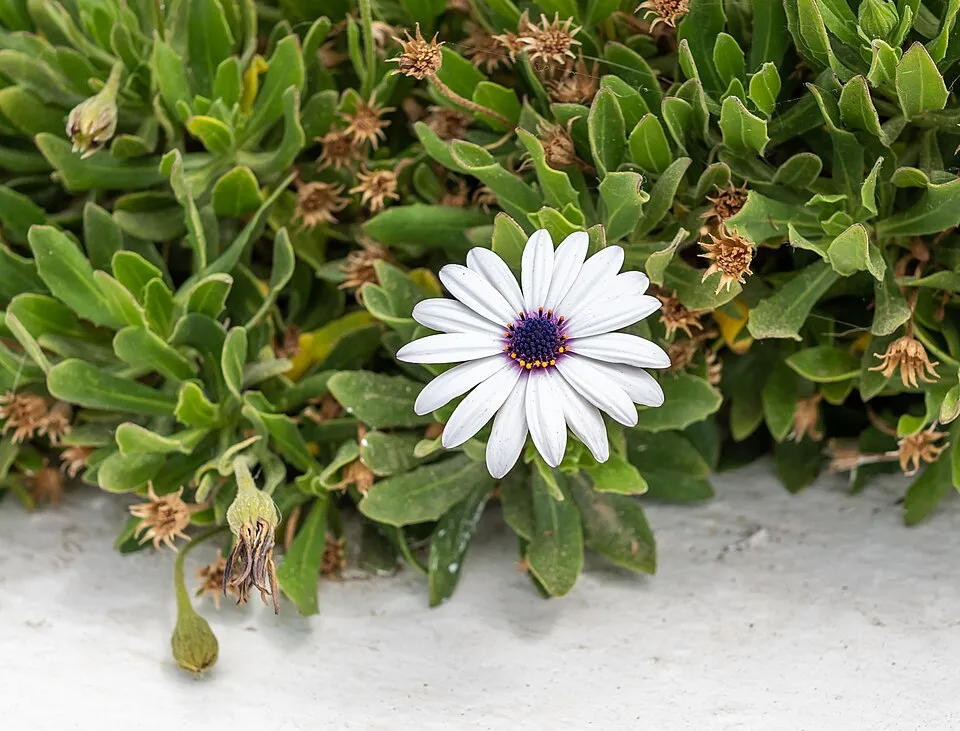
Osteospermum ecklonis, commonly recognized as African Daisy or Cape Daisy, is a striking herbaceous perennial belonging to the extensive Asteraceae family. Native to the Eastern Cape Province of South Africa, this species thrives in its indigenous coastal and inland regions, typically found in grasslands and open woodlands. Morphologically, it presents as a mounding or spreading plant, generally reaching heights of 1 to 3 feet (30-90 cm) and spreading equally wide. Its foliage consists of dark green, sometimes slightly toothed or lobed leaves, which can emit a subtle, somewhat aromatic scent when gently crushed.
The defining feature of Osteospermum ecklonis is its profusion of showy, daisy-like capitula, typically 2 to 4 inches (5-10 cm) in diameter. These composite flowers exhibit a remarkable spectrum of colors, including various shades of white, pink, purple, yellow, and orange, frequently featuring a contrasting central disc of tubular florets, often blue or purple. The ray florets (petals) are notable for their unique spoon-like or iridescent quality, adding to their visual allure. Though a perennial in its native warm climates, it is widely cultivated as an annual in cooler temperate zones due to its sensitivity to frost.
It establishes readily in full sun and well-drained soils, demonstrating considerable drought tolerance once mature. Its extended flowering period, from late spring through summer and into autumn, makes it a highly valued ornamental species globally.
Trusted Scientific References
1. Authoritative external sources for Osteospermum ecklonis
1.1 Wikipedia — Osteospermum ecklonis
1.2 Kew POWO (Plants of the World Online)
1.3 PubMed — peer-reviewed research
1.4 NCBI Taxonomy Browser
1.5 GBIF — Global Biodiversity
1.6Osteospermum should be interpreted through verified botanical identity, practical care, and responsible safety language. This recovery note adds the missing context needed for a complete profile: match light to the plant's habit, use well-drained soil, water according to season, and avoid unsupported medicinal or edible claims. For publishing, the plant can be presented as a source-backed garden plant with clear care guidance, common problem diagnosis, and conservative safety wording.
1.1.Osteospermum — Key Features
- ✓ <strong>Native to South</strong> — Native to South Africa, specifically the Eastern Cape Province.
- ✓ <strong>Member of the</strong> — Member of the Asteraceae family, sharing traits with daisies and sunflowers.
- ✓ <strong>Produces abundant, showy, daisy</strong> — like flowers with diverse colors.
- ✓ <strong>Blooms extensively from</strong> — Blooms extensively from late spring through autumn, especially with deadheading.
- ✓ <strong>Typically grown as</strong> — Typically grown as an annual in temperate zones, perennial in warmer climates.
- ✓ <strong>Prefers full sun and well</strong> — drained soil; drought-tolerant once established.
- ✓ <strong>Forms a mounding</strong> — Forms a mounding or spreading habit, ideal for various garden applications.
- ✓ <strong>Foliage is dark</strong> — Foliage is dark green, sometimes toothed, with a mild aroma when crushed.
- ✓ <strong>Noted for its unique iridescent or spoon</strong> — shaped ray florets.
- ✓ <strong>Primarily valued for</strong> — Primarily valued for its high ornamental appeal and low maintenance.
1.2.Osteospermum — Quick Summary
- ✓ Vibrant ornamental plant from South Africa, known as African Daisy.
- ✓ Belongs to the Asteraceae family, similar to sunflowers.
- ✓ Prized for its colorful, daisy-like flowers in various hues.
- ✓ No established traditional or modern medicinal uses.
- ✓ Contains common plant secondary metabolites like flavonoids and terpenoids.
- ✓ Primarily cultivated for aesthetic appeal in gardens and containers.
2.Osteospermum — Scientific Identity
3.Osteospermum — Quick Facts
4.Osteospermum — Appearance & Identification
5.Osteospermum — Native Habitat
6.Osteospermum — Water Requirements
- ✓ Soil — Thrives in well-drained, moderately fertile soil; sandy or loamy textures are preferred to prevent root rot.
- ✓ Light — Requires full sun exposure (at least 6 hours daily) for optimal flowering and robust growth, though it can tolerate light afternoon shade in very hot climates.
- ✓ Water — Water regularly to keep the soil consistently moist, especially during dry spells and establishment; mature plants are somewhat drought-tolerant.
- ✓ Propagation — Commonly propagated by seeds or stem cuttings taken in late summer or early autumn for overwintering.
- ✓ Fertilization — Benefits from a balanced, all-purpose liquid fertilizer every 2-4 weeks during the active growing and flowering season.
- ✓ Pruning/Deadheading — Regular deadheading (removing spent flowers) encourages continuous blooming and maintains a tidy appearance.
- ✓ Pests & Diseases — Generally pest-resistant but can occasionally be affected by aphids, whiteflies, or powdery mildew, especially in humid conditions.
- ✓ Climate — Best grown as an annual in USDA Zones 3-8, and as a perennial in Zones 9-11 where it is frost-free.
Reviewed by the Flora Medical Global Botanical Review Panel
Multi-disciplinary editorial group · Botany · Ethnobotany · Herbal-medicine literature
Who reviewed this: This page was checked by the Flora Medical Global Botanical Review Panel — an in-house editorial group of botany graduates, ethnobotany researchers, and horticulture practitioners who collectively maintain our 7,000+ plant encyclopedia. Meet the team.
Our 4-step verification process
1. Taxonomic verification
Scientific names and synonyms cross-checked against Kew POWO, World Flora Online, and The Plant List.
2. Phytochemical & medicinal cross-reference
Active compounds, traditional uses, and reported activities are cross-referenced with PubMed, USDA Dr. Duke's database, and peer-reviewed ethnobotanical literature.
3. Conservation & distribution check
Distribution, ecology, and conservation status confirmed against GBIF occurrence records and the IUCN Red List.
4. Editorial & safety review
Every entry passes an editorial pass for clarity, originality, and safety notices (toxicity, contraindications, dosage caveats) before publication.
Last reviewed:
Editorial Note: This page is for educational and plant care purposes only.
Written by: Flora Medical Global Editorial Team
Reviewed by: Flora Medical Global Botanical Review Panel
Last Updated: June 15, 2026







Osteospermum — Comments & Community Reviews
Rate this plant