
Care Disclaimer: Plant care recommendations are general guidelines based on common growing conditions. Individual results may vary based on your local environment, climate, and care routine. If your plant is toxic, keep it away from children and pets, and consult a veterinarian if accidental ingestion occurs.
1.Pachycereus — Overview
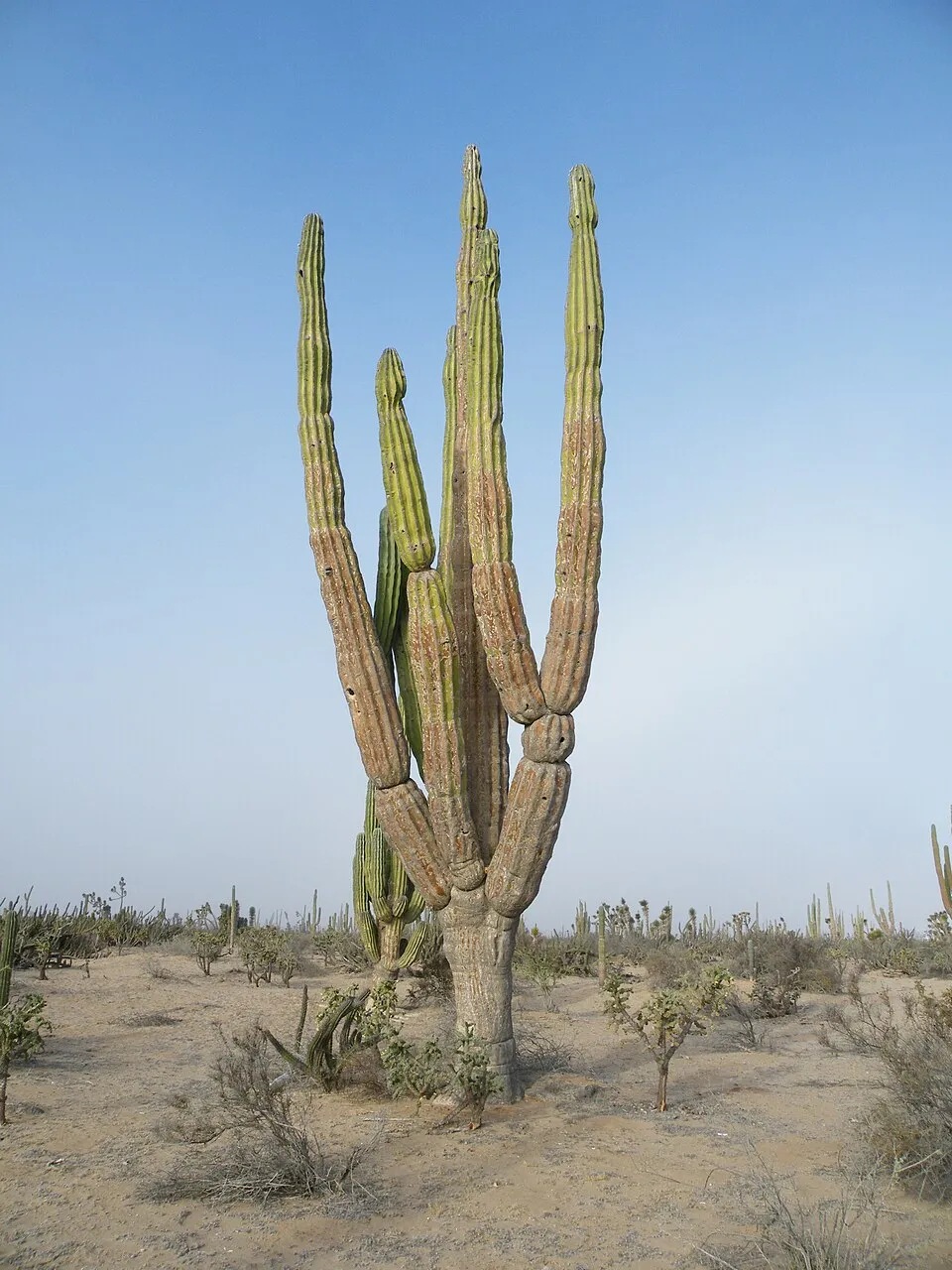
Pachycereus pringlei, widely recognized as the Cardón or Elephant Cactus, stands as an awe-inspiring columnar cactus native to the arid landscapes of northwestern Mexico, specifically flourishing across Baja California, Baja California Sur, and Sonora within the Sonoran Desert. It is acclaimed as one of the most massive cacti globally, frequently reaching monumental heights over 20 meters (65 feet) and weighing multiple tons. The robust, trunk-like stem is distinctly ribbed, typically displaying 20 to 30 prominent ribs that can span up to a meter in diameter. These ribs host large, widely spaced areoles from which stout, sharp spines emerge, varying in color from grayish to yellowish-brown and sometimes exceeding 10 cm (4 inches) in length. While younger plants are densely armored, mature specimens often exhibit sparser spination, revealing more of the vibrant green stem.
The Cardón typically branches infrequently, often developing a majestic candelabra-like silhouette with age. Its spectacular white, tubular flowers are nocturnal, measuring approximately 5 cm (2 inches) long, and appear along the ribs rather than solely at the apices of the stems. These blossoms attract a diverse array of nocturnal pollinators, including bats and moths. The fruit is a reddish-brown, fleshy berry, about 5 cm (2 inches) long, adorned with short, hooked spines that detach with ease. Historically, these fruits were a crucial food source for indigenous peoples.
Pachycereus pringlei is a keystone species, providing essential habitat and sustenance for numerous desert organisms. Its immense size and commanding presence render it an iconic emblem of the Sonoran Desert. Remarkably slow-growing, this cactus can live for hundreds of years, its thick, succulent stems expertly storing vast quantities of water, enabling unparalleled survival in extreme aridity. A waxy epidermis further minimizes water loss, while a unique symbiotic relationship with bacterial and fungal colonies on its roots allows it to thrive as a lithophyte, fixing nitrogen and breaking down rock even in the absence of soil.
Trusted Scientific References
1. Authoritative external sources for Pachycereus pringlei
1.1 Wikipedia — Pachycereus pringlei
1.2 Kew POWO (Plants of the World Online)
1.3 PubMed — peer-reviewed research
1.4 NCBI Taxonomy Browser
1.5 GBIF — Global Biodiversity
1.1.Pachycereus — Key Features
- ✓ <strong>Gigantic Stature</strong> — The Cardón is the world's tallest living cactus, reaching over 20 meters (65 feet) in height and weighing many tons.
- ✓ <strong>Candelabra Form</strong> — Mature plants often develop a distinctive, multi-branched, candelabra-like structure.
- ✓ <strong>Nocturnal Flowers</strong> — Produces large, white, tubular flowers that open at night, attracting bats and moths.
- ✓ <strong>Spiny Fruit</strong> — Bears reddish-brown, fleshy berries covered in small, hooked spines, historically a food source.
- ✓ <strong>Lithophytic Growth</strong> — Capable of growing directly on bare rock surfaces due to a symbiotic relationship with root bacteria.
- ✓ <strong>Nitrogen Fixation</strong> — Its root microbiome includes nitrogen-fixing bacteria, enhancing nutrient acquisition in poor soils.
- ✓ <strong>Extreme Drought Adaptation</strong> — Features thick, succulent stems for massive water storage and a waxy epidermis to minimize transpiration.
- ✓ <strong>Keystone Species</strong> — Plays a critical ecological role, providing habitat and sustenance for numerous desert animals.
- ✓ <strong>Unique Alkaloid Profile</strong> — Contains substituted tetrahydroisoquinoline alkaloids, distinguishing its psychoactive chemistry from other cacti like peyote.
- ✓ <strong>Longevity</strong> — A remarkably slow-growing plant with a lifespan that can span several centuries, contributing to ancient desert ecosystems.
1.2.Pachycereus — Quick Summary
- ✓ World's largest columnar cactus, iconic to the Sonoran Desert.
- ✓ Traditional food source (fruit) and construction material for indigenous peoples.
- ✓ Historically used as an entheogen, but with highly unpredictable and severe adverse effects.
- ✓ Contains psychoactive substituted tetrahydroisoquinoline alkaloids, but not mescaline.
- ✓ A keystone species, vital for desert ecosystem health and biodiversity.
- ✓ Slow-growing and long-lived, adapted to extreme arid conditions through unique physiological mechanisms.
2.Pachycereus — Scientific Identity
3.Pachycereus — Quick Facts
4.Pachycereus — Appearance & Identification
5.Pachycereus — Native Habitat
6.Pachycereus — Water Requirements
- ✓ Climate Preference — Pachycereus pringlei thrives in hot, arid climates, requiring full sun exposure and protection from frost, ideally above 10°C (50°F).
- ✓ Soil Requirements — It necessitates extremely well-draining, sandy, or gritty soil mixtures to prevent root rot, mimicking its natural desert habitat.
- ✓ Propagation Techniques — Can be propagated from seeds, which may have improved germination rates with symbiotic bacterial inoculation, or from large stem cuttings allowed to callus before planting.
- ✓ Watering Regimen — Requires minimal watering; allow the soil to dry out completely between waterings, especially during cooler months to avoid fungal issues.
- ✓ Growth Enhancement — Growth in initial stages can be significantly enhanced by inoculating roots with plant growth-promoting bacteria, such as Azospirillum species, aiding nutrient acquisition.
- ✓ Space and Support — Due to its colossal size and weight at maturity, adequate space and structural support must be considered for long-term cultivation in suitable environments.
- ✓ Nutrient Needs — Generally low nutrient requirements, but occasional feeding with a diluted, low-nitrogen cactus fertilizer during the growing season can be beneficial.
- ✓ Pest and Disease Management — Relatively resistant to most pests, but watch for scale insects, mealybugs, and fungal infections in overly moist conditions.
Reviewed by the Flora Medical Global Botanical Review Panel
Multi-disciplinary editorial group · Botany · Ethnobotany · Herbal-medicine literature
Who reviewed this: This page was checked by the Flora Medical Global Botanical Review Panel — an in-house editorial group of botany graduates, ethnobotany researchers, and horticulture practitioners who collectively maintain our 7,000+ plant encyclopedia. Meet the team.
Our 4-step verification process
1. Taxonomic verification
Scientific names and synonyms cross-checked against Kew POWO, World Flora Online, and The Plant List.
2. Phytochemical & medicinal cross-reference
Active compounds, traditional uses, and reported activities are cross-referenced with PubMed, USDA Dr. Duke's database, and peer-reviewed ethnobotanical literature.
3. Conservation & distribution check
Distribution, ecology, and conservation status confirmed against GBIF occurrence records and the IUCN Red List.
4. Editorial & safety review
Every entry passes an editorial pass for clarity, originality, and safety notices (toxicity, contraindications, dosage caveats) before publication.
Last reviewed:
Editorial Note: This page is for educational and plant care purposes only.
Written by: Flora Medical Global Editorial Team
Reviewed by: Flora Medical Global Botanical Review Panel
Last Updated: June 15, 2026







Pachycereus — Comments & Community Reviews
Rate this plant