
Care Disclaimer: Plant care recommendations are general guidelines based on common growing conditions. Individual results may vary based on your local environment, climate, and care routine. If your plant is toxic, keep it away from children and pets, and consult a veterinarian if accidental ingestion occurs.
1.Paeonia Delavayi — Overview
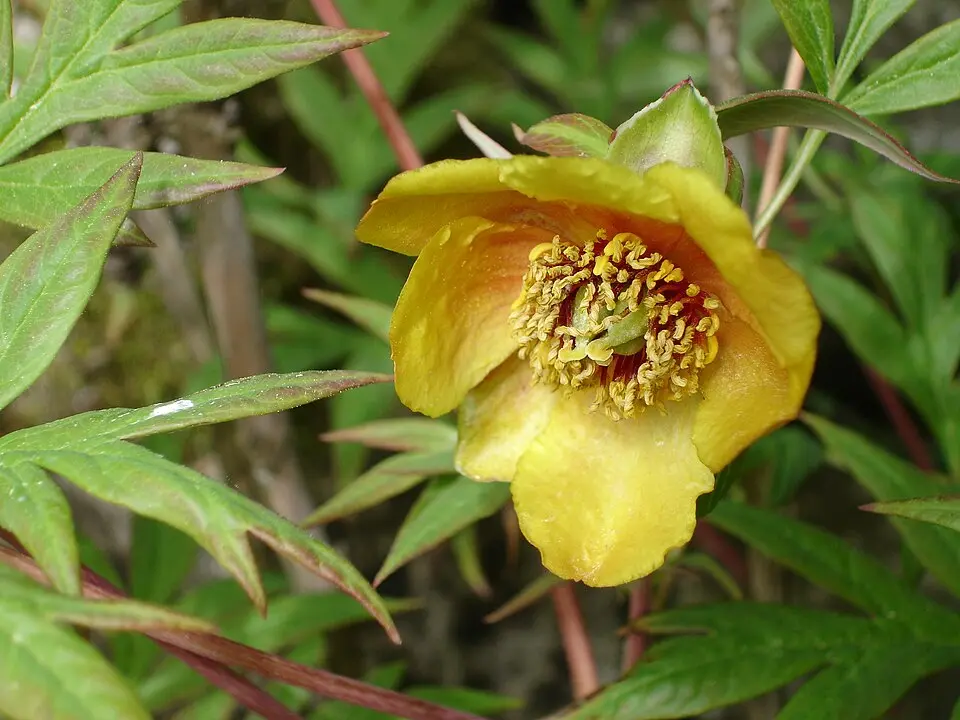
Paeonia Delavayi, commonly known as Delavay's Tree Peony or Dian Mu Dan, is a striking and resilient deciduous shrub native to the mountainous regions of southwestern China, primarily found in Yunnan and Sichuan provinces. This species is a member of the Paeoniaceae family, a lineage celebrated for its ornamental and medicinal members. Unlike herbaceous peonies that die back to the ground each winter, Paeonia Delavayi possesses woody, persistent stems, allowing it to develop into a robust, multi-stemmed bush typically reaching heights of 1 to 2 meters (3 to 6 feet) with a similar spread.
Its foliage is deeply dissected, often bipinnate or tripinnate, composed of delicate, lanceolate to ovate leaflets that create a fine, fern-like texture. A defining characteristic is its solitary, often pendulous flowers, which bloom from late spring to early summer. These impressive blossoms, measuring 5 to 10 cm (2 to 4 inches) in diameter, exhibit a remarkable color range, from vibrant yellows and oranges to deep reds, reddish-browns, and even bicolored forms, frequently featuring a contrasting blotch at the petal bases.
The flowers emit a subtle, pleasant fragrance, adding to their allure. Following successful pollination, the plant produces distinctive follicles, which split open to reveal dark, glossy seeds. Paeonia Delavayi thrives in well-drained soils and full sun to partial shade, adapting to various conditions within its native high-altitude habitats.
Trusted Scientific References
1. Authoritative external sources for Paeonia Delavayi
1.1 Wikipedia — Paeonia Delavayi
1.2 Kew POWO (Plants of the World Online)
1.3 PubMed — peer-reviewed research
1.4 NCBI Taxonomy Browser
1.5 GBIF — Global Biodiversity
1.6Paeonia Delavayi should be interpreted through verified botanical identity, practical care, and responsible safety language. This recovery note adds the missing context needed for a complete profile: match light to the plant's habit, use well-drained soil, water according to season, and avoid unsupported medicinal or edible claims. For publishing, the plant can be presented as a source-backed garden plant with clear care guidance, common problem diagnosis, and conservative safety wording.
1.1.Paeonia Delavayi — Key Features
- ✓ <strong>Woody, deciduous shrub</strong> — Woody, deciduous shrub with persistent stems.
- ✓ <strong>Native to high</strong> — altitude regions of Yunnan and Sichuan, China.
- ✓ <strong>Distinctive deeply dissected, fern</strong> — like foliage.
- ✓ <strong>Produces solitary, often</strong> — Produces solitary, often pendulous flowers in late spring to early summer.
- ✓ <strong>Flowers exhibit a wide range of colors</strong> — yellow, red, orange, bicolored.
- ✓ <strong>Reaches 1</strong> — 2 meters in height and spread, forming a multi-stemmed bush.
- ✓ <strong>Belongs to the</strong> — Belongs to the Paeoniaceae family.
- ✓ <strong>Contains monoterpenoids (e.g.,</strong> — Contains monoterpenoids (e.g., paeoniflorin), flavonoids, and tannins.
- ✓ <strong>Primarily valued as</strong> — Primarily valued as an ornamental plant for its exotic beauty.
- ✓ <strong>Tolerant of various soil conditions if well</strong> — drained.
1.2.Paeonia Delavayi — Quick Summary
- ✓ Paeonia Delavayi is a woody deciduous shrub native to southwestern China.
- ✓ Primarily prized for its striking ornamental value in gardens.
- ✓ Contains phytochemicals like paeoniflorin, common in the medicinal Paeonia genus.
- ✓ Potential health benefits inferred from related species include anti-inflammatory and analgesic effects.
- ✓ Requires well-drained soil and sun to partial shade for optimal growth.
- ✓ Not extensively studied for direct medicinal use; safety profile based on genus.
2.Paeonia Delavayi — Scientific Identity
3.Paeonia Delavayi — Quick Facts
4.Paeonia Delavayi — Appearance & Identification
5.Paeonia Delavayi — Native Habitat
6.Paeonia Delavayi — Water Requirements
- ✓ Site Selection — Choose a location with full sun to partial shade, ideally morning sun and afternoon shade in hotter climates to protect blooms.
- ✓ Soil Requirements — Plant in well-drained, fertile soil with a neutral to slightly alkaline pH (6.5-7.5); heavy clay or constantly wet soils should be avoided or amended.
- ✓ Planting Depth — When planting, ensure the graft union (the swollen area where the peony was joined to rootstock) is set just below or at soil level for optimal establishment.
- ✓ Watering — Water regularly during dry spells, especially in the first few years after planting, but avoid overwatering to prevent root rot.
- ✓ Pruning — Minimal pruning is required; remove dead or damaged wood in late winter/early spring. Spent flowers can be deadheaded to encourage plant vigor.
- ✓ Fertilization — Apply a balanced, slow-release fertilizer in early spring, or a phosphorus-rich fertilizer to promote flowering, avoiding high nitrogen which can encourage foliage over blooms.
- ✓ Winter Protection — In colder zones, apply a layer of mulch around the base in late autumn to protect the roots from extreme freezing and thawing cycles.
Reviewed by the Flora Medical Global Botanical Review Panel
Multi-disciplinary editorial group · Botany · Ethnobotany · Herbal-medicine literature
Who reviewed this: This page was checked by the Flora Medical Global Botanical Review Panel — an in-house editorial group of botany graduates, ethnobotany researchers, and horticulture practitioners who collectively maintain our 7,000+ plant encyclopedia. Meet the team.
Our 4-step verification process
1. Taxonomic verification
Scientific names and synonyms cross-checked against Kew POWO, World Flora Online, and The Plant List.
2. Phytochemical & medicinal cross-reference
Active compounds, traditional uses, and reported activities are cross-referenced with PubMed, USDA Dr. Duke's database, and peer-reviewed ethnobotanical literature.
3. Conservation & distribution check
Distribution, ecology, and conservation status confirmed against GBIF occurrence records and the IUCN Red List.
4. Editorial & safety review
Every entry passes an editorial pass for clarity, originality, and safety notices (toxicity, contraindications, dosage caveats) before publication.
Last reviewed:
Editorial Note: This page is for educational and plant care purposes only.
Written by: Flora Medical Global Editorial Team
Reviewed by: Flora Medical Global Botanical Review Panel
Last Updated: June 15, 2026







Paeonia Delavayi — Comments & Community Reviews
Rate this plant