

Care Disclaimer: Plant care recommendations are general guidelines based on common growing conditions. Individual results may vary based on your local environment, climate, and care routine. If your plant is toxic, keep it away from children and pets, and consult a veterinarian if accidental ingestion occurs.
1.Pandorea Jasminoides — Overview
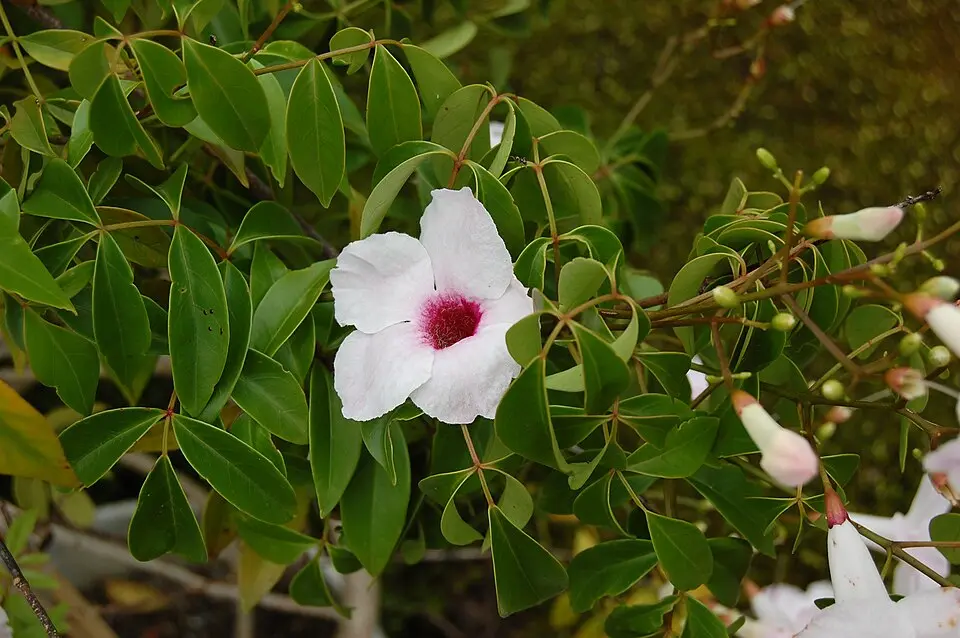
Pandorea jasminoides, commonly known as the Bower Vine, Bower of Beauty, or Wonga-Wonga Vine, is a captivating evergreen climbing plant that originates from the lush rainforests and open woodlands of Eastern Australia. This vigorous woody climber is celebrated for its aesthetic appeal, characterized by robust, dark brown bark and glabrous stems. Its foliage consists of glossy, dark green pinnate leaves, typically arranged in opposite pairs or sometimes in whorls, each leaf measuring between 120 and 170 mm long and composed of three to nine egg-shaped to lance-shaped leaflets.
The magnificent floral display occurs from September to March, featuring trumpet-shaped flowers borne in clusters at the stem ends or in upper leaf axils. These blooms are usually white or pink on the outside, with an inner throat often streaked with contrasting pink to red and covered in fine hairs. The flower tube measures 40-60 mm long, with lobes 20-30 mm long, enclosing four stamens.
Following flowering, the plant produces oblong or oval capsules, 40-60 mm long, containing winged seeds. Capable of reaching impressive heights of 6 to 10 meters, Pandorea jasminoides is primarily cultivated as an ornamental, offering a dense screen of vibrant foliage and continuous floral accents for pergolas, trellises, and fences, making it a prominent feature in warm temperate to subtropical landscapes.
Trusted Scientific References
1. Authoritative external sources for Pandorea Jasminoides
1.1 Wikipedia — Pandorea Jasminoides
1.2 Kew POWO (Plants of the World Online)
1.3 PubMed — peer-reviewed research
1.4 NCBI Taxonomy Browser
1.5 GBIF — Global Biodiversity
1.6Pandorea Jasminoides should be interpreted through verified botanical identity, practical care, and responsible safety language. This recovery note adds the missing context needed for a complete profile: match light to the plant's habit, use well-drained soil, water according to season, and avoid unsupported medicinal or edible claims. For publishing, the plant can be presented as a source-backed garden plant with clear care guidance, common problem diagnosis, and conservative safety wording.
1.1.Pandorea Jasminoides — Key Features
- ✓ <strong>Evergreen Climbing Vine</strong> — A vigorous, woody climber ideal for vertical garden designs.
- ✓ <strong>Spectacular Trumpet Flowers</strong> — Produces showy white or pink blooms with contrasting throats from spring to autumn.
- ✓ <strong>Native to Eastern Australia</strong> — Thrives in warm temperate to subtropical climates.
- ✓ <strong>Lush, Glossy Foliage</strong> — Features dense, dark green pinnate leaves providing excellent coverage.
- ✓ <strong>Fast</strong> — Growing — Quickly establishes itself to cover pergolas, trellises, fences, and arbors.
- ✓ <strong>Low Maintenance</strong> — Relatively easy to care for once established, requiring minimal attention.
- ✓ <strong>RHS Award of Garden Merit</strong> — Recognized by the Royal Horticultural Society for its outstanding performance in gardens.
- ✓ <strong>Supports Biodiversity</strong> — Attracts pollinators such as bees and provides habitat for small garden wildlife.
- ✓ <strong>Primarily Ornamental</strong> — Lacks established medicinal uses or traditional therapeutic applications.
- ✓ <strong>Unknown Bioactivity Profile</strong> — Specific scientific research on its therapeutic compounds and effects is largely absent.
1.2.Pandorea Jasminoides — Quick Summary
- ✓ Ornamental Australian climber with vibrant, trumpet-shaped flowers.
- ✓ Scientifically unvalidated for medicinal benefits; primarily cultivated for aesthetic appeal.
- ✓ Contains general plant compounds like flavonoids and tannins, but their therapeutic roles are unstudied.
- ✓ Requires full sun to partial shade and well-drained soil; propagated by cuttings or seeds.
- ✓ Avoid internal consumption due to unknown toxicity and lack of safety data.
- ✓ Valued for garden screening, architectural enhancement, and attracting pollinators.
2.Pandorea Jasminoides — Scientific Identity
3.Pandorea Jasminoides — Quick Facts
4.Pandorea Jasminoides — Appearance & Identification
5.Pandorea Jasminoides — Native Habitat
6.Pandorea Jasminoides — Water Requirements
- ✓ Site Selection — Thrives best in a location with full sun to partial shade, ideally protected from harsh, strong winds that can damage its vigorous growth.
- ✓ Soil Requirements — Prefers well-drained, fertile soil, ideally enriched with organic matter; it tolerates a range of soil types but is intolerant of waterlogging.
- ✓ Watering — Requires regular watering, particularly during dry periods and its establishment phase, though it becomes relatively drought-tolerant once mature.
- ✓ Propagation — Easily propagated from semi-hardwood stem cuttings taken in spring or summer, or by layering; seeds can also be used, but germination may be slower and less reliable.
- ✓ Support Structure — Given its vigorous climbing nature, it absolutely requires a robust support system such as a pergola, trellis, fence, or arbor to climb upon.
- ✓ Pruning — Prune after its main flowering period to maintain shape, control its size, and encourage bushier growth and more abundant blooms in the subsequent season.
- ✓ Fertilization — Benefits from the application of a balanced, slow-release fertilizer in spring to support its vigorous growth, dense foliage, and prolific flowering.
- ✓ Pest and Disease Management — Generally robust and disease-resistant, but gardeners should monitor for common garden pests like aphids or scale insects and treat them as necessary.
Reviewed by the Flora Medical Global Botanical Review Panel
Multi-disciplinary editorial group · Botany · Ethnobotany · Herbal-medicine literature
Who reviewed this: This page was checked by the Flora Medical Global Botanical Review Panel — an in-house editorial group of botany graduates, ethnobotany researchers, and horticulture practitioners who collectively maintain our 7,000+ plant encyclopedia. Meet the team.
Our 4-step verification process
1. Taxonomic verification
Scientific names and synonyms cross-checked against Kew POWO, World Flora Online, and The Plant List.
2. Phytochemical & medicinal cross-reference
Active compounds, traditional uses, and reported activities are cross-referenced with PubMed, USDA Dr. Duke's database, and peer-reviewed ethnobotanical literature.
3. Conservation & distribution check
Distribution, ecology, and conservation status confirmed against GBIF occurrence records and the IUCN Red List.
4. Editorial & safety review
Every entry passes an editorial pass for clarity, originality, and safety notices (toxicity, contraindications, dosage caveats) before publication.
Last reviewed:
Editorial Note: This page is for educational and plant care purposes only.
Written by: Flora Medical Global Editorial Team
Reviewed by: Flora Medical Global Botanical Review Panel
Last Updated: June 15, 2026







Pandorea Jasminoides — Comments & Community Reviews
Rate this plant