
Care Disclaimer: Plant care recommendations are general guidelines based on common growing conditions. Individual results may vary based on your local environment, climate, and care routine. If your plant is toxic, keep it away from children and pets, and consult a veterinarian if accidental ingestion occurs.
1.Petasites Japonicus — Overview
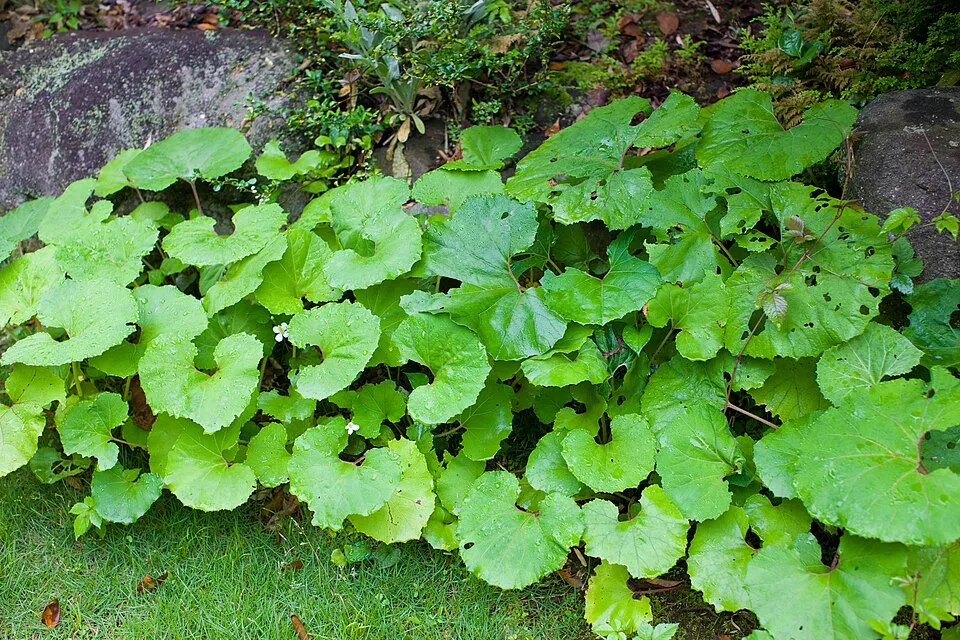
Petasites japonicus, commonly known as Fuki or Giant Butterbur, is a distinctive, robust rhizomatous perennial herb belonging to the Asteraceae family. It is indigenous to the temperate regions of East Asia, including Japan, Korea, and China, where it thrives in moist, shaded environments such as stream banks, woodland understories, and damp meadows. This plant is renowned for its strikingly large, orbicular to reniform (kidney-shaped) leaves, which can expand up to 1.2 meters (4 feet) in diameter, supported by thick, succulent petioles of comparable length.
A unique characteristic of Petasites japonicus is its precocious flowering habit; dense clusters of greenish-white or pale yellow flowers emerge on stout, scaly stems directly from the ground in late winter to early spring, often before the magnificent foliage fully unfurls. The plant's extensive network of thick, subterranean rhizomes facilitates its vigorous and often aggressive spread, allowing it to form dense, sprawling colonies over time. While highly valued for its architectural form and exotic presence in naturalized garden settings, particularly near water features, its assertive growth necessitates careful placement and management to prevent it from dominating less competitive flora.
Its unique life cycle and imposing size make it a botanical marvel, contributing significantly to its local ecosystems.
Trusted Scientific References
1. Authoritative external sources for Petasites Japonicus
1.1 Wikipedia — Petasites Japonicus
1.2 Kew POWO (Plants of the World Online)
1.3 PubMed — peer-reviewed research
1.4 NCBI Taxonomy Browser
1.5 GBIF — Global Biodiversity
1.6Petasites Japonicus should be interpreted through verified botanical identity, practical care, and responsible safety language. This recovery note adds the missing context needed for a complete profile: match light to the plant's habit, use well-drained soil, water according to season, and avoid unsupported medicinal or edible claims. For publishing, the plant can be presented as a source-backed garden plant with clear care guidance, common problem diagnosis, and conservative safety wording.
1.1.Petasites Japonicus — Key Features
- ✓ <strong>Native to East</strong> — Native to East Asia, including Japan, Korea, and China, thriving in moist, shady habitats.
- ✓ <strong>Distinctive large, kidney</strong> — shaped leaves (up to 1.2m diameter) and precocious greenish-white flowers.
- ✓ <strong>Rhizomatous perennial with</strong> — Rhizomatous perennial with an aggressive spreading habit, forming dense colonies.
- ✓ <strong>Primary active compounds</strong> — Primary active compounds are the sesquiterpenes petasin and isopetasin.
- ✓ <strong>Possesses potent anti</strong> — inflammatory and antispasmodic properties.
- ✓ <strong>Effective in managing</strong> — Effective in managing symptoms of migraines and allergic rhinitis.
- ✓ <strong>Contains hepatotoxic pyrrolizidine</strong> — Contains hepatotoxic pyrrolizidine alkaloids (PAs) in its raw, unprocessed form.
- ✓ <strong>Requires specialized processing to produce PA</strong> — free medicinal extracts for safe consumption.
- ✓ <strong>Used in traditional</strong> — Used in traditional Asian medicine for respiratory ailments, pain relief, and as a seasonal vegetable.
- ✓ <strong>Valued ornamental plant</strong> — Valued ornamental plant for naturalizing in moist garden areas, especially near water.
1.2.Petasites Japonicus — Quick Summary
- Petasites japonicus, or Fuki, is a robust East Asian perennial known for its large leaves and early spring flowers.
- Traditionally used for its anti-inflammatory and antispasmodic effects, particularly for migraines and allergic rhinitis.
- Contains petasin and isopetasin, key compounds responsible for its therapeutic actions.
- Raw plant contains toxic pyrrolizidine alkaloids (PAs) and should never be consumed.
- Only PA-free commercial extracts are safe for medicinal use under professional guidance.
- Offers natural relief for various inflammatory and spasmodic conditions when used responsibly.
2.Petasites Japonicus — Scientific Identity
3.Petasites Japonicus — Quick Facts
4.Petasites Japonicus — Appearance & Identification
5.Petasites Japonicus — Native Habitat
6.Petasites Japonicus — Water Requirements
- Requires consistently moist to wet, well-drained soil rich in organic matter, mimicking its natural woodland habitat.
- Thrives in partial to full shade; direct afternoon sun can scorch its exceptionally large leaves and inhibit growth.
- Propagated primarily by division of its vigorous rhizomes in early spring or autumn, ensuring each section has a bud.
- Can be grown from seed, but germination can be erratic and plants take longer to establish, making rhizome division more common.
- Prefers cool, temperate climates and is hardy in USDA zones 4-8, tolerating cold winters.
- Due to its aggressive spreading nature, consider planting in areas where it can naturalize or use root barriers to control its expansion.
- Mulching with organic material helps retain soil moisture, suppress weeds, and provide nutrients, especially in drier climates.
Reviewed by the Flora Medical Global Botanical Review Panel
Multi-disciplinary editorial group · Botany · Ethnobotany · Herbal-medicine literature
Who reviewed this: This page was checked by the Flora Medical Global Botanical Review Panel — an in-house editorial group of botany graduates, ethnobotany researchers, and horticulture practitioners who collectively maintain our 7,000+ plant encyclopedia. Meet the team.
Our 4-step verification process
1. Taxonomic verification
Scientific names and synonyms cross-checked against Kew POWO, World Flora Online, and The Plant List.
2. Phytochemical & medicinal cross-reference
Active compounds, traditional uses, and reported activities are cross-referenced with PubMed, USDA Dr. Duke's database, and peer-reviewed ethnobotanical literature.
3. Conservation & distribution check
Distribution, ecology, and conservation status confirmed against GBIF occurrence records and the IUCN Red List.
4. Editorial & safety review
Every entry passes an editorial pass for clarity, originality, and safety notices (toxicity, contraindications, dosage caveats) before publication.
Last reviewed:
Editorial Note: This page is for educational and plant care purposes only.
Written by: Flora Medical Global Editorial Team
Reviewed by: Flora Medical Global Botanical Review Panel
Last Updated: June 15, 2026







Petasites Japonicus — Comments & Community Reviews
Rate this plant