

Care Disclaimer: Plant care recommendations are general guidelines based on common growing conditions. Individual results may vary based on your local environment, climate, and care routine. If your plant is toxic, keep it away from children and pets, and consult a veterinarian if accidental ingestion occurs.
1.Petunia — Overview
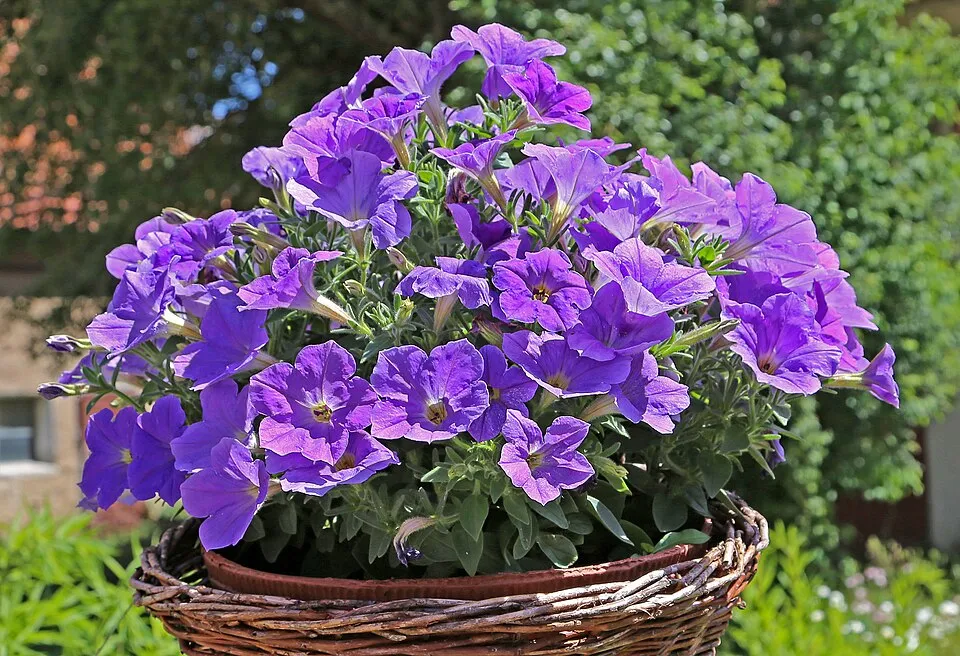
Petunia × atkinsiana, widely recognized as the garden petunia or simply petunia, is a captivating hybrid species belonging to the Solanaceae family, commonly known as the nightshade family. This immensely popular ornamental plant is celebrated globally for its stunning, trumpet-shaped flowers, which display an extraordinary spectrum of colors, encompassing rich purples, soft pinks, fiery reds, pristine whites, sunny yellows, and intricate bi-color patterns. Typically cultivated as an annual in most temperate climates, the garden petunia exhibits a versatile growth habit, ranging from compact mounding forms to elegant trailing varieties, generally reaching heights of 15 to 45 cm (6 to 18 inches) and spreading up to 90 cm (3 feet) depending on the specific cultivar.
Its foliage consists of ovate to elliptical leaves, often characterized by a sticky texture due to a covering of fine glandular hairs, arranged alternately along the branching stems. The prominent flowers, which are the plant's primary allure, are either solitary or clustered, featuring five fused petals that form a distinctive corolla tube. Petunias are renowned for their prolific and extended blooming period, frequently gracing gardens from late spring through the initial autumn frost, making them an indispensable component in hanging baskets, container arrangements, garden borders, and mass plantings.
The species itself is a horticultural marvel, resulting from extensive hybridization efforts primarily involving South American native species such as Petunia axillaris and Petunia violacea, leading to the vast diversity in flower morphology, size, and overall plant architecture observed today.
Trusted Scientific References
1. Authoritative external sources for Petunia × atkinsiana
1.1 Wikipedia — Petunia × atkinsiana
1.2 Kew POWO (Plants of the World Online)
1.3 PubMed — peer-reviewed research
1.4 NCBI Taxonomy Browser
1.5 GBIF — Global Biodiversity
1.6Petunia should be interpreted through verified botanical identity, practical care, and responsible safety language. This recovery note adds the missing context needed for a complete profile: match light to the plant's habit, use well-drained soil, water according to season, and avoid unsupported medicinal or edible claims. For publishing, the plant can be presented as a source-backed garden plant with clear care guidance, common problem diagnosis, and conservative safety wording.
1.1.Petunia — Key Features
- ✓ <strong>Hybrid Origin</strong> — A result of cross-breeding between species like Petunia axillaris and P. violacea, leading to diverse forms.
- ✓ <strong>Vibrant Flowers</strong> — Known for its large, trumpet-shaped flowers in a vast array of colors and patterns.
- ✓ <strong>Prolific Bloomer</strong> — Flowers continuously from late spring until the first frost, providing extended visual interest.
- ✓ <strong>Sticky Foliage</strong> — Leaves and stems are often covered with fine glandular hairs, giving them a slightly sticky texture.
- ✓ <strong>Diverse Cultivars</strong> — Available in numerous varieties, including trailing, mounding, upright, and grandiflora types.
- ✓ <strong>Solanaceae Family Member</strong> — Belongs to the nightshade family, indicating the presence of various secondary metabolites, including potential alkaloids.
- ✓ <strong>Antioxidant Richness</strong> — Contains flavonoids and phenolic acids that demonstrate significant antioxidant activity in studies.
- ✓ <strong>Adaptable Growth</strong> — Suitable for hanging baskets, containers, garden beds, and borders in various landscape designs.
- ✓ <strong>Low Maintenance</strong> — Generally easy to grow with proper sunlight, watering, and occasional feeding.
- ✓ <strong>Non</strong> — Traditional Medicinal Use — While possessing interesting phytochemicals, it lacks established traditional medicinal applications.
1.2.Petunia — Quick Summary
- ✓ Petunia × atkinsiana is a widely cultivated ornamental hybrid known for its vibrant, trumpet-shaped flowers.
- ✓ It belongs to the Solanaceae family, which includes both edible and toxic species.
- ✓ Research indicates that petunia extracts possess in vitro antioxidant, anti-inflammatory, and antimicrobial properties due to various phytochemicals.
- ✓ Despite these potential benefits, the plant is not traditionally used medicinally and should not be ingested due to potential toxicity from alkaloids.
- ✓ Primarily valued for its aesthetic appeal in gardens, containers, and hanging baskets globally.
2.Petunia — Scientific Identity
3.Petunia — Quick Facts
4.Petunia — Appearance & Identification
5.Petunia — Native Habitat
6.Petunia — Water Requirements
- ✓ Seed Propagation — Surface sow fine seeds in containers, gently pressing them into the soil without covering, ensuring consistent moisture for germination at 15-20°C.
- ✓ Softwood Cuttings — Propagate from young, non-flowering stem cuttings in late spring to early summer, rooting in a moist, well-drained medium.
- ✓ Light Requirements — Petunias thrive in full sun, requiring at least 6 hours of direct sunlight daily to promote abundant flowering.
- ✓ Soil Preference — They prefer a light, well-drained soil rich in organic matter; avoid heavy, compacted soils that retain too much moisture.
- ✓ Watering Regimen — Water regularly, especially during dry periods, keeping the soil consistently moist but never waterlogged; container plants may require daily watering.
- ✓ Fertilization — Feed regularly with a balanced liquid fertilizer, particularly for container-grown plants, to support continuous blooming throughout the season.
- ✓ Deadheading — Remove spent flowers (deadhead) consistently to encourage new bloom production and prevent the plant from self-seeding, which can reduce flowering.
- ✓ Pruning — Pinch back leggy stems to promote bushier growth and a more compact plant habit, especially for trailing varieties.
Reviewed by the Flora Medical Global Botanical Review Panel
Multi-disciplinary editorial group · Botany · Ethnobotany · Herbal-medicine literature
Who reviewed this: This page was checked by the Flora Medical Global Botanical Review Panel — an in-house editorial group of botany graduates, ethnobotany researchers, and horticulture practitioners who collectively maintain our 7,000+ plant encyclopedia. Meet the team.
Our 4-step verification process
1. Taxonomic verification
Scientific names and synonyms cross-checked against Kew POWO, World Flora Online, and The Plant List.
2. Phytochemical & medicinal cross-reference
Active compounds, traditional uses, and reported activities are cross-referenced with PubMed, USDA Dr. Duke's database, and peer-reviewed ethnobotanical literature.
3. Conservation & distribution check
Distribution, ecology, and conservation status confirmed against GBIF occurrence records and the IUCN Red List.
4. Editorial & safety review
Every entry passes an editorial pass for clarity, originality, and safety notices (toxicity, contraindications, dosage caveats) before publication.
Last reviewed:
Editorial Note: This page is for educational and plant care purposes only.
Written by: Flora Medical Global Editorial Team
Reviewed by: Flora Medical Global Botanical Review Panel
Last Updated: June 15, 2026







Petunia — Comments & Community Reviews
Rate this plant