
Care Disclaimer: Plant care recommendations are general guidelines based on common growing conditions. Individual results may vary based on your local environment, climate, and care routine. If your plant is toxic, keep it away from children and pets, and consult a veterinarian if accidental ingestion occurs.
1.Petunia Hybrida — Overview
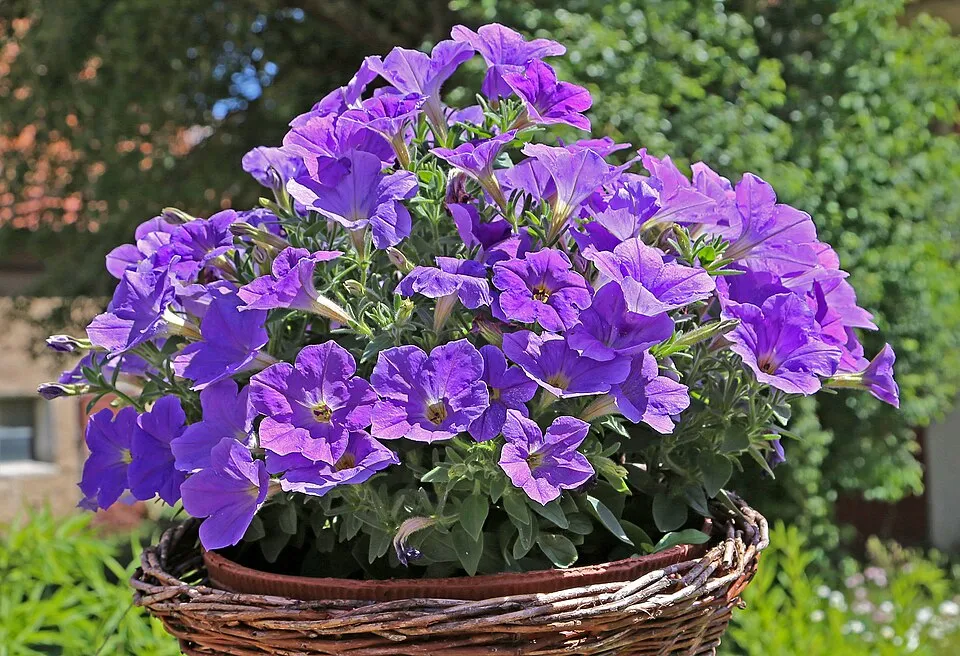
Petunia × hybrida, commonly known as the Garden Petunia, is a highly popular and extensively cultivated ornamental plant celebrated for its abundant flowering and vibrant blossoms. This annual or tender perennial, frequently grown as an annual in temperate climates, is a member of the Solanaceae family, which notably includes economically important crops such as tomatoes and potatoes. It represents a complex horticultural hybrid, meticulously developed through extensive cross-breeding of various wild Petunia species indigenous to South America, primarily Petunia integrifolia and Petunia axillaris. The Garden Petunia exhibits an astonishing morphological diversity in flower form, size, and color.
Its trumpet-shaped flowers can be single or double, possess ruffled or smooth edges, be fringed or picotee-edged, and range from diminutive dime-sized blooms to large specimens spanning several inches across. The color spectrum is nearly exhaustive, encompassing shades of white, cream, yellow, pink, red, magenta, purple, blue, and even black, often adorned with intricate veining, splashes, or contrasting throats. The foliage is typically somewhat sticky due to glandular hairs and varies in shades of green. Growth habits are significantly diverse, from compact, mounding varieties ideal for bedding and containers, to vigorous, trailing types perfectly suited for hanging baskets and ground cover applications.
Most cultivars emit a mild, often sweet, fragrance, which becomes particularly noticeable in the evenings. Their extended blooming season, from late spring until the first frost, solidifies their status as a global garden staple, providing continuous color and visual appeal. The plant generally attains heights of 15 to 45 centimeters (6 to 18 inches) and spreads 30 to 90 centimeters (1 to 3 feet), depending on the specific cultivar.
Trusted Scientific References
1. Authoritative external sources for Petunia × hybrida
1.1 Wikipedia — Petunia × hybrida
1.2 Kew POWO (Plants of the World Online)
1.3 PubMed — peer-reviewed research
1.4 NCBI Taxonomy Browser
1.5 GBIF — Global Biodiversity
1.1.Petunia Hybrida — Key Features
- ✓ <strong>Prolific Flowering</strong> — Produces abundant blooms from spring until frost.
- ✓ <strong>Wide Color Spectrum</strong> — Flowers in almost every shade, often with intricate patterns.
- ✓ <strong>Diverse Growth Habits</strong> — Ranges from compact mounds to vigorous trailers.
- ✓ <strong>Aromatic Blooms</strong> — Many varieties emit a mild, sweet fragrance, especially at night.
- ✓ <strong>Pollinator Friendly</strong> — Attracts butterflies, hummingbirds, and other beneficial insects.
- ✓ <strong>Low Maintenance</strong> — Relatively easy to grow with proper care, deadheading, and feeding.
- ✓ <strong>Versatile Use</strong> — Ideal for beds, borders, containers, hanging baskets, and ground cover.
- ✓ <strong>Hybrid Origin</strong> — A testament to horticultural breeding from wild South American species.
- ✓ <strong>Sticky Foliage</strong> — Characteristic hairy, somewhat sticky leaves.
- ✓ <strong>Heat and Drought Tolerant</strong> — Many modern cultivars exhibit good tolerance to warm conditions and moderate drought.
1.2.Petunia Hybrida — Quick Summary
- ✓ Ornamental powerhouse with diverse flower forms and colors.
- ✓ Member of the Solanaceae family, a complex horticultural hybrid.
- ✓ Primarily valued for aesthetic appeal, contributing to mental well-being.
- ✓ Attracts pollinators like butterflies and hummingbirds.
- ✓ Easy to grow, requiring full sun and well-drained soil.
- ✓ No known significant medicinal uses or traditional herbal applications.
2.Petunia Hybrida — Scientific Identity
3.Petunia Hybrida — Quick Facts
4.Petunia Hybrida — Appearance & Identification
5.Petunia Hybrida — Native Habitat
6.Petunia Hybrida — Water Requirements
- ✓ Seed Sowing — Sow Petunia seeds indoors 6-10 weeks before the last frost, as they require warm temperatures (72-75°F or 22-24°C) for optimal germination.
- ✓ Light Requirements — Plant in full sun to partial shade; while tolerant of some shade, abundant blooms are achieved with at least 6 hours of direct sunlight daily.
- ✓ Soil Preference — Thrive in light, well-ddrained soils. They can tolerate poor soils provided drainage is excellent, preventing root rot.
- ✓ Watering — Requires moderate, consistent watering, especially in hot, dry periods. Allow the top inch of soil to dry out between waterings.
- ✓ Fertilization — Feed regularly with a balanced liquid fertilizer every 2-4 weeks to support continuous prolific blooming.
- ✓ Pinching and Deadheading — Pinch back young plants to encourage a bushier habit; deadhead spent flowers to promote new bud production and prolong the blooming season.
- ✓ Overwintering — In zones below 10a-11b, Petunias are grown as annuals; however, they can be overwintered indoors in a bright, cool location away from direct heat sources.
- ✓ Spacing — Depending on the hybrid, provide 30-90 cm (1-3 feet) of space in the garden to allow for proper air circulation and growth.
Reviewed by the Flora Medical Global Botanical Review Panel
Multi-disciplinary editorial group · Botany · Ethnobotany · Herbal-medicine literature
Who reviewed this: This page was checked by the Flora Medical Global Botanical Review Panel — an in-house editorial group of botany graduates, ethnobotany researchers, and horticulture practitioners who collectively maintain our 7,000+ plant encyclopedia. Meet the team.
Our 4-step verification process
1. Taxonomic verification
Scientific names and synonyms cross-checked against Kew POWO, World Flora Online, and The Plant List.
2. Phytochemical & medicinal cross-reference
Active compounds, traditional uses, and reported activities are cross-referenced with PubMed, USDA Dr. Duke's database, and peer-reviewed ethnobotanical literature.
3. Conservation & distribution check
Distribution, ecology, and conservation status confirmed against GBIF occurrence records and the IUCN Red List.
4. Editorial & safety review
Every entry passes an editorial pass for clarity, originality, and safety notices (toxicity, contraindications, dosage caveats) before publication.
Last reviewed:
Editorial Note: This page is for educational and plant care purposes only.
Written by: Flora Medical Global Editorial Team
Reviewed by: Flora Medical Global Botanical Review Panel
Last Updated: June 15, 2026







Petunia Hybrida — Comments & Community Reviews
Rate this plant