
Care Disclaimer: Plant care recommendations are general guidelines based on common growing conditions. Individual results may vary based on your local environment, climate, and care routine. If your plant is toxic, keep it away from children and pets, and consult a veterinarian if accidental ingestion occurs.
1.Phedimus Spurius — Overview
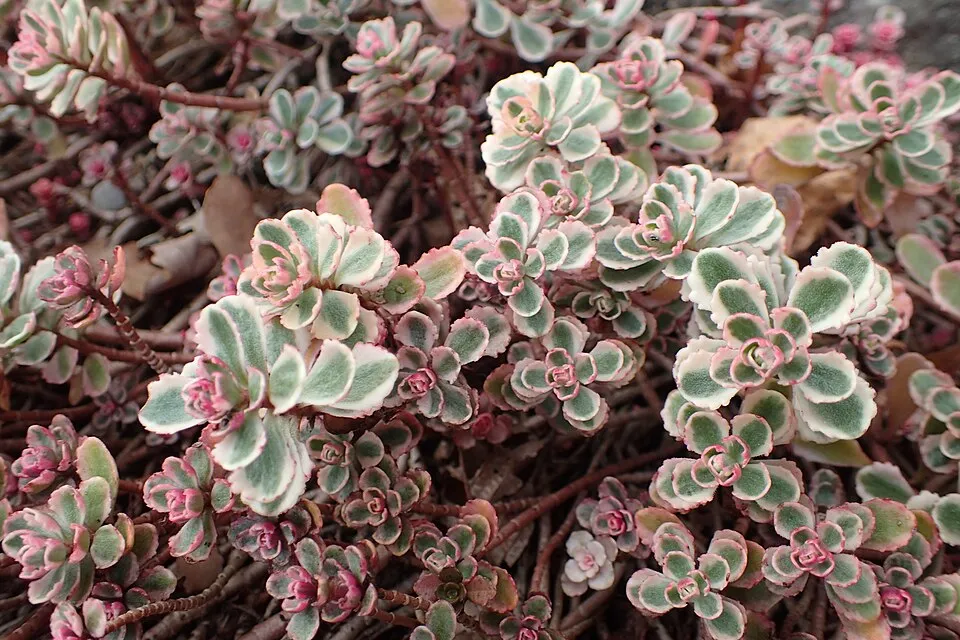
Phedimus spurius, commonly known as Caucasian stonecrop or false stonecrop, is a resilient succulent perennial belonging to the Crassulaceae family. Native to the rugged landscapes of the Caucasus region, encompassing southeastern Europe and western Asia, this plant has become a popular horticultural subject due to its aesthetic appeal, drought tolerance, and minimal maintenance requirements. Architecturally, Phedimus spurius forms dense, low-growing mats or cushions of foliage, typically reaching a modest height of 10-15 cm but spreading extensively. The leaves are fleshy, obovate to spatulate, and often arranged oppositely or in whorls along the stems.
A remarkable feature is their chromatic plasticity, shifting from a vibrant green in shaded conditions to a deep reddish-bronze or purplish hue when exposed to intense sunlight and cooler temperatures. This striking color change is attributed to the synthesis of anthocyanin pigments, serving as a photoprotective mechanism. The stems are succulent and somewhat rigid, contributing to the plant's ground-covering habit. During the summer, Phedimus spurius produces a profusion of small, star-shaped flowers, typically borne in terminal cymes.
These inflorescences are commonly vibrant pink or deep rose, creating a beautiful contrast with the foliage and attracting various pollinators. Each flower features five distinct petals and eventually develops into small seed capsules. In colder climates, the foliage often intensifies in color and may persist through winter, while in regions with severe frosts, the aerial parts might die back, with regeneration occurring from its robust root system in spring. Phedimus spurius is exceptionally well-adapted to arid and semi-arid conditions, thriving in well-drained soils and requiring minimal watering, a testament to its efficient water storage capabilities.
Trusted Scientific References
1. Authoritative external sources for Phedimus Spurius
1.1 Wikipedia — Phedimus Spurius
1.2 Kew POWO (Plants of the World Online)
1.3 PubMed — peer-reviewed research
1.4 NCBI Taxonomy Browser
1.5 GBIF — Global Biodiversity
1.1.Phedimus Spurius — Key Features
- ✓ <strong>Succulent foliage with vibrant green to reddish</strong> — bronze hues.
- ✓ <strong>Drought</strong> — tolerant and low-maintenance groundcover.
- ✓ <strong>Star</strong> — shaped pink or rose flowers bloom in summer.
- ✓ <strong>Forms dense, spreading</strong> — Forms dense, spreading mats, ideal for rock gardens.
- ✓ <strong>Native to the</strong> — Native to the Caucasus region, naturalized in parts of North America.
- ✓ <strong>Exhibits Crassulacean Acid</strong> — Exhibits Crassulacean Acid Metabolism (CAM) for water efficiency.
- ✓ <strong>Cold</strong> — hardy perennial (USDA Zones 3-9).
- ✓ <strong>Contains beneficial phenolic</strong> — Contains beneficial phenolic compounds and anthocyanins.
- ✓ <strong>Attracts pollinators like</strong> — Attracts pollinators like bees and butterflies.
- ✓ <strong>Easy propagation via</strong> — Easy propagation via cuttings or division.
1.2.Phedimus Spurius — Quick Summary
- ✓ Drought-tolerant succulent perennial from the Caucasus region.
- ✓ Forms dense mats with colorful foliage and pink star-shaped flowers.
- ✓ Contains flavonoids, anthocyanins, and organic acids with potential antioxidant benefits.
- ✓ Primarily ornamental, with limited traditional medicinal use specifically for Phedimus spurius.
- ✓ Easy to cultivate in well-drained soil and full sun.
- ✓ Generally safe for topical use, but internal consumption is not recommended.
2.Phedimus Spurius — Scientific Identity
3.Phedimus Spurius — Quick Facts
4.Phedimus Spurius — Appearance & Identification
5.Phedimus Spurius — Native Habitat
6.Phedimus Spurius — Water Requirements
- ✓ Soil Requirements — Phedimus spurius thrives in well-drained, gritty soil; a mix of sand, perlite, and a small amount of compost is ideal to prevent root rot.
- ✓ Light Exposure — Full sun to partial shade is preferred, with more sun enhancing the vibrant reddish foliage coloration of Caucasian stonecrop.
- ✓ Watering — As a succulent, it requires minimal watering; allow the soil to dry out completely between waterings, especially during dormant periods.
- ✓ Temperature and Hardiness — This plant is remarkably cold-hardy (USDA Zones 3-9), tolerating frost, but prefers temperate conditions.
- ✓ Propagation — Easily propagated by stem cuttings, division, or seeds; stem cuttings root readily in well-drained soil.
- ✓ Fertilization — Fertilize sparingly, if at all; a balanced, diluted liquid fertilizer once in spring is sufficient for Phedimus spurius.
- ✓ Pests and Diseases — Generally pest-free, but watch for slugs and snails in moist conditions, and ensure good air circulation to prevent fungal issues.
Reviewed by the Flora Medical Global Botanical Review Panel
Multi-disciplinary editorial group · Botany · Ethnobotany · Herbal-medicine literature
Who reviewed this: This page was checked by the Flora Medical Global Botanical Review Panel — an in-house editorial group of botany graduates, ethnobotany researchers, and horticulture practitioners who collectively maintain our 7,000+ plant encyclopedia. Meet the team.
Our 4-step verification process
1. Taxonomic verification
Scientific names and synonyms cross-checked against Kew POWO, World Flora Online, and The Plant List.
2. Phytochemical & medicinal cross-reference
Active compounds, traditional uses, and reported activities are cross-referenced with PubMed, USDA Dr. Duke's database, and peer-reviewed ethnobotanical literature.
3. Conservation & distribution check
Distribution, ecology, and conservation status confirmed against GBIF occurrence records and the IUCN Red List.
4. Editorial & safety review
Every entry passes an editorial pass for clarity, originality, and safety notices (toxicity, contraindications, dosage caveats) before publication.
Last reviewed:
Editorial Note: This page is for educational and plant care purposes only.
Written by: Flora Medical Global Editorial Team
Reviewed by: Flora Medical Global Botanical Review Panel
Last Updated: June 15, 2026







Phedimus Spurius — Comments & Community Reviews
Rate this plant