
Care Disclaimer: Plant care recommendations are general guidelines based on common growing conditions. Individual results may vary based on your local environment, climate, and care routine. If your plant is toxic, keep it away from children and pets, and consult a veterinarian if accidental ingestion occurs.
1.Phlox Divaricata — Overview
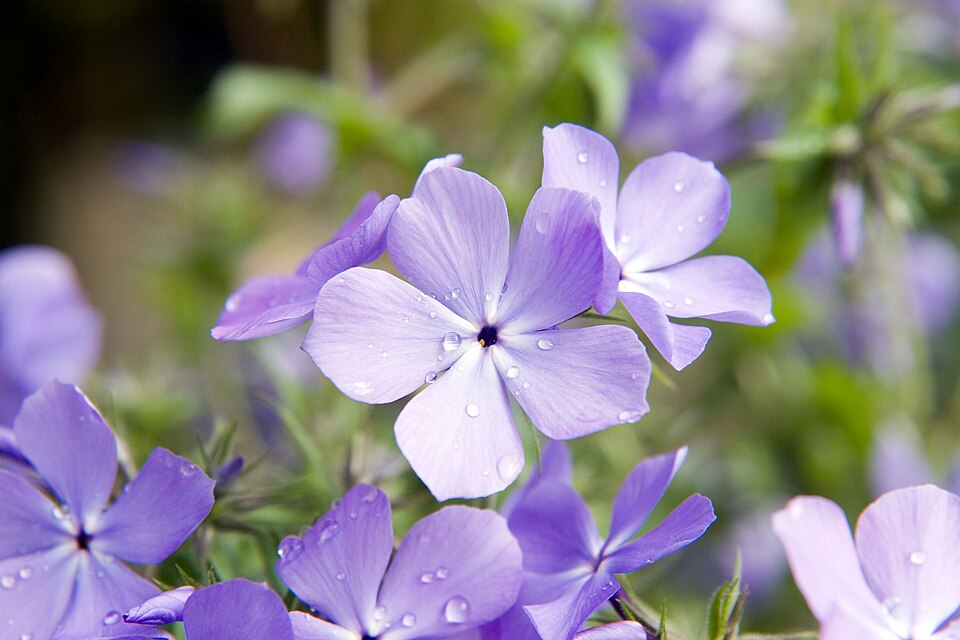
Phlox divaricata, widely recognized as Woodland Phlox or Wild Blue Phlox, is an enchanting herbaceous perennial wildflower indigenous to the rich forest floors of eastern North America. This captivating member of the Polemoniaceae family typically forms loose, spreading clumps, reaching heights of 6 to 12 inches and spreading similarly.
Its stems are often angled, covered in fine hairs, and possess a slightly sticky texture, supporting lance-shaped to ovate leaves arranged oppositely. These leaves, usually 2-4 inches long, feature a pointed apex and a tapering base, with smooth margins often fringed with fine hairs.
The true botanical spectacle of Phlox divaricata unfolds in spring, from April to June, when it produces exquisite clusters (cymes) of fragrant, five-petaled flowers at the stem tips. Each delicate corolla measures approximately 1 to 1.5 inches in diameter, with petals that are notched or subtly lobed at their tips. The flower color displays a charming variability, encompassing soft lavender, pale blue, pinkish-purple, and pristine white, frequently adorned with darker purple veins radiating from the center.
Beyond its aesthetic appeal, Woodland Phlox serves as a vital early spring nectar source for pollinators, contributing significantly to woodland biodiversity. It is also known by other common names such as Eastern Blue Phlox, Louisiana Phlox, and Wild Sweet William.
Trusted Scientific References
1. Authoritative external sources for Phlox Divaricata
1.1 Wikipedia — Phlox Divaricata
1.2 Kew POWO (Plants of the World Online)
1.3 PubMed — peer-reviewed research
1.4 NCBI Taxonomy Browser
1.5 GBIF — Global Biodiversity
1.6Phlox Divaricata should be interpreted through verified botanical identity, practical care, and responsible safety language. This recovery note adds the missing context needed for a complete profile: match light to the plant's habit, use well-drained soil, water according to season, and avoid unsupported medicinal or edible claims. For publishing, the plant can be presented as a source-backed garden plant with clear care guidance, common problem diagnosis, and conservative safety wording.
1.1.Phlox Divaricata — Key Features
- ✓ <strong>Native Eastern North</strong> — Native Eastern North American perennial.
- ✓ <strong>Produces fragrant, five</strong> — petaled flowers in spring.
- ✓ <strong>Excellent for naturalizing</strong> — Excellent for naturalizing shaded woodland gardens.
- ✓ <strong>Attracts a variety</strong> — Attracts a variety of pollinators, including bees, butterflies, and hummingbirds.
- ✓ <strong>Features delicate blooms</strong> — Features delicate blooms in shades of blue, lavender, pink, and white.
- ✓ <strong>Relatively low maintenance</strong> — Relatively low maintenance once established.
- ✓ <strong>Several attractive cultivars</strong> — Several attractive cultivars available, offering variations in flower color and size.
- ✓ <strong>Possesses ethnobotanical significance,</strong> — Possesses ethnobotanical significance, with related species used traditionally.
- ✓ <strong>Forms attractive spreading</strong> — Forms attractive spreading clumps, providing good groundcover.
- ✓ <strong>Generally considered deer</strong> — Generally considered deer and rabbit resistant, though rabbits may occasionally browse foliage.
1.2.Phlox Divaricata — Quick Summary
- ✓ Native Perennial Wildflower — Phlox divaricata is a beautiful, shade-loving native to eastern North America.
- ✓ Fragrant Spring Blooms — Known for its delicate, sweet-scented flowers in shades of blue, lavender, and white.
- ✓ Primarily Ornamental & Pollinator Support — Valued for aesthetic appeal in gardens and as an important nectar source for early pollinators.
- ✓ Ethnobotanical Uses — Historically, related Phlox species have been used by Indigenous peoples for minor ailments and topical applications.
- ✓ Limited Medicinal Research — Specific clinical evidence for Phlox divaricata's medicinal benefits is scarce, with most uses inferred from traditional practices or general plant chemistry.
- ✓ Easy to Cultivate — Thrives in moist, well-drained, organic-rich soil under partial to full shade.
2.Phlox Divaricata — Scientific Identity
3.Phlox Divaricata — Quick Facts
4.Phlox Divaricata — Appearance & Identification
5.Phlox Divaricata — Native Habitat
6.Phlox Divaricata — Water Requirements
- ✓ Site Selection — Plant in partial to full shade, mimicking its natural woodland habitat, avoiding harsh direct afternoon sun.
- ✓ Soil Requirements — Prefers moist, well-drained soil rich in organic matter. Amend heavy clay soils with compost to improve drainage and fertility.
- ✓ Watering — Keep the soil consistently moist, especially during dry periods, but avoid waterlogging to prevent root rot.
- ✓ Spacing — Space plants 12-18 inches apart to allow for natural clumping and spreading, creating a beautiful groundcover effect.
- ✓ Fertilization — A light application of balanced organic fertilizer or compost in early spring supports vigorous growth and flowering.
- ✓ Pruning — After flowering, cut back stems to encourage new basal growth and reduce the incidence of powdery mildew, promoting a tidier appearance.
- ✓ Pest and Disease Management — Monitor for common issues like powdery mildew (especially in humid conditions), spider mites (in hot, dry spells), and deter rabbits which may browse foliage.
- ✓ Propagation — Easily propagated by division in early spring or fall, or by stem cuttings taken in late spring.
Reviewed by the Flora Medical Global Botanical Review Panel
Multi-disciplinary editorial group · Botany · Ethnobotany · Herbal-medicine literature
Who reviewed this: This page was checked by the Flora Medical Global Botanical Review Panel — an in-house editorial group of botany graduates, ethnobotany researchers, and horticulture practitioners who collectively maintain our 7,000+ plant encyclopedia. Meet the team.
Our 4-step verification process
1. Taxonomic verification
Scientific names and synonyms cross-checked against Kew POWO, World Flora Online, and The Plant List.
2. Phytochemical & medicinal cross-reference
Active compounds, traditional uses, and reported activities are cross-referenced with PubMed, USDA Dr. Duke's database, and peer-reviewed ethnobotanical literature.
3. Conservation & distribution check
Distribution, ecology, and conservation status confirmed against GBIF occurrence records and the IUCN Red List.
4. Editorial & safety review
Every entry passes an editorial pass for clarity, originality, and safety notices (toxicity, contraindications, dosage caveats) before publication.
Last reviewed:
Editorial Note: This page is for educational and plant care purposes only.
Written by: Flora Medical Global Editorial Team
Reviewed by: Flora Medical Global Botanical Review Panel
Last Updated: June 15, 2026







Phlox Divaricata — Comments & Community Reviews
Rate this plant