
Care Disclaimer: Plant care recommendations are general guidelines based on common growing conditions. Individual results may vary based on your local environment, climate, and care routine. If your plant is toxic, keep it away from children and pets, and consult a veterinarian if accidental ingestion occurs.
1.Phlox Paniculata — Overview
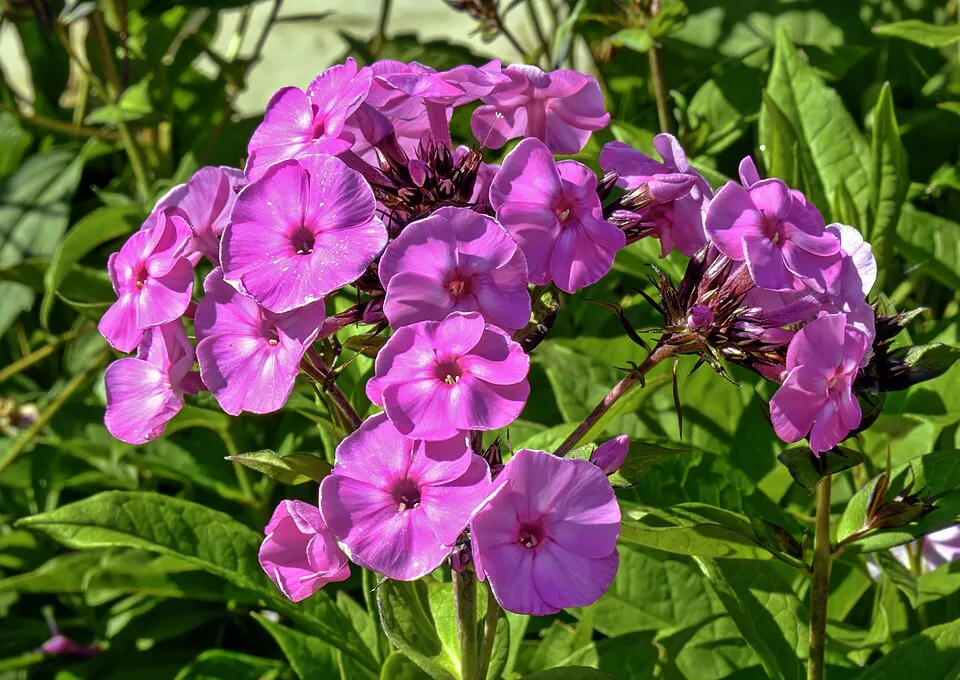
Phlox paniculata, commonly known as Garden Phlox or Summer Phlox, stands as a resilient and visually striking herbaceous perennial within the Polemoniaceae family. This species is indigenous to the eastern and central regions of North America, where its natural habitats include the edges of woodlands, along riverbanks, and in open, consistently moist meadows. It thrives best in locations offering dappled sunlight and rich, well-drained soils, characteristic of its native environments. The plant is highly valued for its magnificent, often fragrant flower panicles that grace gardens from mid-summer through early autumn, delivering a vital burst of color late in the growing season.
Typically reaching a height of 2 to 4 feet (60 to 120 cm), Phlox paniculata develops sturdy, upright stems supporting large, dense clusters of individual flowers. Each bloom, measuring approximately 1 to 1.5 inches (2.5 to 3.8 cm) in diameter, features five distinct petals, frequently notched at their tips, and exhibits a wide color palette encompassing pure whites, soft pinks, vibrant magentas, lavenders, and various shades of red. The corolla tube is elongated, with the stamens and pistil often exserted, imparting a delicate, star-like quality to each flower. Its lanceolate to ovate leaves are arranged oppositely along the stems, displaying an entire margin and a smooth, medium to dark green texture.
Phlox paniculata adopts a clumping growth habit, gradually expanding its presence through rhizomatous root systems. While robust and adaptable to diverse conditions, it benefits significantly from consistent moisture and ample air circulation to mitigate common issues such as powdery mildew. The intricate architecture of its inflorescences, comprising numerous individual blossoms, creates a profound visual impact, actively attracting a wide array of pollinators including butterflies, bees, and hummingbirds, thereby fulfilling a crucial ecological role. Extensive hybridization efforts have led to a vast selection of cultivars, offering variations in flower color, size, disease resistance, and growth patterns, cementing its status as a staple in both ornamental horticulture and, historically, in certain traditional herbal practices.
Trusted Scientific References
1. Authoritative external sources for Phlox Paniculata
1.1 Wikipedia — Phlox Paniculata
1.2 Kew POWO (Plants of the World Online)
1.3 PubMed — peer-reviewed research
1.4 NCBI Taxonomy Browser
1.5 GBIF — Global Biodiversity
1.1.Phlox Paniculata — Key Features
- ✓ <strong>Spectacular, fragrant flower</strong> — Spectacular, fragrant flower panicles that bloom from mid-summer to early autumn.
- ✓ <strong>Native to eastern</strong> — Native to eastern and central North America, thriving in woodland edges and moist meadows.
- ✓ <strong>Resilient herbaceous perennial</strong> — Resilient herbaceous perennial with a clumping growth habit, reaching 2-4 feet in height.
- ✓ <strong>Flowers display a</strong> — Flowers display a wide spectrum of colors, from white and pink to magenta, lavender, and red.
- ✓ <strong>Attracts a diverse</strong> — Attracts a diverse range of pollinators, including butterflies, bees, and hummingbirds.
- ✓ <strong>Extensive hybridization has</strong> — Extensive hybridization has yielded numerous cultivars with varying traits and disease resistance.
- ✓ <strong>Contains notable phytochemicals</strong> — Contains notable phytochemicals like flavonoids, phenolic acids, and tannins.
- ✓ <strong>Historically used in</strong> — Historically used in some traditional herbal practices for its potential medicinal properties.
- ✓ <strong>Requires consistent moisture</strong> — Requires consistent moisture and good air circulation to prevent common diseases like powdery mildew.
- ✓ <strong>An important ecological plant, providing late</strong> — season nectar for pollinators.
1.2.Phlox Paniculata — Quick Summary
- ✓ Phlox paniculata — A vibrant herbaceous perennial native to eastern and central North America, cherished for its fragrant summer blooms.
- ✓ Botanical Features — Characterized by upright stems, lanceolate leaves, and large panicles of five-petaled flowers in a spectrum of colors.
- ✓ Potential Traditional Uses — Historically noted for potential antioxidant, anti-inflammatory, and astringent properties, though primarily ornamental.
- ✓ Key Chemical Groups — Rich in flavonoids, phenolic acids, tannins, and anthocyanins, contributing to its color and potential bioactivities.
- ✓ Cultivation Insights — Prefers full sun to partial shade, moist well-drained soil, and good air circulation to prevent powdery mildew.
- ✓ Safety Precaution — Limited medicinal research necessitates caution; consult a healthcare professional before use, especially for pregnant or nursing individuals.
2.Phlox Paniculata — Scientific Identity
3.Phlox Paniculata — Quick Facts
4.Phlox Paniculata — Appearance & Identification
5.Phlox Paniculata — Native Habitat
6.Phlox Paniculata — Water Requirements
- ✓ Soil Requirements — Thrives in rich, well-drained, humus-rich loamy soil with a neutral to slightly acidic pH (6.0-7.0).
- ✓ Light Exposure — Prefers full sun to partial shade; too much shade can reduce flowering and increase powdery mildew susceptibility.
- ✓ Watering — Requires consistent moisture, especially during dry periods; avoid waterlogging but do not let the soil dry out completely.
- ✓ Propagation — Can be propagated by seed, stem cuttings in early summer, or division of established clumps every 3-5 years in spring or fall.
- ✓ Pest and Disease Management — Susceptible to powdery mildew; ensure good air circulation, select resistant cultivars, and apply fungicides if necessary. Watch for spider mites and nematodes.
- ✓ Pruning and Deadheading — Deadhead spent flowers to encourage rebloom and prevent self-seeding; cut back stems to the ground after the first hard frost.
- ✓ Hardiness Zones — Hardy in USDA Zones 4-8, tolerating cold winters and hot summers within this range.
- ✓ Fertilization — Benefit from a balanced slow-release fertilizer in spring or a layer of compost around the base.
Reviewed by the Flora Medical Global Botanical Review Panel
Multi-disciplinary editorial group · Botany · Ethnobotany · Herbal-medicine literature
Who reviewed this: This page was checked by the Flora Medical Global Botanical Review Panel — an in-house editorial group of botany graduates, ethnobotany researchers, and horticulture practitioners who collectively maintain our 7,000+ plant encyclopedia. Meet the team.
Our 4-step verification process
1. Taxonomic verification
Scientific names and synonyms cross-checked against Kew POWO, World Flora Online, and The Plant List.
2. Phytochemical & medicinal cross-reference
Active compounds, traditional uses, and reported activities are cross-referenced with PubMed, USDA Dr. Duke's database, and peer-reviewed ethnobotanical literature.
3. Conservation & distribution check
Distribution, ecology, and conservation status confirmed against GBIF occurrence records and the IUCN Red List.
4. Editorial & safety review
Every entry passes an editorial pass for clarity, originality, and safety notices (toxicity, contraindications, dosage caveats) before publication.
Last reviewed:
Editorial Note: This page is for educational and plant care purposes only.
Written by: Flora Medical Global Editorial Team
Reviewed by: Flora Medical Global Botanical Review Panel
Last Updated: June 15, 2026







Phlox Paniculata — Comments & Community Reviews
Rate this plant