
Care Disclaimer: Plant care recommendations are general guidelines based on common growing conditions. Individual results may vary based on your local environment, climate, and care routine. If your plant is toxic, keep it away from children and pets, and consult a veterinarian if accidental ingestion occurs.
1.Phlox Subulata — Overview
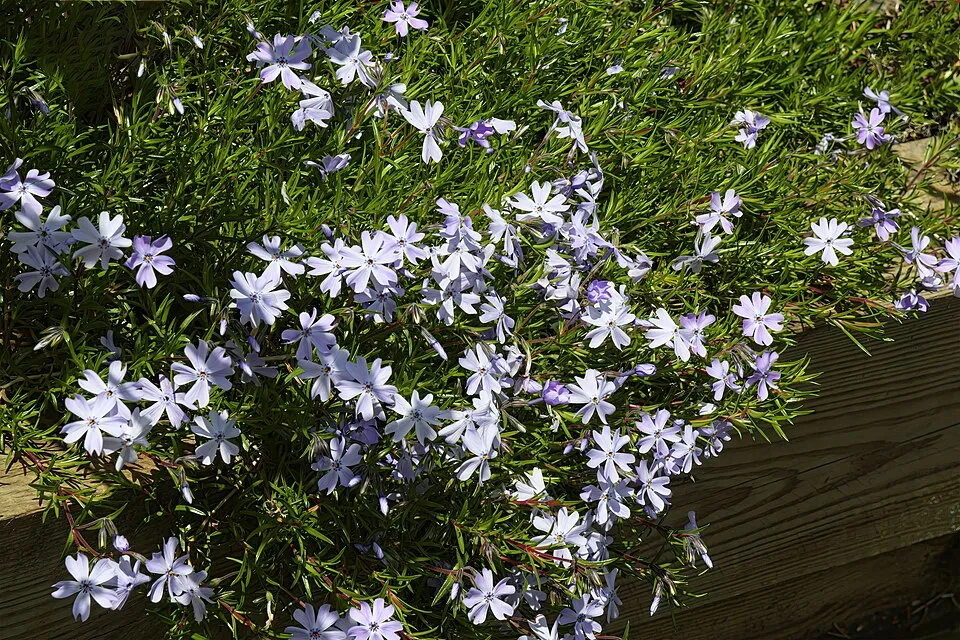
Phlox subulata, commonly known as Creeping Phlox or Moss Phlox, is a captivating perennial herbaceous flowering plant indigenous to the rocky outcrops and sandy plains of eastern North America. As a distinguished member of the Polemoniaceae family, this species is celebrated for its dense, low-growing, mat-forming habit, typically reaching a modest height of 10 to 15 cm (4 to 6 inches) while spreading extensively to cover areas of 30 to 60 cm (1-2 feet) or more.
Its evergreen foliage consists of distinctive needle-like, linear leaves, approximately 1.3 to 2.5 cm (0.5 to 1 inch) in length, which are stiff, often slightly revolute, and arranged oppositely along the stems, giving the plant its characteristic mossy appearance. The specific epithet 'subulata' directly references the awl-like (subulate) shape of these leaves.
From late spring to early summer, generally spanning April through June, Phlox subulata orchestrates a breathtaking floral display. Profuse clusters of star-shaped, five-petaled flowers, each measuring about 1.3 to 2 cm (0.5 to 0.75 inches) in diameter, emerge at the stem tips. The color spectrum is remarkably diverse, encompassing pure whites, a myriad of pinks, rose, lavender, blues, and magentas, often featuring bicolors or contrasting 'eyes' at the center.
This prolific blooming creates a vibrant, carpet-like effect, transforming landscapes into vivid tapestries of color. Adaptable and resilient, Creeping Phlox thrives in full sun and well-drained, lean soils, mimicking its native arid, rocky habitats. Its robust nature, including drought tolerance once established and general resistance to pests and diseases, makes it an exemplary choice for ground cover, rock gardens, border edgings, and containers, while also serving as an early and vital nectar source for pollinators such as bees and butterflies.
Trusted Scientific References
1. Authoritative external sources for Phlox Subulata
1.1 Wikipedia — Phlox Subulata
1.2 Kew POWO (Plants of the World Online)
1.3 PubMed — peer-reviewed research
1.4 NCBI Taxonomy Browser
1.5 GBIF — Global Biodiversity
1.1.Phlox Subulata — Key Features
- ✓ <strong>Dense, mat</strong> — forming growth habit.
- ✓ <strong>Brilliant, carpet</strong> — like spring floral display.
- ✓ <strong>Evergreen, needle</strong> — like foliage.
- ✓ <strong>Wide range of</strong> — Wide range of flower colors (white, pink, lavender, blue, magenta).
- ✓ <strong>Drought</strong> — tolerant once established.
- ✓ <strong>Attracts early</strong> — season pollinators (bees, butterflies).
- ✓ <strong>Low maintenance and</strong> — Low maintenance and relatively pest/disease resistant.
- ✓ <strong>Excellent for ground</strong> — Excellent for ground cover, rock gardens, and slopes.
- ✓ <strong>Native to eastern</strong> — Native to eastern North America.
- ✓ <strong>Hardy in USDA Zones 3</strong> — 9.
1.2.Phlox Subulata — Quick Summary
- ✓ Phlox subulata is a vibrant, low-growing perennial native to Eastern North America.
- ✓ Known for its dense, moss-like foliage and spectacular spring floral display.
- ✓ Primarily an ornamental plant, ideal for groundcover, rock gardens, and borders.
- ✓ Offers indirect wellness benefits through aesthetic appeal and pollinator support.
- ✓ Contains common plant compounds like flavonoids and phenolics, offering potential mild antioxidant effects.
- ✓ Generally considered safe for ornamental use, with no significant documented toxicity.
2.Phlox Subulata — Scientific Identity
3.Phlox Subulata — Quick Facts
4.Phlox Subulata — Appearance & Identification
5.Phlox Subulata — Native Habitat
6.Phlox Subulata — Water Requirements
- ✓ Sunlight Requirement — Thrives in full sun, requiring at least six hours of direct sunlight daily for optimal flowering and dense growth.
- ✓ Soil Preference — Prefers well-drained, sandy, or gravelly loams with a neutral to slightly acidic pH; poor to average fertility is sufficient.
- ✓ Watering Regimen — Drought-tolerant once established, requiring minimal supplemental watering; avoid soggy conditions which can lead to root rot.
- ✓ Propagation Techniques — Easily propagated from stem cuttings taken after flowering, by division of mature clumps in spring or fall, or from seeds.
- ✓ Maintenance & Pruning — Shear back lightly after flowering to encourage denser growth, prevent legginess, and promote a tidy appearance; this also helps prevent self-seeding.
- ✓ Hardiness Zones — Highly cold hardy, typically thriving in USDA Hardiness Zones 3-9, tolerating significant winter temperatures.
- ✓ Fertilization — Generally does not require heavy fertilization; a light application of balanced granular fertilizer in early spring can enhance vigor but is often unnecessary.
- ✓ Pest and Disease Management — Relatively pest and disease resistant; occasional issues may include spider mites in dry conditions or powdery mildew in humid, crowded environments.
Reviewed by the Flora Medical Global Botanical Review Panel
Multi-disciplinary editorial group · Botany · Ethnobotany · Herbal-medicine literature
Who reviewed this: This page was checked by the Flora Medical Global Botanical Review Panel — an in-house editorial group of botany graduates, ethnobotany researchers, and horticulture practitioners who collectively maintain our 7,000+ plant encyclopedia. Meet the team.
Our 4-step verification process
1. Taxonomic verification
Scientific names and synonyms cross-checked against Kew POWO, World Flora Online, and The Plant List.
2. Phytochemical & medicinal cross-reference
Active compounds, traditional uses, and reported activities are cross-referenced with PubMed, USDA Dr. Duke's database, and peer-reviewed ethnobotanical literature.
3. Conservation & distribution check
Distribution, ecology, and conservation status confirmed against GBIF occurrence records and the IUCN Red List.
4. Editorial & safety review
Every entry passes an editorial pass for clarity, originality, and safety notices (toxicity, contraindications, dosage caveats) before publication.
Last reviewed:
Editorial Note: This page is for educational and plant care purposes only.
Written by: Flora Medical Global Editorial Team
Reviewed by: Flora Medical Global Botanical Review Panel
Last Updated: June 15, 2026







Phlox Subulata — Comments & Community Reviews
Rate this plant