
Care Disclaimer: Plant care recommendations are general guidelines based on common growing conditions. Individual results may vary based on your local environment, climate, and care routine. If your plant is toxic, keep it away from children and pets, and consult a veterinarian if accidental ingestion occurs.
1.Photinia Red Robin — Overview
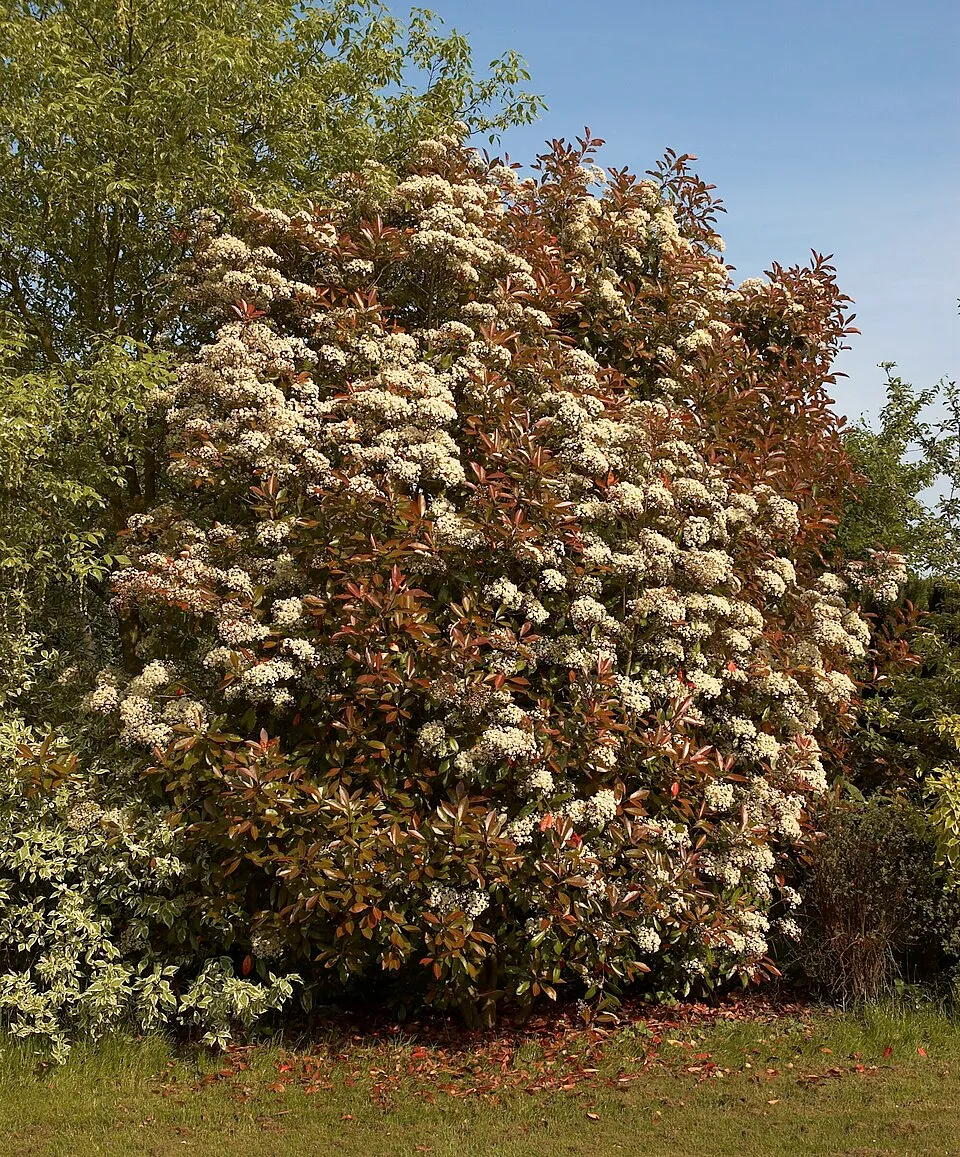
Photinia × fraseri, widely recognized by its cultivar name 'Red Robin', is a striking evergreen hybrid shrub belonging to the Rosaceae family. This vigorous, dense-growing plant is believed to be a cross between Photinia glabra and Photinia serrulata, exhibiting characteristics from both parent species. It typically grows as a large shrub or small tree, reaching heights of 3 to 5 meters (10 to 15 feet) and a similar spread, forming an excellent choice for hedges, screens, or as a standalone specimen in temperate landscapes. The most iconic feature of 'Red Robin' is its spectacular new foliage, which emerges in brilliant, glossy, fire-engine red during spring and often again in autumn. These young leaves provide a dramatic visual contrast against the mature, dark green, leathery, elliptical to ovate leaves, which can measure 8-10 cm (3-4 inches) in length.
The new shoots are often covered in fine reddish pubescence, contributing to their vibrant appearance. As the leaves age, they transition to a deep, lustrous green, maintaining their color throughout the winter months. In late spring, typically May to June, 'Red Robin' produces small, star-shaped white flowers arranged in flattened clusters (corymbs) at the branch tips. While not individually showy, the collective display can be quite attractive. These flowers are occasionally followed by small, red, crabapple-like pome fruits, though fruit production is often sparse and not a primary ornamental feature.
This hybrid is remarkably adaptable, thriving in a wide range of well-drained soil types, from sandy to clay, and tolerating full sun to partial shade. Optimal red foliage color is achieved in sunny locations. Its resilience to urban pollution, coastal conditions, and moderate drought once established further enhances its popularity in diverse horticultural settings.
Trusted Scientific References
1. Authoritative external sources for Photinia × fraseri
1.1 Wikipedia — Photinia × fraseri
1.2 Kew POWO (Plants of the World Online)
1.3 PubMed — peer-reviewed research
1.4 NCBI Taxonomy Browser
1.5 GBIF — Global Biodiversity
1.1.Photinia Red Robin — Key Features
- ✓ <strong>Striking Red New Growth</strong> — Emerges in brilliant, glossy red, especially in spring and autumn.
- ✓ <strong>Evergreen Foliage</strong> — Retains dark green, leathery leaves year-round, providing consistent garden structure.
- ✓ <strong>Hybrid Vigor</strong> — A robust and fast-growing shrub, reaching significant size.
- ✓ <strong>Dense Growth Habit</strong> — Forms a thick, bushy structure, excellent for privacy and screening.
- ✓ <strong>White Spring Flowers</strong> — Clusters of small, star-shaped white flowers appear in late spring.
- ✓ <strong>Adaptable to Conditions</strong> — Tolerates various soil types and urban pollution.
- ✓ <strong>Responds Well to Pruning</strong> — Easily shaped and maintained, encouraging more red flushes.
- ✓ <strong>Low Maintenance</strong> — Generally easy to care for once established.
- ✓ <strong>Moderate Drought Tolerance</strong> — Can withstand periods of dryness after establishment.
- ✓ <strong>Potential Toxicity</strong> — Contains cyanogenic glycosides, making it harmful if ingested.
1.2.Photinia Red Robin — Quick Summary
- ✓ Photinia 'Red Robin' is a popular ornamental evergreen shrub.
- ✓ Known for its vibrant red new foliage and dense growth.
- ✓ Ideal for hedging, screening, and as a specimen plant.
- ✓ Contains cyanogenic glycosides, making it toxic if ingested.
- ✓ Requires full sun to partial shade and well-drained soil.
- ✓ Not recommended for medicinal use; primarily for aesthetic landscaping.
2.Photinia Red Robin — Scientific Identity
3.Photinia Red Robin — Quick Facts
4.Photinia Red Robin — Appearance & Identification
5.Photinia Red Robin — Native Habitat
6.Photinia Red Robin — Water Requirements
- ✓ Site Selection — Choose a location with full sun to partial shade; full sun promotes the best red foliage color.
- ✓ Soil Requirements — Thrives in a wide range of well-drained soils, including sandy, loamy, or clay, with a preference for slightly acidic to neutral pH.
- ✓ Watering — Requires regular watering during its establishment phase; once mature, it is moderately drought-tolerant but benefits from consistent moisture, especially during dry spells.
- ✓ Fertilization — Apply a balanced slow-release fertilizer in early spring to encourage vigorous growth and vibrant foliage, avoiding over-fertilization.
- ✓ Pruning — Prune in late winter or early spring before new growth begins to maintain shape, encourage bushier growth, and stimulate the production of more red new shoots. Light trimming can be done after the first flush of red leaves.
- ✓ Propagation — Typically propagated by semi-hardwood cuttings taken in summer, rooted in a moist, well-draining medium with rooting hormone.
- ✓ Pest and Disease Management — Generally robust, but can be susceptible to leaf spot (Entomosporium maculatum), especially in humid conditions, and occasionally aphids or vine weevils. Ensure good air circulation.
- ✓ Climate — Hardy in USDA Zones 7-9, tolerating temperatures down to -15°C (5°F), though severe frosts can damage new growth.
Reviewed by the Flora Medical Global Botanical Review Panel
Multi-disciplinary editorial group · Botany · Ethnobotany · Herbal-medicine literature
Who reviewed this: This page was checked by the Flora Medical Global Botanical Review Panel — an in-house editorial group of botany graduates, ethnobotany researchers, and horticulture practitioners who collectively maintain our 7,000+ plant encyclopedia. Meet the team.
Our 4-step verification process
1. Taxonomic verification
Scientific names and synonyms cross-checked against Kew POWO, World Flora Online, and The Plant List.
2. Phytochemical & medicinal cross-reference
Active compounds, traditional uses, and reported activities are cross-referenced with PubMed, USDA Dr. Duke's database, and peer-reviewed ethnobotanical literature.
3. Conservation & distribution check
Distribution, ecology, and conservation status confirmed against GBIF occurrence records and the IUCN Red List.
4. Editorial & safety review
Every entry passes an editorial pass for clarity, originality, and safety notices (toxicity, contraindications, dosage caveats) before publication.
Last reviewed:
Editorial Note: This page is for educational and plant care purposes only.
Written by: Flora Medical Global Editorial Team
Reviewed by: Flora Medical Global Botanical Review Panel
Last Updated: June 15, 2026







Photinia Red Robin — Comments & Community Reviews
Rate this plant