
Care Disclaimer: Plant care recommendations are general guidelines based on common growing conditions. Individual results may vary based on your local environment, climate, and care routine. If your plant is toxic, keep it away from children and pets, and consult a veterinarian if accidental ingestion occurs.
1.Phyteuma — Overview
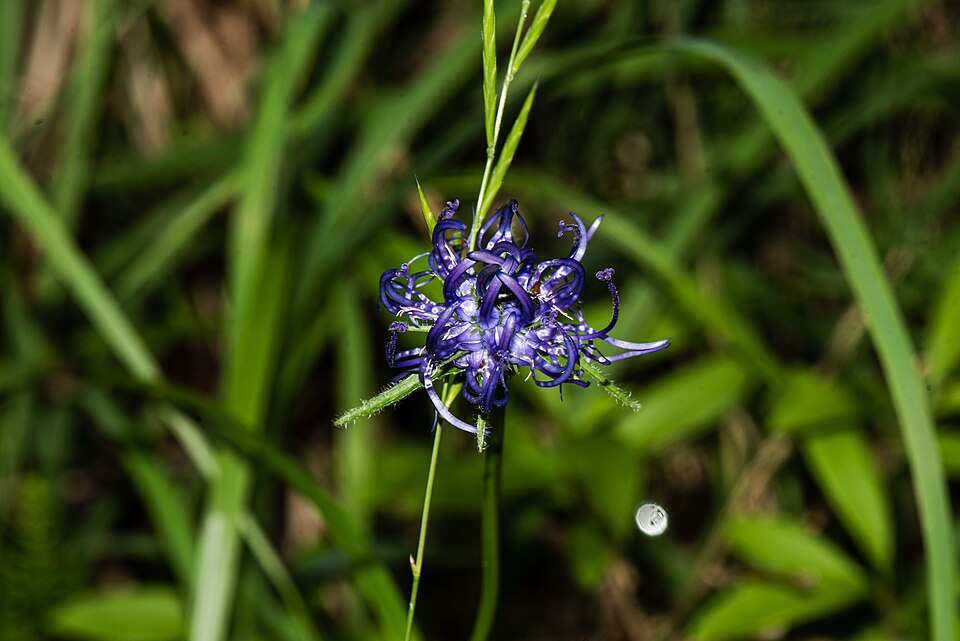
Phyteuma orbiculare, commonly known as the Round-headed Rampion or Pride of Sussex, is an enchanting herbaceous perennial belonging to the Campanulaceae family. This resilient species is indigenous to the mountainous regions of Europe, thriving across the Alps, Pyrenees, and Carpathians, and extending to lower altitudes in Western Europe, particularly in chalk grasslands of the UK South Downs. It typically inhabits calcareous grasslands, alpine meadows, and rocky slopes at elevations ranging from 600 to 2500 meters, demonstrating remarkable adaptability to harsh alpine conditions. The plant features a basal rosette of ovate to lanceolate, serrated, and often hairy leaves, which emerge early in the growing season.
From this rosette, a single, erect, glabrous, and striated stem, or scape, ascends to a height of 20-50 cm, usually in late spring to mid-summer. The most distinctive characteristic of Phyteuma orbiculare is its dense, globular or hemispherical inflorescence, measuring 1.5-3 cm in diameter. This head comprises 15 to 30 small, tubular flowers, each exhibiting a striking deep violet-blue to lilac hue. The petals are fused for a significant portion, forming unique bilabiate structures.
The outer bracts subtending the inflorescence are lanceolate, often two to four times longer than wide. Following successful insect pollination, the plant produces small, dehiscent capsules containing numerous tiny seeds. Its robust taproot system provides firm anchorage and efficient nutrient and water uptake in its often-exposed habitats. Phyteuma orbiculare is a vital ecological component, providing essential nectar for pollinators and enhancing the biodiversity of its native ecosystems.
Trusted Scientific References
1. Authoritative external sources for Phyteuma orbiculare
1.1 Wikipedia — Phyteuma orbiculare
1.2 Kew POWO (Plants of the World Online)
1.3 PubMed — peer-reviewed research
1.4 NCBI Taxonomy Browser
1.5 GBIF — Global Biodiversity
1.6Phyteuma should be interpreted through verified botanical identity, practical care, and responsible safety language. This recovery note adds the missing context needed for a complete profile: match light to the plant's habit, use well-drained soil, water according to season, and avoid unsupported medicinal or edible claims. For publishing, the plant can be presented as a source-backed garden plant with clear care guidance, common problem diagnosis, and conservative safety wording.
1.1.Phyteuma — Key Features
- ✓ <strong>Common Name</strong> — Round-headed Rampion or Pride of Sussex.
- ✓ <strong>Scientific Name</strong> — Phyteuma orbiculare.
- ✓ <strong>Family</strong> — Campanulaceae (Bellflower Family).
- ✓ <strong>Distinctive Flowers</strong> — Dense, globular heads of deep violet-blue tubular flowers.
- ✓ <strong>Habitat Preference</strong> — Calcareous grasslands, alpine meadows, and rocky slopes at high altitudes.
- ✓ <strong>European Native</strong> — Widespread across the mountainous regions of Europe.
- ✓ <strong>Herbaceous Perennial</strong> — Returns year after year with a robust taproot system.
- ✓ <strong>Ecological Importance</strong> — Significant nectar source for various insect pollinators.
- ✓ <strong>Resilience</strong> — Adapted to withstand harsh alpine environmental conditions.
- ✓ <strong>Research Potential</strong> — Underexplored in terms of specific medicinal applications, offering avenues for phytochemical and pharmacological studies.
1.2.Phyteuma — Quick Summary
- ✓ Phyteuma orbiculare, the Round-headed Rampion, is an attractive European alpine perennial from the Campanulaceae family.
- ✓ Characterized by its dense, spherical violet-blue flower heads and resilience in calcareous, mountainous habitats.
- ✓ Primarily valued for its ecological role, providing nectar for pollinators and enhancing biodiversity.
- ✓ Lacks extensive traditional or modern documented medicinal uses, requiring further scientific investigation.
- ✓ Contains general plant compounds like flavonoids and phenolics, suggesting potential for antioxidant or anti-inflammatory effects.
- ✓ Cultivation is possible in well-drained, sunny, calcareous soils, making it suitable for rock gardens.
2.Phyteuma — Scientific Identity
3.Phyteuma — Quick Facts
4.Phyteuma — Appearance & Identification
5.Phyteuma — Native Habitat
6.Phyteuma — Water Requirements
- ✓ Site Selection — Choose a location with full sun exposure and well-drained, calcareous soil, mimicking its native chalk grassland or alpine meadow habitat.
- ✓ Seed Propagation — Sow tiny seeds directly outdoors in late autumn or early spring, or indoors after a cold stratification period. Germination can be slow and erratic.
- ✓ Soil Preparation — Ensure the soil is rich in lime and has excellent drainage; amending with grit or crushed limestone can be beneficial.
- ✓ Watering — Phyteuma orbiculare is drought-tolerant once established but benefits from moderate watering during prolonged dry spells, especially during its initial growth phase.
- ✓ Spacing — Plant seedlings or young plants 15-20 cm apart to allow for mature growth and basal rosette development.
- ✓ Maintenance — Requires minimal maintenance; deadhead spent flowers to prevent self-seeding and encourage plant vigor. Avoid heavy fertilization.
- ✓ Pest and Disease — Generally robust, Phyteuma orbiculare is not prone to many pests or diseases, thriving in its preferred conditions.
Reviewed by the Flora Medical Global Botanical Review Panel
Multi-disciplinary editorial group · Botany · Ethnobotany · Herbal-medicine literature
Who reviewed this: This page was checked by the Flora Medical Global Botanical Review Panel — an in-house editorial group of botany graduates, ethnobotany researchers, and horticulture practitioners who collectively maintain our 7,000+ plant encyclopedia. Meet the team.
Our 4-step verification process
1. Taxonomic verification
Scientific names and synonyms cross-checked against Kew POWO, World Flora Online, and The Plant List.
2. Phytochemical & medicinal cross-reference
Active compounds, traditional uses, and reported activities are cross-referenced with PubMed, USDA Dr. Duke's database, and peer-reviewed ethnobotanical literature.
3. Conservation & distribution check
Distribution, ecology, and conservation status confirmed against GBIF occurrence records and the IUCN Red List.
4. Editorial & safety review
Every entry passes an editorial pass for clarity, originality, and safety notices (toxicity, contraindications, dosage caveats) before publication.
Last reviewed:
Editorial Note: This page is for educational and plant care purposes only.
Written by: Flora Medical Global Editorial Team
Reviewed by: Flora Medical Global Botanical Review Panel
Last Updated: June 15, 2026







Phyteuma — Comments & Community Reviews
Rate this plant