
Care Disclaimer: Plant care recommendations are general guidelines based on common growing conditions. Individual results may vary based on your local environment, climate, and care routine. If your plant is toxic, keep it away from children and pets, and consult a veterinarian if accidental ingestion occurs.
1.Pistia Stratiotes — Overview
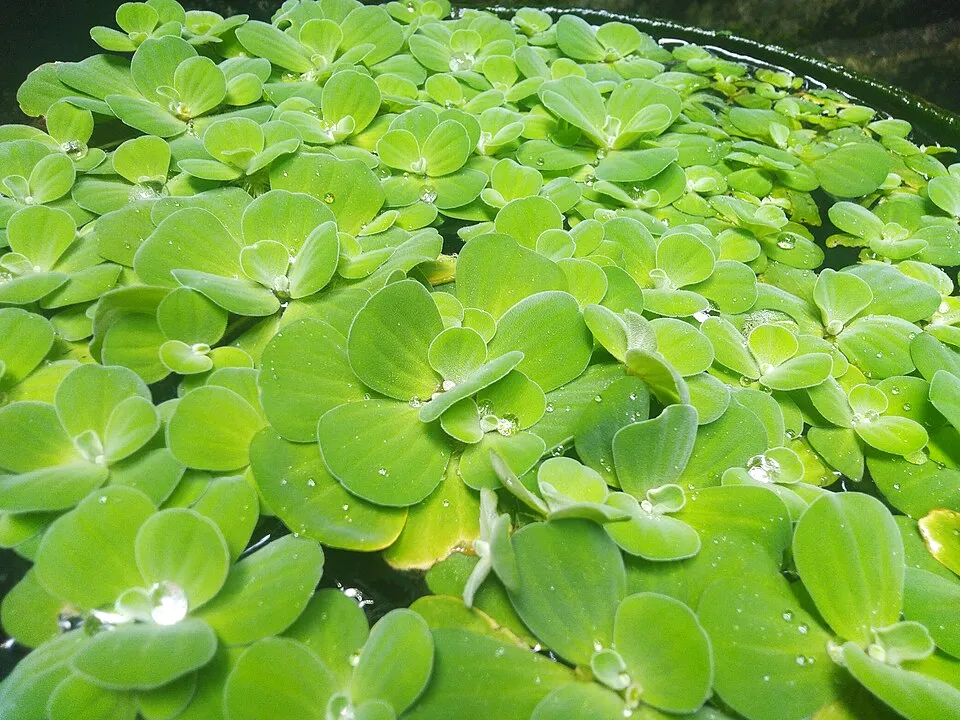
Pistia stratiotes, commonly known as water lettuce or shellflower, is a remarkable free-floating aquatic perennial herb within the Araceae family. This monotypic genus is characterized by its distinctive rosette of fleshy, obovate to spathulate leaves, typically ranging from 10-30 cm in length and 5-15 cm in width. The leaves possess a unique velvety texture on their upper surface, attributed to a dense covering of fine, water-repellent hairs, which enhance buoyancy and prevent waterlogging.
A prominent ribbed pattern further distinguishes the leaf surface, while the undersides often display a purplish hue from anthocyanin pigments. From the axils of these leaves, a profusion of feathery, adventitious roots descends into the water column, often extending up to a meter, serving crucial roles in nutrient absorption and plant stabilization. The inflorescences are inconspicuous, arising from the center of the rosette and enclosed by a spathe and spadix, typical of the Araceae family, bearing unisexual flowers.
Indigenous to tropical and subtropical regions worldwide, Pistia stratiotes thrives in still or slow-moving freshwater environments such as ponds, lakes, and canals. Its exceptional growth rate and prolific vegetative propagation via stolons allow it to rapidly colonize water bodies, often forming dense mats. While this adaptability has led to its classification as an invasive species in many non-native habitats, posing ecological challenges by outcompeting native flora and impeding water flow, it also underscores its significant potential in phytoremediation.
The plant efficiently absorbs excess nutrients and various pollutants, including heavy metals, from contaminated aquatic systems, making it a valuable subject for environmental applications. Its unique morphological adaptations and ecological versatility highlight its fascinating botanical interest.
Trusted Scientific References
1. Authoritative external sources for Pistia stratiotes
1.1 Wikipedia — Pistia stratiotes
1.2 Kew POWO (Plants of the World Online)
1.3 PubMed — peer-reviewed research
1.4 NCBI Taxonomy Browser
1.5 GBIF — Global Biodiversity
1.1.Pistia Stratiotes — Key Features
- ✓ <strong>Free</strong> — floating aquatic herb with distinctive rosette formation.
- ✓ <strong>Velvety, water</strong> — repellent leaves aiding buoyancy and preventing waterlogging.
- ✓ <strong>Extensive feathery adventitious</strong> — Extensive feathery adventitious roots for nutrient absorption and stability.
- ✓ <strong>Rapid growth rate</strong> — Rapid growth rate and prolific vegetative propagation via stolons.
- ✓ <strong>Pantropical distribution, often</strong> — Pantropical distribution, often considered an invasive species in non-native habitats.
- ✓ <strong>Significant traditional medicinal uses, including anti</strong> — inflammatory and wound healing.
- ✓ <strong>High potential for</strong> — High potential for phytoremediation, absorbing pollutants from water.
- ✓ <strong>Presence of calcium</strong> — Presence of calcium oxalate crystals, requiring careful processing for internal use.
- ✓ <strong>Inconspicuous inflorescences typical</strong> — Inconspicuous inflorescences typical of the Araceae family.
- ✓ <strong>Adaptable to various still or slow</strong> — moving freshwater environments.
1.2.Pistia Stratiotes — Quick Summary
- ✓ Pistia stratiotes is a free-floating aquatic plant known as water lettuce, belonging to the Araceae family.
- ✓ Characterized by velvety, rosette-forming leaves and extensive feathery roots, it thrives in warm freshwater.
- ✓ Traditionally used for its anti-inflammatory, antioxidant, antimicrobial, and wound-healing properties across various cultures.
- ✓ Rich in flavonoids, phenolic acids, and other beneficial phytochemicals, contributing to its medicinal potential.
- ✓ Also recognized for its ecological role in phytoremediation, effectively cleaning polluted water bodies.
- ✓ Requires careful preparation and adherence to safety guidelines, particularly avoiding raw ingestion due to calcium oxalate.
2.Pistia Stratiotes — Scientific Identity
3.Pistia Stratiotes — Quick Facts
4.Pistia Stratiotes — Appearance & Identification
5.Pistia Stratiotes — Native Habitat
6.Pistia Stratiotes — Water Requirements
- ✓ Water Requirement — Requires still or slow-moving freshwater; ideal for ponds, aquariums, or water gardens.
- ✓ Light Conditions — Thrives in full sun to partial shade; adequate light is crucial for robust growth.
- ✓ Temperature Range — Prefers warm tropical to subtropical temperatures, typically 20-35°C (68-95°F); sensitive to frost.
- ✓ Nutrient Availability — Benefits from nutrient-rich water, readily absorbing nitrates, phosphates, and other minerals.
- ✓ Propagation — Primarily propagates vegetatively via stolons, producing daughter plants that easily detach; can also be grown from seeds.
- ✓ Containment — Due to its invasive potential, cultivation in non-native regions should be strictly contained to prevent ecological spread.
- ✓ Water Quality — Tolerates a wide pH range (6.0-8.0) but prefers slightly acidic to neutral conditions; good water circulation helps prevent stagnation.
- ✓ Pest and Disease Management — Generally robust, but can be susceptible to fungal diseases or aphid infestations in certain conditions.
Reviewed by the Flora Medical Global Botanical Review Panel
Multi-disciplinary editorial group · Botany · Ethnobotany · Herbal-medicine literature
Who reviewed this: This page was checked by the Flora Medical Global Botanical Review Panel — an in-house editorial group of botany graduates, ethnobotany researchers, and horticulture practitioners who collectively maintain our 7,000+ plant encyclopedia. Meet the team.
Our 4-step verification process
1. Taxonomic verification
Scientific names and synonyms cross-checked against Kew POWO, World Flora Online, and The Plant List.
2. Phytochemical & medicinal cross-reference
Active compounds, traditional uses, and reported activities are cross-referenced with PubMed, USDA Dr. Duke's database, and peer-reviewed ethnobotanical literature.
3. Conservation & distribution check
Distribution, ecology, and conservation status confirmed against GBIF occurrence records and the IUCN Red List.
4. Editorial & safety review
Every entry passes an editorial pass for clarity, originality, and safety notices (toxicity, contraindications, dosage caveats) before publication.
Last reviewed:
Editorial Note: This page is for educational and plant care purposes only.
Written by: Flora Medical Global Editorial Team
Reviewed by: Flora Medical Global Botanical Review Panel
Last Updated: June 15, 2026







Pistia Stratiotes — Comments & Community Reviews
Rate this plant