


Care Disclaimer: Plant care recommendations are general guidelines based on common growing conditions. Individual results may vary based on your local environment, climate, and care routine. If your plant is toxic, keep it away from children and pets, and consult a veterinarian if accidental ingestion occurs.
1.Plumeria Obtusa — Overview
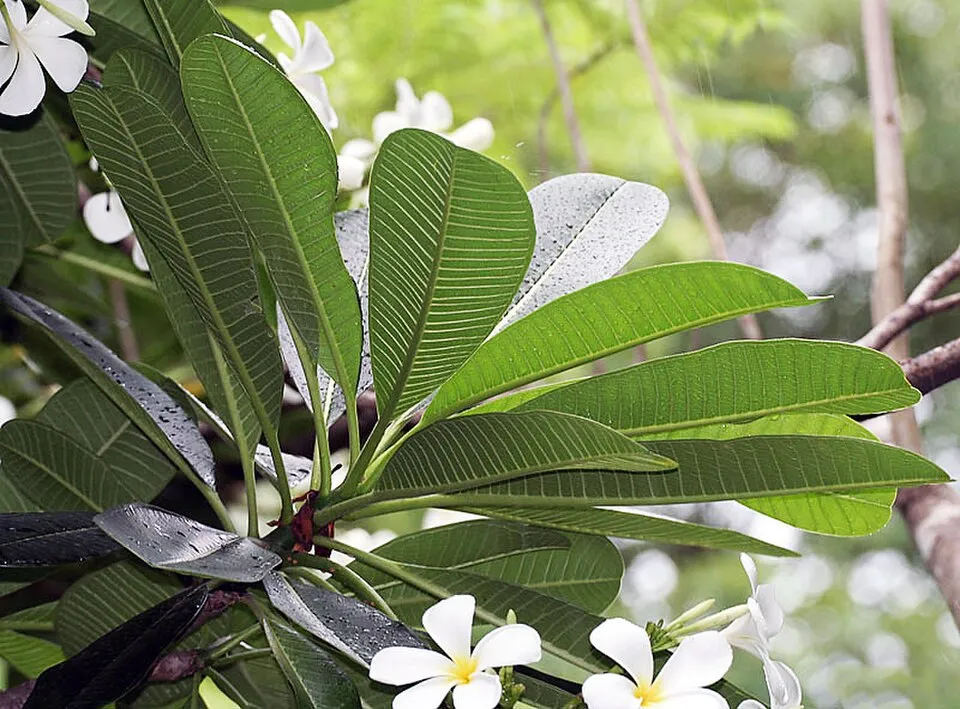
Plumeria obtusa, widely recognized as the Singapore graveyard flower or nosegay, is an elegant species within the Apocynaceae family, native to the sun-drenched Caribbean, Mexico, and Central America. This captivating plant manifests as a small tree or robust shrub, typically reaching heights of up to 8 meters (26 feet) and spreading up to 5 meters (16 feet) wide. Its distinctive morphology includes thick, fleshy, and somewhat succulent branches that, when incised, release a milky white latex known to cause skin and eye irritation.
The foliage is characterized by alternate, simple leaves, obovate to oblong in shape, displaying a lustrous dark green adaxial surface and a paler, often minutely pubescent abaxial surface. These leaves are typically arranged in dense clusters at the branch termini, imparting a a distinctly palm-like silhouette.
The specific epithet 'obtusa' directly references the obtuse or rounded apex of its leaves, which feature entire margins. The most celebrated attribute of Plumeria obtusa is undoubtedly its highly fragrant flowers, presented in terminal cymes. Each flower is typically comprised of five pristine white petals with a vibrant yellow center, forming a funnel-shaped corolla approximately 5-7 cm (2-3 inches) in diameter, though color variations can occur.
The intoxicatingly sweet fragrance, often likened to a harmonious blend of jasmine and gardenia, intensifies notably during the evening hours. Following successful pollination, the flowers give way to slender, elongated follicular fruits, measuring 10-20 cm (4-8 inches) in length, which encase numerous small, winged seeds. Beyond its native range, Plumeria obtusa has been extensively cultivated across tropical and subtropical regions globally, cherished for its ornamental allure and profound aromatic qualities.
Trusted Scientific References
1. Authoritative external sources for Plumeria obtusa
1.1 Wikipedia — Plumeria obtusa
1.2 Kew POWO (Plants of the World Online)
1.3 PubMed — peer-reviewed research
1.4 NCBI Taxonomy Browser
1.5 GBIF — Global Biodiversity
1.1.Plumeria Obtusa — Key Features
- ✓ <strong>Highly fragrant white</strong> — Highly fragrant white flowers with yellow centers.
- ✓ <strong>Thick, succulent branches</strong> — Thick, succulent branches exuding milky sap.
- ✓ <strong>Obovate, glossy dark</strong> — Obovate, glossy dark green leaves clustered at branch ends.
- ✓ <strong>Native to Caribbean,</strong> — Native to Caribbean, Mexico, and Central America.
- ✓ <strong>Widely cultivated ornamental</strong> — Widely cultivated ornamental plant.
- ✓ <strong>Traditional uses for</strong> — Traditional uses for inflammation, pain, and infections.
- ✓ <strong>Contains diverse phytochemicals</strong> — Contains diverse phytochemicals including iridoids and flavonoids.
- ✓ <strong>Flowers are most</strong> — Flowers are most fragrant in the evening.
- ✓ <strong>Produces slender, elongated</strong> — Produces slender, elongated seed pods.
- ✓ <strong>Member of the</strong> — Member of the Apocynaceae family.
1.2.Plumeria Obtusa — Quick Summary
- ✓ Plumeria obtusa is a fragrant ornamental shrub with traditional medicinal uses.
- ✓ Known for anti-inflammatory, analgesic, and antimicrobial properties.
- ✓ Contains iridoids, flavonoids, and triterpenoids as key active compounds.
- ✓ Sap is irritating; plant is toxic if ingested.
- ✓ Primarily used topically or in highly diluted forms in traditional practices.
- ✓ Requires careful handling and is not recommended for internal self-medication.
2.Plumeria Obtusa — Scientific Identity
3.Plumeria Obtusa — Quick Facts
4.Plumeria Obtusa — Appearance & Identification
5.Plumeria Obtusa — Native Habitat
6.Plumeria Obtusa — Water Requirements
- ✓ Climate — Thrives in tropical to subtropical climates with warm temperatures and high humidity.
- ✓ Sunlight — Requires full sun exposure for at least 6 hours daily for optimal flowering.
- ✓ Soil — Prefers well-draining, slightly acidic to neutral soil (pH 6.0-7.0) rich in organic matter.
- ✓ Watering — Water regularly during the growing season, allowing the topsoil to dry out between waterings; reduce significantly in winter.
- ✓ Fertilization — Feed with a balanced, high-phosphorus fertilizer during spring and summer to encourage blooming.
- ✓ Propagation — Easily propagated from stem cuttings taken in spring or early summer, allowed to callus before planting.
- ✓ Pruning — Prune to maintain shape, remove dead or diseased branches, and promote bushier growth, ideally after flowering.
- ✓ Pests & Diseases — Generally robust, but watch for spider mites, mealybugs, and rust fungus; ensure good air circulation.
Reviewed by the Flora Medical Global Botanical Review Panel
Multi-disciplinary editorial group · Botany · Ethnobotany · Herbal-medicine literature
Who reviewed this: This page was checked by the Flora Medical Global Botanical Review Panel — an in-house editorial group of botany graduates, ethnobotany researchers, and horticulture practitioners who collectively maintain our 7,000+ plant encyclopedia. Meet the team.
Our 4-step verification process
1. Taxonomic verification
Scientific names and synonyms cross-checked against Kew POWO, World Flora Online, and The Plant List.
2. Phytochemical & medicinal cross-reference
Active compounds, traditional uses, and reported activities are cross-referenced with PubMed, USDA Dr. Duke's database, and peer-reviewed ethnobotanical literature.
3. Conservation & distribution check
Distribution, ecology, and conservation status confirmed against GBIF occurrence records and the IUCN Red List.
4. Editorial & safety review
Every entry passes an editorial pass for clarity, originality, and safety notices (toxicity, contraindications, dosage caveats) before publication.
Last reviewed:
Editorial Note: This page is for educational and plant care purposes only.
Written by: Flora Medical Global Editorial Team
Reviewed by: Flora Medical Global Botanical Review Panel
Last Updated: June 15, 2026







Plumeria Obtusa — Comments & Community Reviews
Rate this plant