
Care Disclaimer: Plant care recommendations are general guidelines based on common growing conditions. Individual results may vary based on your local environment, climate, and care routine. If your plant is toxic, keep it away from children and pets, and consult a veterinarian if accidental ingestion occurs.
1.Polyxena Ensifolia — Overview
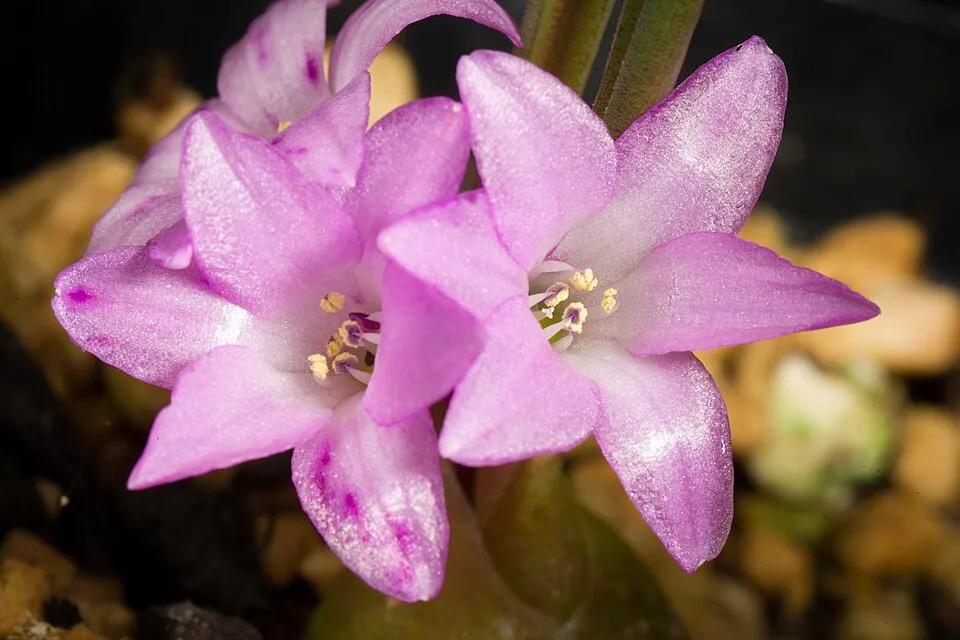
Polyxena ensifolia, often referred to as 'Little Pink Oxalis' or 'Fan-leaved Oxalis', is a captivating geophyte historically classified under the genus Polyxena but now taxonomically recognized as Lachenalia ensifolia within the Hyacinthaceae family. This shift highlights its close phylogenetic relationship with other Lachenalia species. Native to the distinctive winter-rainfall regions of South Africa's Cape provinces, particularly thriving in arid to semi-arid environments, this species is typically found in sandy or clay-based soils, often nestled in rocky outcrops, coastal scrub, and succulent karoo biomes. Its perennial nature is underpinned by a compact, ovoid corm, which acts as a crucial underground storage organ, enabling it to endure prolonged dry periods and regenerate vigorously with seasonal rains. The corm is enveloped in protective papery tunics, an adaptation vital for survival in its harsh native habitat.
The plant typically presents two, sometimes three, lanceolate to ovate leaves, initially prostrate but becoming semi-erect as flowering progresses. These leaves are about 2.5 cm wide by 10 cm long. The specific epithet 'ensifolia' (sword-leaved) refers to the shape of its foliage. Flowering occurs in late winter to early spring, coinciding with increased moisture availability. The inflorescences emerge as a dense corymbose raceme, bearing small, star-shaped flowers that range in color from white to various shades of pink and mauve.
A notable characteristic is the pronounced hyacinth-like fragrance, earning it the synonym P. odorata. The flowers possess a long, slender perianth tube and exerted filaments, which are key diagnostic features. Polyxena ensifolia is a diminutive species, typically reaching only about 5 cm in height.
Trusted Scientific References
1. Authoritative external sources for Polyxena Ensifolia
1.1 Wikipedia — Polyxena Ensifolia
1.2 Kew POWO (Plants of the World Online)
1.3 PubMed — peer-reviewed research
1.4 NCBI Taxonomy Browser
1.5 GBIF — Global Biodiversity
1.1.Polyxena Ensifolia — Key Features
- ✓ <strong>Native to South Africa</strong> — Endemic to the Cape provinces' winter-rainfall regions.
- ✓ <strong>Geophyte with Corm</strong> — Possesses an underground corm for survival and regeneration.
- ✓ <strong>Small Stature</strong> — Typically grows to only about 5 cm in height.
- ✓ <strong>Lanceolate Leaves</strong> — Features two to three broad, lance-shaped leaves.
- ✓ <strong>Pink to Mauve Flowers</strong> — Blooms with delicate, star-shaped flowers in corymbose racemes.
- ✓ <strong>Hyacinth</strong> — like Fragrance — Emits a strong, pleasant scent.
- ✓ <strong>Taxonomic Reclassification</strong> — Now Lachenalia ensifolia, previously Polyxena ensifolia.
- ✓ <strong>Winter to Early Spring Bloomer</strong> — Flowers appear during cooler, wetter months.
- ✓ <strong>Requires Good Drainage</strong> — Thrives in well-draining sandy or clay-based soils.
- ✓ <strong>Ornamental Appeal</strong> — Valued for its aesthetic qualities in horticulture.
1.2.Polyxena Ensifolia — Quick Summary
- ✓ South African Geophyte — Native to the Cape, thrives in winter rainfall regions.
- ✓ Ornamental Value — Prized for its small size, pink/mauve flowers, and fragrance.
- ✓ Taxonomic Shift — Formerly Polyxena, now classified as Lachenalia ensifolia.
- ✓ Corm Survival — Uses an underground corm to survive arid periods.
- ✓ Distinctive Fragrance — Known for its hyacinth-like scent.
- ✓ No Documented Medicinal Use — Primarily ornamental, lacking traditional medicinal applications.
2.Polyxena Ensifolia — Scientific Identity
3.Polyxena Ensifolia — Quick Facts
4.Polyxena Ensifolia — Appearance & Identification
5.Polyxena Ensifolia — Native Habitat
6.Polyxena Ensifolia — Water Requirements
- ✓ Soil Preparation — Use a free-draining, gritty/sandy soil mix, ensuring good aeration to prevent corm rot.
- ✓ Watering Schedule — Keep soil evenly moist during the active growth phase (fall to spring), reducing water significantly during dormancy.
- ✓ Light Requirements — Provide as much natural light as possible, ideally full sun, for robust growth and flowering.
- ✓ Frost Protection — Protect plants from hard frosts, as they are sensitive to freezing temperatures.
- ✓ Propagation — Propagate readily from offsets produced by the corm or from seed, which typically flowers in 2-3 years.
- ✓ Disease Prevention — Practice good housekeeping; remove fading flowers promptly to prevent botrytis, especially in dense plantings.
- ✓ Container Growing — Best suited for cultivation in containers due to their small size and specific cultural needs.
- ✓ Mass Planting — Can be massed for good effect in containers, as they prefer growing in close proximity.
Reviewed by the Flora Medical Global Botanical Review Panel
Multi-disciplinary editorial group · Botany · Ethnobotany · Herbal-medicine literature
Who reviewed this: This page was checked by the Flora Medical Global Botanical Review Panel — an in-house editorial group of botany graduates, ethnobotany researchers, and horticulture practitioners who collectively maintain our 7,000+ plant encyclopedia. Meet the team.
Our 4-step verification process
1. Taxonomic verification
Scientific names and synonyms cross-checked against Kew POWO, World Flora Online, and The Plant List.
2. Phytochemical & medicinal cross-reference
Active compounds, traditional uses, and reported activities are cross-referenced with PubMed, USDA Dr. Duke's database, and peer-reviewed ethnobotanical literature.
3. Conservation & distribution check
Distribution, ecology, and conservation status confirmed against GBIF occurrence records and the IUCN Red List.
4. Editorial & safety review
Every entry passes an editorial pass for clarity, originality, and safety notices (toxicity, contraindications, dosage caveats) before publication.
Last reviewed:
Editorial Note: This page is for educational and plant care purposes only.
Written by: Flora Medical Global Editorial Team
Reviewed by: Flora Medical Global Botanical Review Panel
Last Updated: June 15, 2026







Polyxena Ensifolia — Comments & Community Reviews
Rate this plant