
Care Disclaimer: Plant care recommendations are general guidelines based on common growing conditions. Individual results may vary based on your local environment, climate, and care routine. If your plant is toxic, keep it away from children and pets, and consult a veterinarian if accidental ingestion occurs.
1.Poppy — Overview
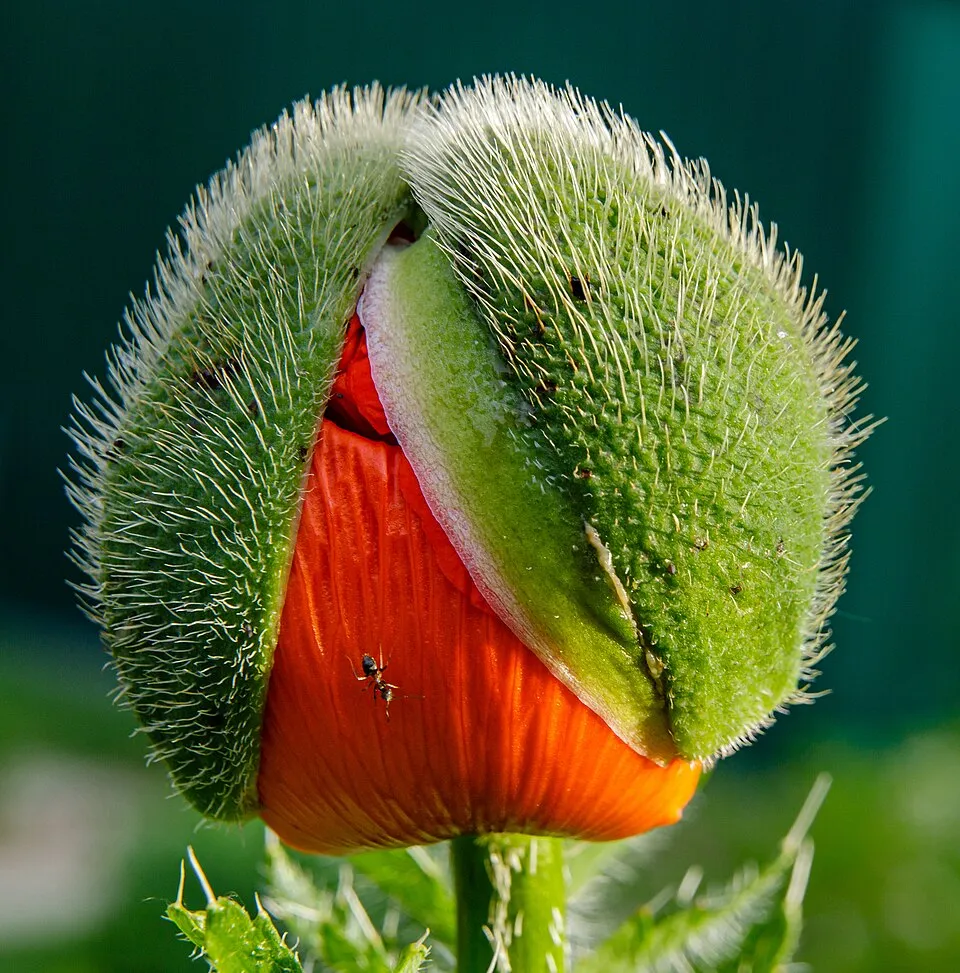
Papaver orientale, commonly known as the Oriental Poppy, is a distinguished herbaceous perennial celebrated for its dramatic floral display. Native to a vast region spanning from Turkey and Armenia through northern Iran and the Caucasus, it thrives in mountainous grasslands and rocky slopes. This robust species develops a prominent basal rosette of deeply dissected, bristly, glaucous-green leaves, from which sturdy, hairy flower stalks ascend, reaching heights of 2 to 4 feet (0.6 to 1.2 meters). Each stem typically culminates in a single, magnificent flower, often exceeding 6 inches (15 cm) in diameter.
The petals, characteristically vibrant scarlet, but also available in shades of orange, pink, salmon, and occasionally white or deep crimson, possess a delicate, crinkled texture reminiscent of tissue paper. A signature feature is the conspicuous, dark purplish-black blotch at the base of each petal, forming a striking contrast around the central boss of stamens and the characteristic disc-shaped stigma. Following its late spring to early summer bloom, the plant forms an urn-shaped, dehiscent seed capsule. A key ecological adaptation and horticultural characteristic is its summer dormancy; the foliage often yellows and dies back in hot weather, only to re-emerge in cooler autumn temperatures or the subsequent spring.
This dormancy helps the plant conserve energy during adverse conditions. Papaver orientale is distinguished from its psychoactive relatives by its negligible alkaloid content, primarily cultivated for its ornamental grandeur.
Trusted Scientific References
1. Authoritative external sources for Papaver orientale
1.1 Wikipedia — Papaver orientale
1.2 Kew POWO (Plants of the World Online)
1.3 PubMed — peer-reviewed research
1.4 NCBI Taxonomy Browser
1.5 GBIF — Global Biodiversity
1.6Poppy should be interpreted through verified botanical identity, practical care, and responsible safety language. This recovery note adds the missing context needed for a complete profile: match light to the plant's habit, use well-drained soil, water according to season, and avoid unsupported medicinal or edible claims. For publishing, the plant can be presented as a source-backed garden plant with clear care guidance, common problem diagnosis, and conservative safety wording.
1.1.Poppy — Key Features
- ✓ <strong>Large, showy flowers,</strong> — Large, showy flowers, often 6+ inches in diameter.
- ✓ <strong>Vibrant scarlet, orange,</strong> — Vibrant scarlet, orange, pink, or white petals with crinkled texture.
- ✓ <strong>Distinctive dark blotches</strong> — Distinctive dark blotches at the base of petals.
- ✓ <strong>Basal rosette of</strong> — Basal rosette of deeply lobed, bristly leaves.
- ✓ <strong>Erect, hairy flower</strong> — Erect, hairy flower stalks.
- ✓ <strong>Urn</strong> — shaped seed capsules.
- ✓ <strong>Summer dormancy of</strong> — Summer dormancy of foliage.
- ✓ <strong>Deep taproot system.</strong> — Deep taproot system.
- ✓ <strong>Native to Eastern</strong> — Native to Eastern Mediterranean and Central Asia.
- ✓ <strong>Perennial herbaceous plant.</strong> — Perennial herbaceous plant.
1.2.Poppy — Quick Summary
- ✓ Striking Ornamental Plant — Known for large, vibrant flowers.
- ✓ Native to Eastern Mediterranean — Thrives in well-drained, sunny locations.
- ✓ Contains Alkaloids — Primarily oripavine and thebaine, but not psychoactive in relevant amounts.
- ✓ Summer Dormancy — Foliage dies back in heat, re-emerges later.
- ✓ Not for Internal Consumption — Primarily grown for aesthetic appeal, not medicinal use.
- ✓ Attracts Pollinators — Supports biodiversity in garden settings.
2.Poppy — Scientific Identity
3.Poppy — Quick Facts
4.Poppy — Appearance & Identification
5.Poppy — Native Habitat
6.Poppy — Water Requirements
- ✓ Site Selection — Plant in full sun (at least 6 hours daily) with well-drained soil to prevent root rot.
- ✓ Soil Preparation — Amend heavy clay soils with organic matter to improve drainage; prefers a neutral to slightly alkaline pH.
- ✓ Planting — Plant bare-root divisions or container-grown plants in early spring or fall. Space plants 18-24 inches apart.
- ✓ Watering — Water regularly during dry periods, especially in the first year, but reduce watering during summer dormancy.
- ✓ Fertilization — Apply a balanced slow-release fertilizer in early spring, or compost around the base.
- ✓ Pruning — Deadhead spent flowers to prevent self-seeding and encourage rebloom in some varieties, though P. orientale typically has a singular bloom period.
- ✓ Winter Care — Protect roots in colder climates with a layer of mulch after the ground freezes.
- ✓ Propagation — Primarily by seed or root cuttings. Seeds require a cold stratification period for germination.
Reviewed by the Flora Medical Global Botanical Review Panel
Multi-disciplinary editorial group · Botany · Ethnobotany · Herbal-medicine literature
Who reviewed this: This page was checked by the Flora Medical Global Botanical Review Panel — an in-house editorial group of botany graduates, ethnobotany researchers, and horticulture practitioners who collectively maintain our 7,000+ plant encyclopedia. Meet the team.
Our 4-step verification process
1. Taxonomic verification
Scientific names and synonyms cross-checked against Kew POWO, World Flora Online, and The Plant List.
2. Phytochemical & medicinal cross-reference
Active compounds, traditional uses, and reported activities are cross-referenced with PubMed, USDA Dr. Duke's database, and peer-reviewed ethnobotanical literature.
3. Conservation & distribution check
Distribution, ecology, and conservation status confirmed against GBIF occurrence records and the IUCN Red List.
4. Editorial & safety review
Every entry passes an editorial pass for clarity, originality, and safety notices (toxicity, contraindications, dosage caveats) before publication.
Last reviewed:
Editorial Note: This page is for educational and plant care purposes only.
Written by: Flora Medical Global Editorial Team
Reviewed by: Flora Medical Global Botanical Review Panel
Last Updated: June 15, 2026







Poppy — Comments & Community Reviews
Rate this plant