
Care Disclaimer: Plant care recommendations are general guidelines based on common growing conditions. Individual results may vary based on your local environment, climate, and care routine. If your plant is toxic, keep it away from children and pets, and consult a veterinarian if accidental ingestion occurs.
1.Pulmonaria Saccharata — Overview
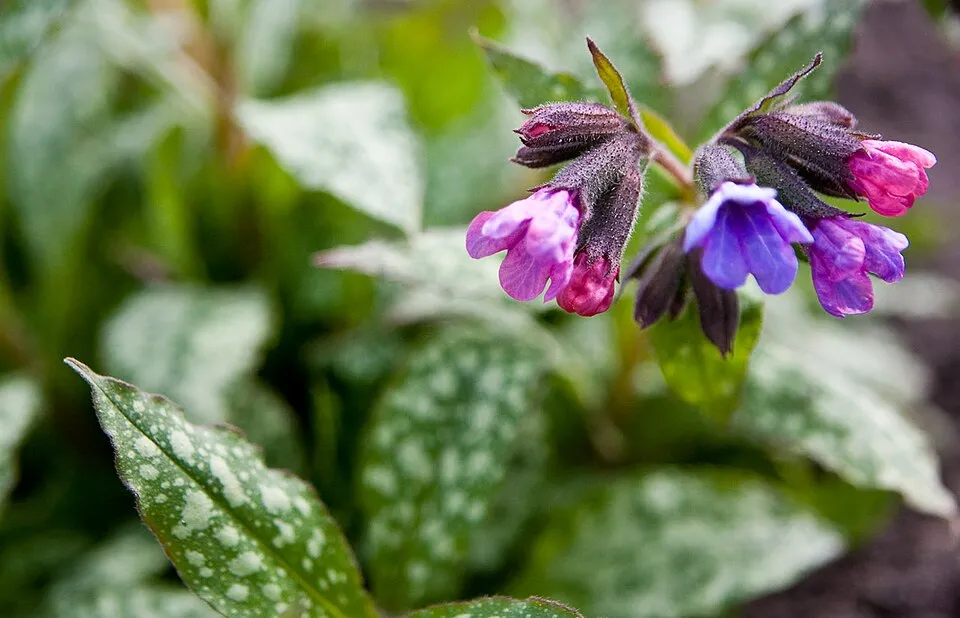
Pulmonaria saccharata, commonly known as Bethlehem sage or spotted lungwort, is a captivating herbaceous perennial belonging to the Boraginaceae family. Native to Europe, particularly the Apennine Mountains, it has gained widespread popularity in temperate shade gardens across North America and other regions. This low-growing plant typically reaches heights of 12-18 inches with a similar spread, forming attractive clumps.
Its most striking feature is the foliage: ovate to lanceolate leaves, often broadly elliptic, which are dark green and intricately adorned with prominent silver-white blotches or spots, creating a unique speckled effect that persists throughout the growing season. The specific epithet 'saccharata' refers to these sugar-like spots.
In early spring, Pulmonaria saccharata produces clusters of funnel-shaped flowers at the tips of its stems. These delicate blooms exhibit a fascinating color transformation, typically emerging pink in bud and gradually maturing to shades of blue, purple, or sometimes white as they open. This color change is often attributed to shifts in pH within the flower cells.
The blossoms are a valuable early nectar source, attracting various pollinators like bees. The plant thrives in cool, moist, well-drained soils rich in organic matter and prefers partial to full shade, making it an excellent choice for woodland gardens or shaded borders. Its natural distribution in Europe typically encompasses deciduous forests and rocky slopes, where it benefits from the protection of tree canopies.
It is a hardy species, generally adaptable to USDA hardiness zones 3-8, and is known for its resistance to deer and rabbits.
Trusted Scientific References
1. Authoritative external sources for Pulmonaria Saccharata
1.1 Wikipedia — Pulmonaria Saccharata
1.2 Kew POWO (Plants of the World Online)
1.3 PubMed — peer-reviewed research
1.4 NCBI Taxonomy Browser
1.5 GBIF — Global Biodiversity
1.6Pulmonaria Saccharata should be interpreted through verified botanical identity, practical care, and responsible safety language. This recovery note adds the missing context needed for a complete profile: match light to the plant's habit, use well-drained soil, water according to season, and avoid unsupported medicinal or edible claims. For publishing, the plant can be presented as a source-backed garden plant with clear care guidance, common problem diagnosis, and conservative safety wording.
1.1.Pulmonaria Saccharata — Key Features
- ✓ <strong>Distinctive Foliage</strong> — Dark green leaves with prominent silver-white spots or blotches.
- ✓ <strong>Early Spring Blooms</strong> — Funnel-shaped flowers that change color from pink to blue/purple.
- ✓ <strong>Medicinal History</strong> — Long tradition of use for respiratory ailments and wound healing.
- ✓ <strong>Shade Loving</strong> — Thrives in partial to full shade conditions.
- ✓ <strong>Attracts Pollinators</strong> — Provides early nectar for bees and other beneficial insects.
- ✓ <strong>Low Maintenance</strong> — Generally easy to grow once established in suitable conditions.
- ✓ <strong>Deer and Rabbit Resistant</strong> — Seldom bothered by common garden pests.
- ✓ <strong>Rich in Mucilage</strong> — Key component supporting its demulcent properties.
- ✓ <strong>Hardy Perennial</strong> — Suitable for USDA zones 3-8, offering year-round interest.
- ✓ <strong>European Native</strong> — Indigenous to central and southern Europe.
1.2.Pulmonaria Saccharata — Quick Summary
- ✓ Respiratory Health — Traditional remedy for coughs, bronchitis, and lung irritation.
- ✓ Wound Healing — Allantoin-rich leaves support skin repair.
- ✓ Anti-inflammatory — Contains flavonoids and phenolic acids to reduce inflammation.
- ✓ Antioxidant Power — Protects cells from oxidative damage.
- ✓ Beautiful Shade Plant — Prized for speckled foliage and early spring flowers.
- ✓ European Origin — Native to European forests, now a popular garden perennial.
2.Pulmonaria Saccharata — Scientific Identity
3.Pulmonaria Saccharata — Quick Facts
4.Pulmonaria Saccharata — Appearance & Identification
5.Pulmonaria Saccharata — Native Habitat
6.Pulmonaria Saccharata — Water Requirements
- ✓ Site Selection — Choose a location with partial to full shade and protection from harsh afternoon sun to prevent leaf scorch.
- ✓ Soil Preparation — Requires consistently moist, well-drained soil rich in organic matter; amend heavy clay or sandy soils with compost.
- ✓ Planting Time — Best planted in spring or early fall, allowing roots to establish before extreme temperatures.
- ✓ Watering — Keep soil consistently moist, especially during dry periods; avoid waterlogging.
- ✓ Fertilization — Apply a balanced, slow-release granular fertilizer or organic compost in early spring.
- ✓ Mulching — Apply a 2-3 inch layer of organic mulch around the base to conserve moisture, regulate soil temperature, and suppress weeds.
- ✓ Propagation — Easily propagated by division in early spring or fall; can also be grown from seed, though germination may be slow.
- ✓ Pests and Diseases — Generally robust, but watch for powdery mildew in humid conditions or slugs and snails.
Reviewed by the Flora Medical Global Botanical Review Panel
Multi-disciplinary editorial group · Botany · Ethnobotany · Herbal-medicine literature
Who reviewed this: This page was checked by the Flora Medical Global Botanical Review Panel — an in-house editorial group of botany graduates, ethnobotany researchers, and horticulture practitioners who collectively maintain our 7,000+ plant encyclopedia. Meet the team.
Our 4-step verification process
1. Taxonomic verification
Scientific names and synonyms cross-checked against Kew POWO, World Flora Online, and The Plant List.
2. Phytochemical & medicinal cross-reference
Active compounds, traditional uses, and reported activities are cross-referenced with PubMed, USDA Dr. Duke's database, and peer-reviewed ethnobotanical literature.
3. Conservation & distribution check
Distribution, ecology, and conservation status confirmed against GBIF occurrence records and the IUCN Red List.
4. Editorial & safety review
Every entry passes an editorial pass for clarity, originality, and safety notices (toxicity, contraindications, dosage caveats) before publication.
Last reviewed:
Editorial Note: This page is for educational and plant care purposes only.
Written by: Flora Medical Global Editorial Team
Reviewed by: Flora Medical Global Botanical Review Panel
Last Updated: June 15, 2026







Pulmonaria Saccharata — Comments & Community Reviews
Rate this plant