
Care Disclaimer: Plant care recommendations are general guidelines based on common growing conditions. Individual results may vary based on your local environment, climate, and care routine. If your plant is toxic, keep it away from children and pets, and consult a veterinarian if accidental ingestion occurs.
1.Puschkinia Scilloides — Overview
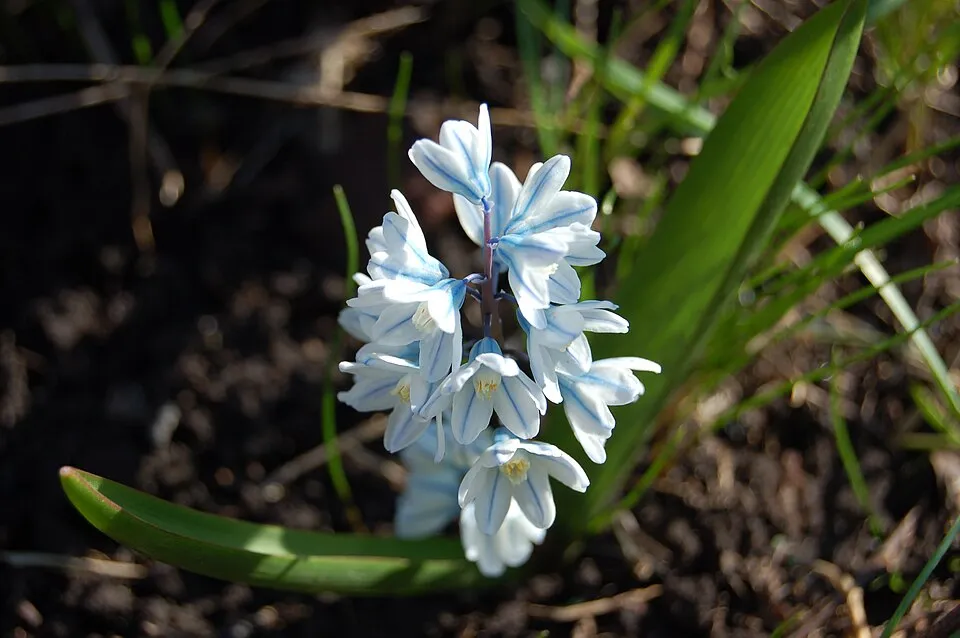
Puschkinia scilloides, commonly known as striped squill, Lebanon squill, or starch hyacinth, is an enchanting bulbous perennial belonging to the family Asparagaceae, though it has historically been classified under Liliaceae and Hyacinthaceae. This resilient plant is indigenous to the rugged, mountainous terrains of the Caucasus region and northeastern Turkey, where it often thrives near snow lines in alpine meadows. Typically reaching a modest height of 10-15 cm, Puschkinia scilloides forms a basal rosette of 2-3 linear, glossy green leaves that emerge in late winter or early spring, signaling the nascent growing season.
Its floral display is a true spectacle: a short, dense raceme supports 5-10 star-shaped flowers, each exhibiting a delicate pale blue to white hue, strikingly adorned with a darker blue stripe running down the center of each tepal (petal-like segment). A distinguishing characteristic is the small, crown-like corona at the throat of each flower, intricately formed by fused staminodes. The bulbs are ovoid and readily produce offsets, enabling the plant to naturalize effectively in suitable environments.
As an early spring bloomer, Puschkinia scilloides often pushes through residual snow, making it a cherished harbinger of warmer weather. Its compact size and early flowering habit render it an ideal choice for rock gardens, border edgings, and naturalized plantings, providing a burst of color when few other plants are in bloom. The genus name honors Russian botanist Apollos Mussin-Puschkin, while 'scilloides' refers to its resemblance to the genus Scilla.
Trusted Scientific References
1. Authoritative external sources for Puschkinia Scilloides
1.1 Wikipedia — Puschkinia Scilloides
1.2 Kew POWO (Plants of the World Online)
1.3 PubMed — peer-reviewed research
1.4 NCBI Taxonomy Browser
1.5 GBIF — Global Biodiversity
1.6Puschkinia Scilloides should be interpreted through verified botanical identity, practical care, and responsible safety language. This recovery note adds the missing context needed for a complete profile: match light to the plant's habit, use well-drained soil, water according to season, and avoid unsupported medicinal or edible claims. For publishing, the plant can be presented as a source-backed garden plant with clear care guidance, common problem diagnosis, and conservative safety wording.
1.1.Puschkinia Scilloides — Key Features
- ✓ <strong>Common Name</strong> — Striped Squill, Lebanon Squill, Starch Hyacinth.
- ✓ <strong>Scientific Name</strong> — Puschkinia scilloides.
- ✓ <strong>Family</strong> — Asparagaceae (formerly Liliaceae/Hyacinthaceae).
- ✓ <strong>Native Region</strong> — Caucasus and northeastern Turkey.
- ✓ <strong>Flower Color</strong> — Pale blue to white with darker blue stripes.
- ✓ <strong>Bloom Time</strong> — Early spring, often through snow.
- ✓ <strong>Plant Height</strong> — 10-15 cm (4-6 inches).
- ✓ <strong>Growth Habit</strong> — Clumping, naturalizes readily via offsets and self-seeding.
- ✓ <strong>Distinctive Feature</strong> — Crown-like corona at flower throat.
- ✓ <strong>Bulb Type</strong> — Ovoid perennial bulb.
1.2.Puschkinia Scilloides — Quick Summary
- ✓ Early spring bloomer with star-shaped blue/white striped flowers.
- ✓ Native to Caucasus and Turkey, thrives in well-drained soil.
- ✓ Ornamental plant, excellent for naturalizing and rock gardens.
- ✓ Contains potential antioxidants, anti-inflammatories, and saponins.
- ✓ All parts, especially bulbs, are considered toxic if ingested.
- ✓ No established traditional medicinal uses; primarily horticultural interest.
2.Puschkinia Scilloides — Scientific Identity
3.Puschkinia Scilloides — Quick Facts
4.Puschkinia Scilloides — Appearance & Identification
5.Puschkinia Scilloides — Native Habitat
6.Puschkinia Scilloides — Water Requirements
- ✓ Planting Bulbs — Plant Puschkinia scilloides bulbs 2-3 inches deep and 3 inches apart in fall for spring blooms.
- ✓ Soil Requirements — Thrives in moist, well-drained, fertile soils rich in organic matter.
- ✓ Light Conditions — Prefers full sun to partial shade, especially in warmer climates to protect from intense afternoon sun.
- ✓ Watering Schedule — Keep consistently moist during the active growing season; tolerates summer drought once dormant.
- ✓ Fertilization — Apply a balanced, slow-release fertilizer in early spring as foliage emerges, if soil fertility is low.
- ✓ Naturalization — Readily naturalizes by self-seeding and bulb offsets, creating charming drifts over time.
- ✓ Post-Bloom Care — Allow foliage to yellow and die back naturally after flowering to replenish bulb energy; do not mow or remove prematurely.
- ✓ Pest and Disease Resistance — Generally resistant to major pests and diseases, making it a low-maintenance plant.
Reviewed by the Flora Medical Global Botanical Review Panel
Multi-disciplinary editorial group · Botany · Ethnobotany · Herbal-medicine literature
Who reviewed this: This page was checked by the Flora Medical Global Botanical Review Panel — an in-house editorial group of botany graduates, ethnobotany researchers, and horticulture practitioners who collectively maintain our 7,000+ plant encyclopedia. Meet the team.
Our 4-step verification process
1. Taxonomic verification
Scientific names and synonyms cross-checked against Kew POWO, World Flora Online, and The Plant List.
2. Phytochemical & medicinal cross-reference
Active compounds, traditional uses, and reported activities are cross-referenced with PubMed, USDA Dr. Duke's database, and peer-reviewed ethnobotanical literature.
3. Conservation & distribution check
Distribution, ecology, and conservation status confirmed against GBIF occurrence records and the IUCN Red List.
4. Editorial & safety review
Every entry passes an editorial pass for clarity, originality, and safety notices (toxicity, contraindications, dosage caveats) before publication.
Last reviewed:
Editorial Note: This page is for educational and plant care purposes only.
Written by: Flora Medical Global Editorial Team
Reviewed by: Flora Medical Global Botanical Review Panel
Last Updated: June 15, 2026







Puschkinia Scilloides — Comments & Community Reviews
Rate this plant