
Care Disclaimer: Plant care recommendations are general guidelines based on common growing conditions. Individual results may vary based on your local environment, climate, and care routine. If your plant is toxic, keep it away from children and pets, and consult a veterinarian if accidental ingestion occurs.
1.Queen Anne's Lace — Overview
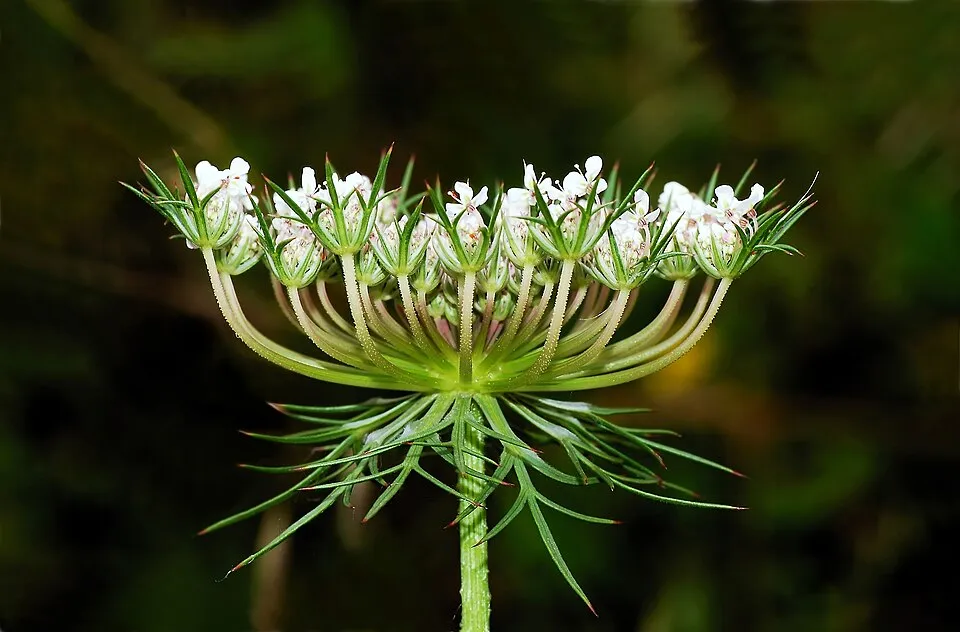
Queen Anne's Lace, scientifically known as Daucus carota, is a distinctive biennial herbaceous plant belonging to the Apiaceae family, renowned globally for its delicate appearance and as the wild progenitor of the cultivated carrot. Typically growing to heights of 60 to 120 cm, its upright habit is supported by a slender, grooved stem that is often covered with fine hairs. The foliage is characterized by its finely divided, pinnate leaves, which are fern-like and feature lobed leaflets up to 15 cm long, imparting an airy and intricate texture.
The plant's most striking feature is its inflorescence—a compound umbel composed of numerous tiny white or pale pink florets arranged in a flat-topped cluster, often reaching 15 cm in diameter. A singular, dark purple floret frequently adorns the center of the umbel, believed to mimic an insect to attract pollinators. Daucus carota develops a robust, yellowish taproot that delves deep into the soil, enabling its resilience in various environments.
This species thrives in disturbed areas, open meadows, and along roadsides, showing a preference for well-drained soils. Its naturalized distribution spans across Europe, Asia, and North America, where it has adapted to a wide range of temperate climates.
Trusted Scientific References
1. Authoritative external sources for Daucus carota
1.1 Wikipedia — Daucus carota
1.2 Kew POWO (Plants of the World Online)
1.3 PubMed — peer-reviewed research
1.4 NCBI Taxonomy Browser
1.5 GBIF — Global Biodiversity
1.6Queen Anne's Lace should be interpreted through verified botanical identity, practical care, and responsible safety language. This recovery note adds the missing context needed for a complete profile: match light to the plant's habit, use well-drained soil, water according to season, and avoid unsupported medicinal or edible claims. For publishing, the plant can be presented as a source-backed medicinal plant with clear care guidance, common problem diagnosis, and conservative safety wording.
1.1.Queen Anne's Lace — Key Features
- ✓ <strong>Biennial Growth Habit</strong> — Completes its life cycle in two years, flowering in the second.
- ✓ <strong>Compound Umbel Flowers</strong> — Distinctive flat-topped clusters of tiny white florets.
- ✓ <strong>Central Purple Florette</strong> — A unique dark spot in the flower head, aiding identification.
- ✓ <strong>Wild Carrot Ancestor</strong> — Genetically linked to the domesticated carrot.
- ✓ <strong>Deep Taproot System</strong> — Possesses a firm, yellowish taproot.
- ✓ <strong>Fern</strong> — like Pinnate Leaves — Finely divided, delicate foliage.
- ✓ <strong>Widespread Distribution</strong> — Naturalized across temperate regions globally.
- ✓ <strong>Medicinal & Edible Uses</strong> — Traditionally used for various ailments and as a wild edible.
- ✓ <strong>Apiaceae Family Member</strong> — Shares characteristics with other plants in the carrot family.
- ✓ <strong>Pollinator Attractor</strong> — Its flowers are a valuable nectar source for insects.
1.2.Queen Anne's Lace — Quick Summary
- ✓ Queen Anne's Lace (Daucus carota) is the wild ancestor of the cultivated carrot.
- ✓ Known for its delicate white lace-like flowers with a distinctive dark purple center.
- ✓ Traditionally valued for its diuretic, digestive, and antioxidant properties.
- ✓ Contains beneficial flavonoids, carotenoids, and essential oils.
- ✓ Caution is vital due to potential skin irritation and poisonous look-alikes.
- ✓ Used in herbal medicine for kidney support, digestive health, and immune modulation.
2.Queen Anne's Lace — Scientific Identity
3.Queen Anne's Lace — Quick Facts
4.Queen Anne's Lace — Appearance & Identification
5.Queen Anne's Lace — Native Habitat
6.Queen Anne's Lace — Water Requirements
- ✓ Seed Sowing — Sow Queen Anne's Lace seeds directly into well-drained soil in early spring or late fall; they generally require light for germination.
- ✓ Sunlight Requirements — Ensure the plant receives full sun exposure for at least 6-8 hours daily to promote robust growth and flowering.
- ✓ Soil Preference — It thrives in a variety of soil types, but prefers well-drained, moderately fertile soil with a neutral to slightly alkaline pH (6.0-7.5).
- ✓ Watering — Provide regular watering, especially during dry periods, to establish young plants, though mature plants are relatively drought-tolerant.
- ✓ Biennial Cycle — Understand its biennial nature; it forms a rosette of leaves in the first year and flowers, sets seed, then dies in the second year.
- ✓ Weed Management — Due to its prolific seeding and invasive potential in some regions, remove seed heads before they mature to prevent unwanted spread.
- ✓ Taproot Development — Allow ample space for its deep taproot to develop, which aids in nutrient uptake and drought resistance.
- ✓ Propagation — Primarily propagated by seed; division is not practical due to its taproot.
Reviewed by the Flora Medical Global Botanical Review Panel
Multi-disciplinary editorial group · Botany · Ethnobotany · Herbal-medicine literature
Who reviewed this: This page was checked by the Flora Medical Global Botanical Review Panel — an in-house editorial group of botany graduates, ethnobotany researchers, and horticulture practitioners who collectively maintain our 7,000+ plant encyclopedia. Meet the team.
Our 4-step verification process
1. Taxonomic verification
Scientific names and synonyms cross-checked against Kew POWO, World Flora Online, and The Plant List.
2. Phytochemical & medicinal cross-reference
Active compounds, traditional uses, and reported activities are cross-referenced with PubMed, USDA Dr. Duke's database, and peer-reviewed ethnobotanical literature.
3. Conservation & distribution check
Distribution, ecology, and conservation status confirmed against GBIF occurrence records and the IUCN Red List.
4. Editorial & safety review
Every entry passes an editorial pass for clarity, originality, and safety notices (toxicity, contraindications, dosage caveats) before publication.
Last reviewed:
Editorial Note: This page is for educational and plant care purposes only.
Written by: Flora Medical Global Editorial Team
Reviewed by: Flora Medical Global Botanical Review Panel
Last Updated: June 15, 2026







Queen Anne's Lace — Comments & Community Reviews
Rate this plant