
Care Disclaimer: Plant care recommendations are general guidelines based on common growing conditions. Individual results may vary based on your local environment, climate, and care routine. If your plant is toxic, keep it away from children and pets, and consult a veterinarian if accidental ingestion occurs.
1.Rodgersia Aesculifolia — Overview
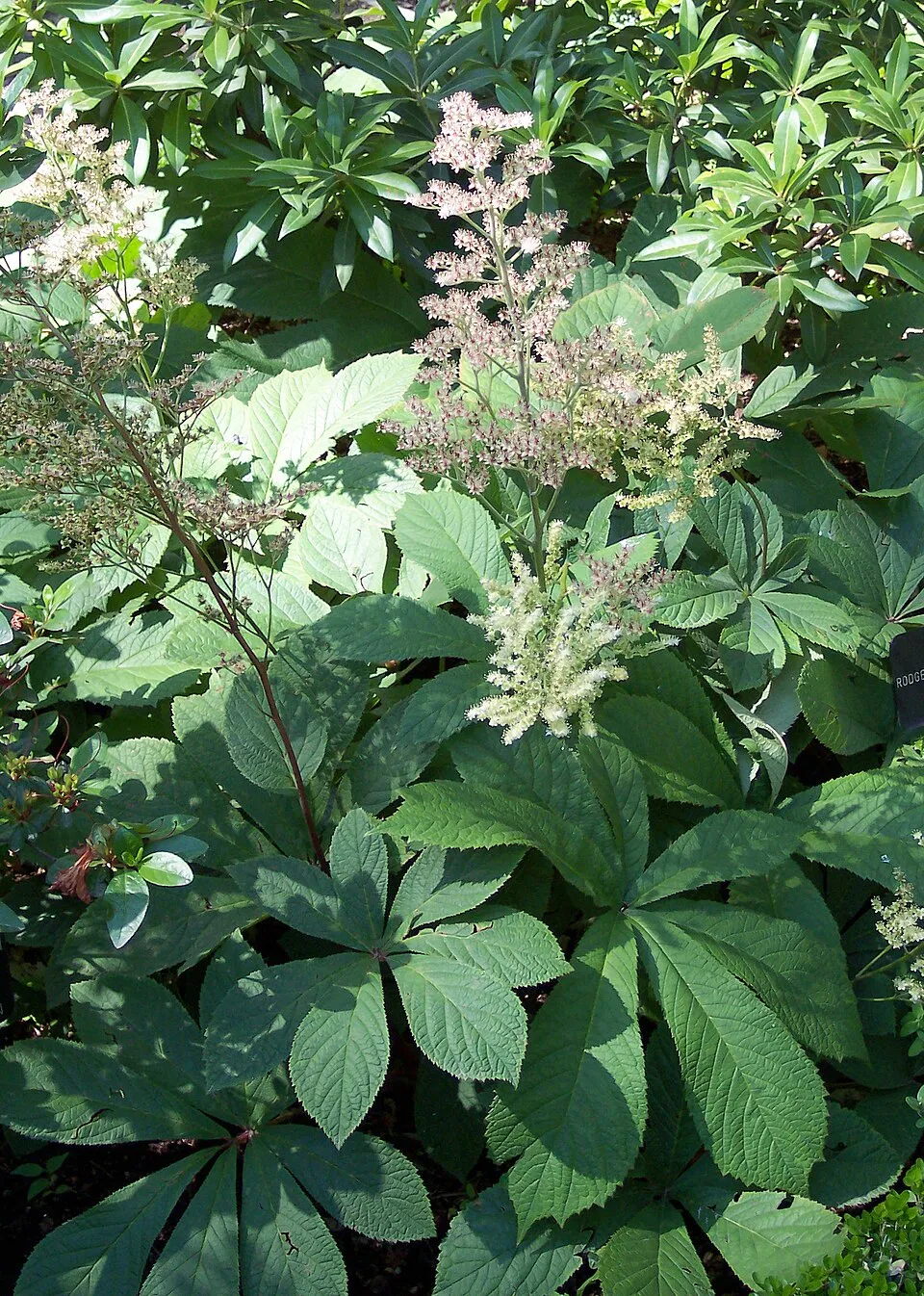
Rodgersia aesculifolia, commonly known as the horse-chestnut-leaved rodgersia, is a magnificent herbaceous perennial belonging to the Saxifragaceae family, a diverse group of flowering plants. This robust species is indigenous to the verdant, mountainous regions of central and western China, where it thrives in the cool, moist, and shaded understory of woodlands and along stream banks.
Its specific epithet, 'aesculifolia', directly references its striking resemblance to the leaves of the horse chestnut tree (Aesculus hippocastanum).
The plant is characterized by its exceptionally large, palmate leaves, which can span up to 60 cm across. Each leaf is typically composed of 5 to 7 ovate to obovate leaflets, deeply veined and featuring distinctly serrated margins.
The texture is somewhat leathery, contributing to its architectural presence in the landscape. These substantial leaves form a dense, lush clump, creating a dramatic groundcover.
From early to late summer, typically June through August, Rodgersia aesculifolia produces impressive, upright panicles of small, star-shaped flowers. These inflorescences emerge above the foliage on stout stems, often reaching heights of 1.0 to 1.5 meters. The individual flowers are usually creamy white to delicate pale pink, clustered tightly to form a plume-like display.
They emit a subtle, sweet fragrance, attracting a variety of pollinators, including bees and butterflies. The plant spreads slowly via stout, creeping rhizomes, gradually forming substantial, attractive colonies. Its grand foliage and elegant floral spikes make it a highly prized ornamental for shaded gardens, woodland settings, and boggy or waterside environments, provided its consistent moisture requirements are met.
It is considered relatively low-maintenance when established in suitable conditions, offering extended seasonal interest.
Trusted Scientific References
1. Authoritative external sources for Rodgersia Aesculifolia
1.1 Wikipedia — Rodgersia Aesculifolia
1.2 Kew POWO (Plants of the World Online)
1.3 PubMed — peer-reviewed research
1.4 NCBI Taxonomy Browser
1.5 GBIF — Global Biodiversity
1.1.Rodgersia Aesculifolia — Key Features
- ✓ <strong>Large, palmate leaves</strong> — Large, palmate leaves resembling horse chestnut foliage.
- ✓ <strong>Impressive, upright panicles</strong> — Impressive, upright panicles of creamy white to pale pink flowers.
- ✓ <strong>Native to the</strong> — Native to the mountainous regions of central and western China.
- ✓ <strong>Member of the</strong> — Member of the Saxifragaceae family.
- ✓ <strong>Prefers moist, shaded, humus</strong> — rich soil conditions.
- ✓ <strong>Spreads slowly via</strong> — Spreads slowly via stout rhizomes, forming substantial clumps.
- ✓ <strong>Traditional uses include digestive and anti</strong> — inflammatory support.
- ✓ <strong>Rich in beneficial</strong> — Rich in beneficial phytochemicals like flavonoids and tannins.
- ✓ <strong>Highly valued as</strong> — Highly valued as an architectural ornamental plant.
- ✓ <strong>Exhibits significant antioxidant</strong> — Exhibits significant antioxidant and astringent properties.
1.2.Rodgersia Aesculifolia — Quick Summary
- ✓ Rodgersia aesculifolia is a striking ornamental perennial from China.
- ✓ Traditionally used for digestive support and anti-inflammatory action.
- ✓ Rich in flavonoids, phenolic acids, and tannins with antioxidant properties.
- ✓ Thrives in moist, shaded environments, ideal for woodland gardens.
- ✓ Requires careful usage, especially concerning dosage and contraindications.
- ✓ Valued for its large, architectural foliage and elegant summer flower spikes.
2.Rodgersia Aesculifolia — Scientific Identity
3.Rodgersia Aesculifolia — Quick Facts
4.Rodgersia Aesculifolia — Appearance & Identification
5.Rodgersia Aesculifolia — Native Habitat
6.Rodgersia Aesculifolia — Water Requirements
- ✓ Site Selection — Thrives in partial to full shade, protecting its large leaves from scorching sun, especially in warmer climates.
- ✓ Soil Requirements — Prefers consistently moist, humus-rich, well-drained soil with a slightly acidic to neutral pH (6.0-7.0).
- ✓ Watering — Requires ample and consistent moisture; do not allow the soil to dry out, particularly during hot periods.
- ✓ Propagation — Best propagated by division of rhizomes in early spring or fall; seeds can also be sown but germination is slow and variable.
- ✓ Fertilization — Benefits from an annual application of balanced organic fertilizer or compost in spring to support vigorous growth.
- ✓ Pest and Disease Management — Generally pest-free; watch for slugs and snails, which can chew holes in the large leaves, and ensure good air circulation to prevent fungal issues.
- ✓ Hardiness Zones — Hardy in USDA Zones 4-9, tolerating cold winters with sufficient mulch protection in the colder range.
- ✓ Maintenance — Remove spent flower stalks after blooming for aesthetic reasons; minimal pruning is required beyond removing any damaged or yellowing foliage.
Reviewed by the Flora Medical Global Botanical Review Panel
Multi-disciplinary editorial group · Botany · Ethnobotany · Herbal-medicine literature
Who reviewed this: This page was checked by the Flora Medical Global Botanical Review Panel — an in-house editorial group of botany graduates, ethnobotany researchers, and horticulture practitioners who collectively maintain our 7,000+ plant encyclopedia. Meet the team.
Our 4-step verification process
1. Taxonomic verification
Scientific names and synonyms cross-checked against Kew POWO, World Flora Online, and The Plant List.
2. Phytochemical & medicinal cross-reference
Active compounds, traditional uses, and reported activities are cross-referenced with PubMed, USDA Dr. Duke's database, and peer-reviewed ethnobotanical literature.
3. Conservation & distribution check
Distribution, ecology, and conservation status confirmed against GBIF occurrence records and the IUCN Red List.
4. Editorial & safety review
Every entry passes an editorial pass for clarity, originality, and safety notices (toxicity, contraindications, dosage caveats) before publication.
Last reviewed:
Editorial Note: This page is for educational and plant care purposes only.
Written by: Flora Medical Global Editorial Team
Reviewed by: Flora Medical Global Botanical Review Panel
Last Updated: June 15, 2026







Rodgersia Aesculifolia — Comments & Community Reviews
Rate this plant