

Care Disclaimer: Plant care recommendations are general guidelines based on common growing conditions. Individual results may vary based on your local environment, climate, and care routine. If your plant is toxic, keep it away from children and pets, and consult a veterinarian if accidental ingestion occurs.
1.Rose of Sharon — Overview
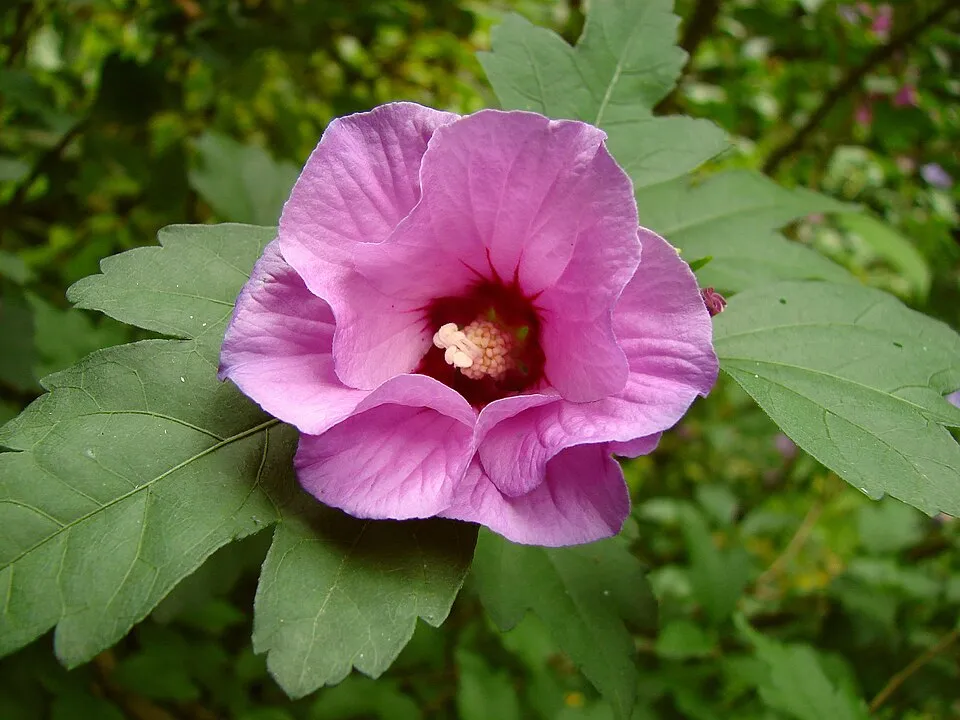
The Rose of Sharon, scientifically known as Hibiscus syriacus, is a highly adaptable and striking deciduous shrub or small tree belonging to the Malvaceae family. Native to East Asia, particularly China and Taiwan, this species has been widely cultivated globally for its ornamental value and is recognized as the national flower of South Korea. It typically forms an upright, vase-shaped silhouette, reaching heights of 2.4 to 3.6 meters (8 to 12 feet) with a similar spread.
Its dark green, ovate to rhombic leaves, measuring 2 to 4 inches, provide a lush backdrop for its most distinctive feature: the abundant, trumpet-shaped flowers. These vibrant blooms, 2 to 4 inches across, appear from midsummer well into autumn, showcasing an array of colors including white, pink, lavender, purple, and blue, often accented by a contrasting red or maroon eye. Flowers can be single or double-petaled, with the double forms resembling roses, inspiring its common name.
Historically, it has been found growing along valleys, open slopes, roadsides, and sea cliffs, demonstrating its robust nature. Hibiscus syriacus is remarkably tolerant of diverse soil types, from sandy to clay, and thrives in full sun to partial shade, though full sun promotes the most prolific flowering. Its resilience and extended blooming period make it a popular choice for hedges, screens, specimen plantings, and adding late-season color to landscapes.
Trusted Scientific References
1. Authoritative external sources for Hibiscus syriacus
1.1 Wikipedia — Hibiscus syriacus
1.2 Kew POWO (Plants of the World Online)
1.3 PubMed — peer-reviewed research
1.4 NCBI Taxonomy Browser
1.5 GBIF — Global Biodiversity
1.6Rose of Sharon should be interpreted through verified botanical identity, practical care, and responsible safety language. This recovery note adds the missing context needed for a complete profile: match light to the plant's habit, use well-drained soil, water according to season, and avoid unsupported medicinal or edible claims. For publishing, the plant can be presented as a source-backed garden plant with clear care guidance, common problem diagnosis, and conservative safety wording.
1.1.Rose of Sharon — Key Features
- ✓ <strong>Common Name</strong> — Rose of Sharon, Shrubby Althea.
- ✓ <strong>Scientific Name</strong> — Hibiscus syriacus L.
- ✓ <strong>Family</strong> — Malvaceae, known for its diverse and often medicinally active members.
- ✓ <strong>Origin</strong> — Native to East Asia, specifically China and Taiwan.
- ✓ <strong>Ornamental Value</strong> — Widely cultivated globally for its showy, abundant summer-to-autumn blooms.
- ✓ <strong>Medicinal Versatility</strong> — Utilized in traditional medicine systems for a broad spectrum of ailments, from digestive disorders to inflammatory conditions.
- ✓ <strong>Phytochemical Richness</strong> — Contains a variety of active compounds including flavonoids, triterpenoids, and unique naphthalenes like Syracusans A-C.
- ✓ <strong>Adaptability</strong> — Highly tolerant of various soil types and environmental conditions, thriving in full sun to partial shade.
- ✓ <strong>National Flower</strong> — Holds cultural significance as the national flower of South Korea.
- ✓ <strong>Growth Habit</strong> — Deciduous shrub or small tree, typically vase-shaped, reaching 8-12 feet in height.
1.2.Rose of Sharon — Quick Summary
- ✓ Rose of Sharon (Hibiscus syriacus) is a versatile East Asian shrub, cherished for both its ornamental beauty and extensive medicinal properties.
- ✓ Traditionally used in Ayurveda, TCM, and Unani for digestive issues, pain, respiratory ailments, and skin conditions.
- ✓ Rich in bioactive compounds like flavonoids, triterpenoids, and anthocyanins, providing antioxidant, anti-inflammatory, and neuroprotective benefits.
- ✓ Caution is advised for pregnant/lactating women, diabetics, and individuals on blood pressure medications due to potential interactions.
- ✓ Thrives in full sun and well-drained soil, making it a robust and adaptable plant for various climates.
2.Rose of Sharon — Scientific Identity
3.Rose of Sharon — Quick Facts
4.Rose of Sharon — Appearance & Identification
5.Rose of Sharon — Native Habitat
6.Rose of Sharon — Water Requirements
- ✓ Site Selection — Choose a location with full sun to partial shade for optimal flowering; ensure well-drained soil to prevent root rot.
- ✓ Soil Requirements — Adaptable to a wide range of soil types, from sandy to clay, but prefers a slightly acidic to neutral pH (6.0-7.0).
- ✓ Watering — Requires regular watering, especially during dry spells and in its establishment phase; mature plants are moderately drought-tolerant.
- ✓ Propagation — Can be propagated from seeds, which often self-sow, or more reliably from softwood cuttings taken in late spring or early summer.
- ✓ Pruning — Prune in late winter or early spring before new growth begins to maintain shape, remove dead wood, and encourage more prolific flowering.
- ✓ Fertilization — Benefits from a balanced, slow-release fertilizer in early spring, especially if soil nutrients are poor, to support vigorous growth and bloom.
- ✓ Pest and Disease Control — Generally robust, but can occasionally be affected by aphids, Japanese beetles, or leaf spots; proper air circulation helps prevent fungal issues.
Reviewed by the Flora Medical Global Botanical Review Panel
Multi-disciplinary editorial group · Botany · Ethnobotany · Herbal-medicine literature
Who reviewed this: This page was checked by the Flora Medical Global Botanical Review Panel — an in-house editorial group of botany graduates, ethnobotany researchers, and horticulture practitioners who collectively maintain our 7,000+ plant encyclopedia. Meet the team.
Our 4-step verification process
1. Taxonomic verification
Scientific names and synonyms cross-checked against Kew POWO, World Flora Online, and The Plant List.
2. Phytochemical & medicinal cross-reference
Active compounds, traditional uses, and reported activities are cross-referenced with PubMed, USDA Dr. Duke's database, and peer-reviewed ethnobotanical literature.
3. Conservation & distribution check
Distribution, ecology, and conservation status confirmed against GBIF occurrence records and the IUCN Red List.
4. Editorial & safety review
Every entry passes an editorial pass for clarity, originality, and safety notices (toxicity, contraindications, dosage caveats) before publication.
Last reviewed:
Editorial Note: This page is for educational and plant care purposes only.
Written by: Flora Medical Global Editorial Team
Reviewed by: Flora Medical Global Botanical Review Panel
Last Updated: June 15, 2026







Rose of Sharon — Comments & Community Reviews
Rate this plant