
Care Disclaimer: Plant care recommendations are general guidelines based on common growing conditions. Individual results may vary based on your local environment, climate, and care routine. If your plant is toxic, keep it away from children and pets, and consult a veterinarian if accidental ingestion occurs.
1.Rosemary — Overview
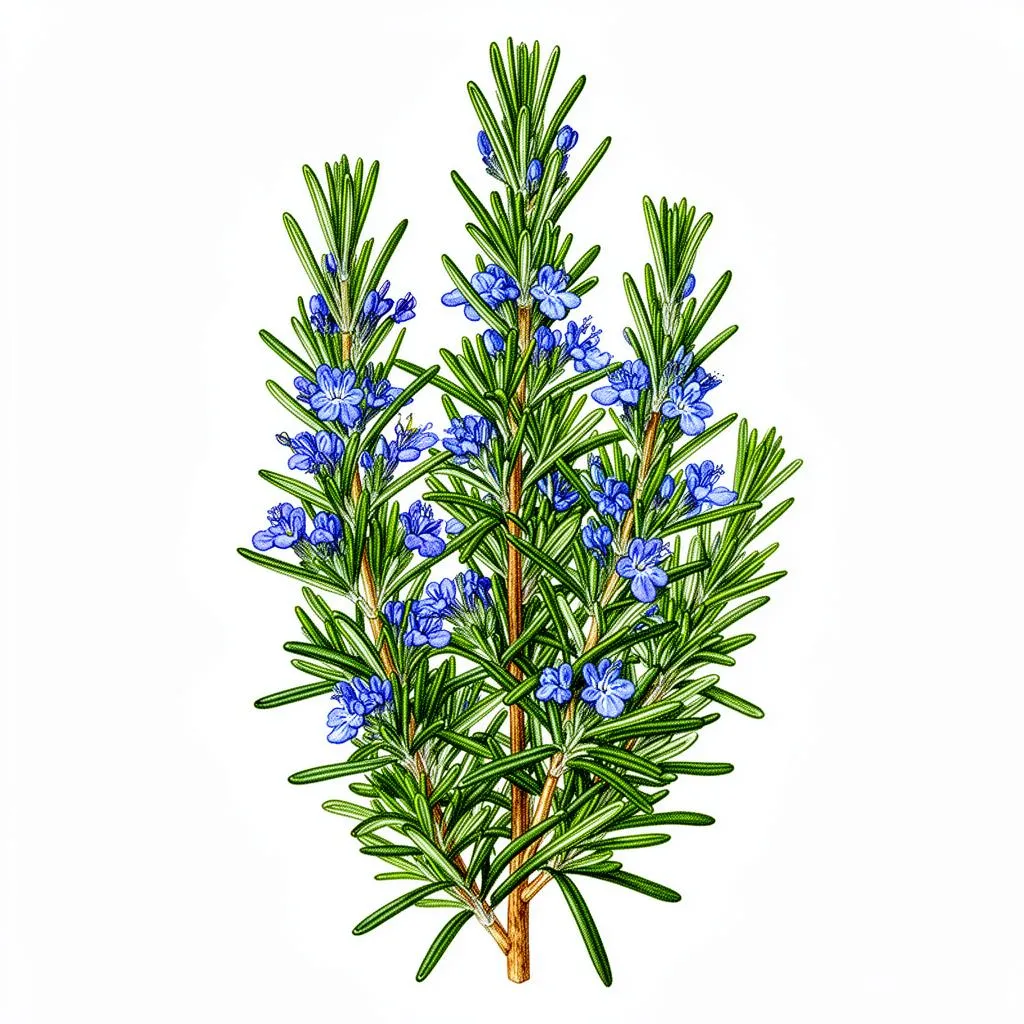
Rosemary, scientifically known as Rosmarinus officinalis L., is an iconic evergreen shrub deeply rooted in the botanical heritage of the Mediterranean basin. Its common name, 'dew of the sea,' beautifully encapsulates its preferred habitat along sun-drenched coastal cliffs. This robust member of the Lamiaceae (mint) family typically achieves a height of 1 to 2 meters, developing into a dense, woody shrub. A hallmark of Rosmarinus officinalis is its distinctive aromatic, needle-like leaves, which are linear and sessile, measuring approximately 2-4 cm in length and 2-5 mm in width. The adaxial (upper) surface is a dark, glossy green, while the abaxial (lower) surface presents a silvery-white hue due to a dense covering of stellate and glandular trichomes.
These trichomes, along with the revolute (rolled) leaf margins, are crucial adaptations for minimizing water loss, allowing the plant to thrive in arid conditions. Its square, woody stems branch profusely from the base, bearing small, bilabiate flowers in delicate axillary racemes. These blossoms range from pale blue to lavender, occasionally white or pink, and are highly attractive to pollinators. The plant establishes a strong, fibrous root system capable of anchoring it in rocky, often nutrient-poor soils. While historically recognized globally as Rosmarinus officinalis, recent phylogenetic research has reclassified it within the genus Salvia, leading to the name Salvia rosmarinus.
Despite this taxonomic update, the traditional and widely understood botanical name Rosmarinus officinalis L. remains prevalent in various sectors, from horticulture to medical herbalism. Its natural range spans from Portugal to Turkey, and it is cultivated extensively worldwide for its ornamental, culinary, and profound medicinal properties.
Trusted Scientific References
1. Authoritative external sources for Rosmarinus officinalis L.
1.1 Wikipedia — Rosmarinus officinalis L.
1.2 Kew POWO (Plants of the World Online)
1.3 PubMed — peer-reviewed research
1.4 NCBI Taxonomy Browser
1.5 GBIF — Global Biodiversity
1.1.Rosemary — Key Features
- ✓ <strong>Evergreen aromatic shrub</strong> — Evergreen aromatic shrub native to the Mediterranean.
- ✓ <strong>Distinctive needle</strong> — like, silvery-green leaves.
- ✓ <strong>Produces small blue,</strong> — Produces small blue, pink, or white bilabiate flowers.
- ✓ <strong>Strong, pungent, camphorous</strong> — Strong, pungent, camphorous fragrance.
- ✓ <strong>Rich in volatile</strong> — Rich in volatile essential oils and phenolic compounds.
- ✓ <strong>Renowned for its</strong> — Renowned for its culinary, ornamental, and medicinal uses.
- ✓ <strong>Drought</strong> — tolerant and prefers full sun.
- ✓ <strong>Historically associated with</strong> — Historically associated with memory and remembrance.
- ✓ <strong>Part of the</strong> — Part of the mint family (Lamiaceae).
1.2.Rosemary — Quick Summary
- ✓ Rosemary is a Mediterranean evergreen shrub known for its pungent aroma and medicinal properties.
- ✓ Rich in antioxidants, anti-inflammatory, and antimicrobial compounds.
- ✓ Traditionally used for cognitive enhancement, digestion, and pain relief.
- ✓ Key constituents include rosmarinic acid, carnosic acid, and 1,8-cineole.
- ✓ Widely cultivated as a culinary, ornamental, and medicinal herb.
- ✓ Caution advised for pregnant individuals, those with epilepsy, or on blood thinners.
2.Rosemary — Scientific Identity
3.Rosemary — Quick Facts
4.Rosemary — Appearance & Identification
5.Rosemary — Native Habitat
6.Rosemary — Water Requirements
- ✓ Climate — Thrives in warm, sunny Mediterranean climates with mild winters; intolerant of heavy frost.
- ✓ Soil — Prefers well-drained, sandy-loam to rocky soil with a pH of 6.0-7.0; dislikes wet feet.
- ✓ Sunlight — Requires full sun exposure, at least 6-8 hours daily, for optimal growth and essential oil production.
- ✓ Watering — Drought-tolerant once established; water moderately, allowing soil to dry out between waterings.
- ✓ Propagation — Easily propagated from semi-hardwood cuttings taken in spring or summer; can also be grown from seed, though germination may be slow.
- ✓ Pruning — Prune after flowering to maintain shape, promote bushiness, and prevent woodiness; avoid heavy pruning into old wood.
- ✓ Pests/Diseases — Generally robust, but can be susceptible to powdery mildew in humid conditions or root rot in waterlogged soil; occasional aphids or whiteflies.
Reviewed by the Flora Medical Global Botanical Review Panel
Multi-disciplinary editorial group · Botany · Ethnobotany · Herbal-medicine literature
Who reviewed this: This page was checked by the Flora Medical Global Botanical Review Panel — an in-house editorial group of botany graduates, ethnobotany researchers, and horticulture practitioners who collectively maintain our 7,000+ plant encyclopedia. Meet the team.
Our 4-step verification process
1. Taxonomic verification
Scientific names and synonyms cross-checked against Kew POWO, World Flora Online, and The Plant List.
2. Phytochemical & medicinal cross-reference
Active compounds, traditional uses, and reported activities are cross-referenced with PubMed, USDA Dr. Duke's database, and peer-reviewed ethnobotanical literature.
3. Conservation & distribution check
Distribution, ecology, and conservation status confirmed against GBIF occurrence records and the IUCN Red List.
4. Editorial & safety review
Every entry passes an editorial pass for clarity, originality, and safety notices (toxicity, contraindications, dosage caveats) before publication.
Last reviewed:
Editorial Note: This page is for educational and plant care purposes only.
Written by: Flora Medical Global Editorial Team
Reviewed by: Flora Medical Global Botanical Review Panel
Last Updated: June 15, 2026







Rosemary — Comments & Community Reviews
Rate this plant