


Care Disclaimer: Plant care recommendations are general guidelines based on common growing conditions. Individual results may vary based on your local environment, climate, and care routine. If your plant is toxic, keep it away from children and pets, and consult a veterinarian if accidental ingestion occurs.
1.Sagittaria Latifolia — Overview
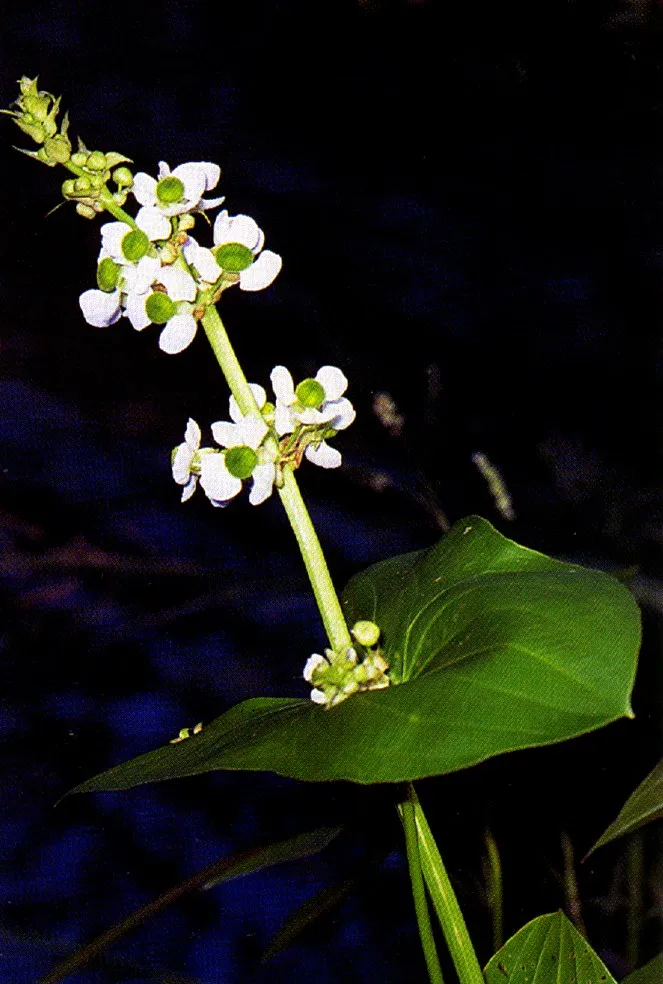
Sagittaria latifolia, commonly known as broadleaf arrowhead or duck potato, is an intriguing aquatic perennial belonging to the Alismataceae family. Native across a vast expanse of North and Central America, extending into the Caribbean, this plant is a distinctive inhabitant of shallow waters, marshes, and the muddy banks of ponds and streams. Its most recognizable feature is its large, vibrant green, arrow-shaped leaves that can emerge either submerged or above the water surface, lending the plant its 'arrowhead' moniker.
During the summer months, Sagittaria latifolia produces delicate white flowers, typically arranged in whorls of three petals on tall, erect stalks, creating a striking visual contrast against the wetland backdrop. The plant's most significant characteristic, from both ecological and historical perspectives, lies beneath the water: its starchy, potato-like tubers. These corms, formed at the ends of rhizomes, have historically served as a crucial food source for numerous indigenous peoples throughout its range, as well as providing sustenance for various wildlife, particularly waterfowl, hence the name 'duck potato'.
This adaptable species can form dense colonies, playing an important role in wetland ecosystems.
Trusted Scientific References
1. Authoritative external sources for Sagittaria Latifolia
1.1 Wikipedia — Sagittaria Latifolia
1.2 Kew POWO (Plants of the World Online)
1.3 PubMed — peer-reviewed research
1.4 NCBI Taxonomy Browser
1.5 GBIF — Global Biodiversity
1.6Sagittaria Latifolia should be interpreted through verified botanical identity, practical care, and responsible safety language. This recovery note adds the missing context needed for a complete profile: match light to the plant's habit, use well-drained soil, water according to season, and avoid unsupported medicinal or edible claims. For publishing, the plant can be presented as a source-backed garden plant with clear care guidance, common problem diagnosis, and conservative safety wording.
1.1.Sagittaria Latifolia — Key Features
- ✓ <strong>Distinctive arrow</strong> — shaped leaves emerging from water.
- ✓ <strong>Produces small, delicate</strong> — Produces small, delicate white flowers with three petals.
- ✓ <strong>Forms edible, starchy</strong> — Forms edible, starchy tubers (duck potato) underground.
- ✓ <strong>Native to North</strong> — Native to North and Central America, including the Caribbean.
- ✓ <strong>Adaptable aquatic perennial</strong> — Adaptable aquatic perennial thriving in shallow water and wetlands.
- ✓ <strong>Historically a vital</strong> — Historically a vital food source for indigenous populations and wildlife.
- ✓ <strong>Traditional applications for</strong> — Traditional applications for skin ailments and digestive support.
- ✓ <strong>Hardy and resilient,</strong> — Hardy and resilient, tolerating cold temperate to tropical zones.
- ✓ <strong>Plays an ecological</strong> — Plays an ecological role in wetland habitats.
- ✓ <strong>Easily propagated from</strong> — Easily propagated from tubers or rhizomes.
1.2.Sagittaria Latifolia — Quick Summary
- ✓ Native North American aquatic perennial known as broadleaf arrowhead or duck potato.
- ✓ Features distinctive arrow-shaped leaves and edible, starchy tubers.
- ✓ Historically a significant food source and traditional medicine for indigenous peoples.
- ✓ Traditional uses include poultices for skin issues and decoctions for digestive complaints.
- ✓ Modern scientific validation for medicinal claims is limited, primarily recognized for its nutritional value.
- ✓ Thrives in shallow water and wet soils, easily cultivated in appropriate environments.
2.Sagittaria Latifolia — Scientific Identity
3.Sagittaria Latifolia — Quick Facts
4.Sagittaria Latifolia — Appearance & Identification
5.Sagittaria Latifolia — Native Habitat
6.Sagittaria Latifolia — Water Requirements
- ✓ Site Selection — Requires a moist or wet loamy soil, ideal for pond margins, bog gardens, or shallow water features.
- ✓ Water Depth — Prefers shallow, still, or slowly flowing water up to 12 cm deep for optimal growth.
- ✓ Light Requirements — Thrives in full sun to partial shade, adapting well to various light conditions.
- ✓ Propagation — Can be propagated from seeds, which benefit from cold stratification, or more commonly from rhizomes or tubers.
- ✓ Planting — Plant tubers about 5-10 cm (2-4 inches) deep in muddy soil or heavy substrate during spring.
- ✓ Hardiness — This adaptable perennial is hardy to at least -20°C, suitable for a wide range of temperate zones.
- ✓ Maintenance — Generally low maintenance, though can spread vigorously in ideal conditions, forming large colonies.
- ✓ Soil Type — Prefers rich, organic, mucky soils typical of wetland environments to support tuber development.
Reviewed by the Flora Medical Global Botanical Review Panel
Multi-disciplinary editorial group · Botany · Ethnobotany · Herbal-medicine literature
Who reviewed this: This page was checked by the Flora Medical Global Botanical Review Panel — an in-house editorial group of botany graduates, ethnobotany researchers, and horticulture practitioners who collectively maintain our 7,000+ plant encyclopedia. Meet the team.
Our 4-step verification process
1. Taxonomic verification
Scientific names and synonyms cross-checked against Kew POWO, World Flora Online, and The Plant List.
2. Phytochemical & medicinal cross-reference
Active compounds, traditional uses, and reported activities are cross-referenced with PubMed, USDA Dr. Duke's database, and peer-reviewed ethnobotanical literature.
3. Conservation & distribution check
Distribution, ecology, and conservation status confirmed against GBIF occurrence records and the IUCN Red List.
4. Editorial & safety review
Every entry passes an editorial pass for clarity, originality, and safety notices (toxicity, contraindications, dosage caveats) before publication.
Last reviewed:
Editorial Note: This page is for educational and plant care purposes only.
Written by: Flora Medical Global Editorial Team
Reviewed by: Flora Medical Global Botanical Review Panel
Last Updated: June 15, 2026







Sagittaria Latifolia — Comments & Community Reviews
Rate this plant