

Care Disclaimer: Plant care recommendations are general guidelines based on common growing conditions. Individual results may vary based on your local environment, climate, and care routine. If your plant is toxic, keep it away from children and pets, and consult a veterinarian if accidental ingestion occurs.
1.Sempervivum Garden — Overview
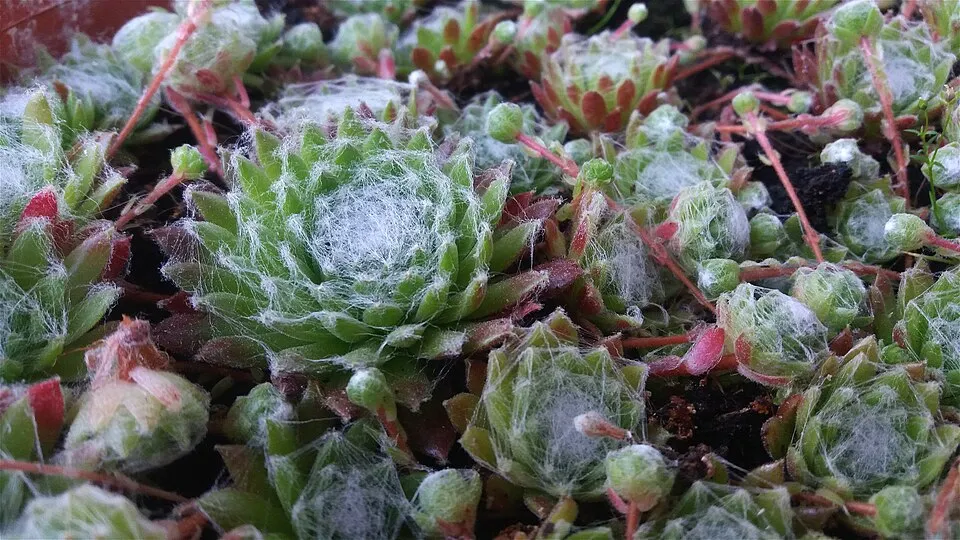
Sempervivum arachnoideum, widely recognized as Cobweb Houseleek or Spiderweb Hens and Chicks, is a distinctive succulent perennial belonging to the Crassulaceae family. This captivating species is indigenous to the rugged mountainous terrains of Europe, particularly thriving across the Alps, Pyrenees, and Carpathians, where it naturally colonizes rocky, exposed environments. Its defining feature is the intricate network of fine, silvery-white hairs that interconnect the tips of its fleshy, pointed leaves, forming a protective 'cobweb' across the rosette's surface. This unique adaptation serves a critical physiological role, shielding the plant from intense solar radiation and extreme temperature fluctuations, thereby significantly minimizing transpirational water loss in its arid habitats.
Individual rosettes typically achieve a diameter of 2-4 inches (5-10 cm) and proliferate by producing numerous offsets, or 'chicks,' which cluster around the mother plant, hence its charming common name. The leaves exhibit a vibrant green hue, often acquiring attractive red or purple tinges when subjected to cooler temperatures or direct sunlight. Mature rosettes may produce a tall, erect flowering stalk, reaching 6-10 inches (15-25 cm) in height, adorned with clusters of star-shaped, pinkish-red flowers during the summer. Post-flowering, the mother rosette senesces and dies, but the abundant offsets ensure the plant's continuous survival and spread.
Its remarkable resilience, unique aesthetic, and ease of cultivation make Cobweb Houseleek a favored choice for rock gardens, container plantings, green roofs, and xeriscaping, contributing texture and year-round visual interest. The genus name 'Sempervivum,' meaning 'always living,' aptly describes its extraordinary ability to withstand harsh environmental conditions, including severe drought and cold.
Trusted Scientific References
1. Authoritative external sources for Sempervivum arachnoideum
1.1 Wikipedia — Sempervivum arachnoideum
1.2 Kew POWO (Plants of the World Online)
1.3 PubMed — peer-reviewed research
1.4 NCBI Taxonomy Browser
1.5 GBIF — Global Biodiversity
1.1.Sempervivum Garden — Key Features
- ✓ <strong>Botanical Name</strong> — Sempervivum arachnoideum.
- ✓ <strong>Common Names</strong> — Cobweb Houseleek, Spiderweb Hens and Chicks.
- ✓ <strong>Family</strong> — Crassulaceae, known for succulent adaptations.
- ✓ <strong>Morphology</strong> — Unique rosettes of fleshy leaves interwoven with silvery 'cobweb' hairs.
- ✓ <strong>Habitat</strong> — Native to mountainous, rocky regions of Europe, thriving in harsh conditions.
- ✓ <strong>Medicinal Use</strong> — Traditionally used topically for wound healing, anti-inflammatory, and skin soothing properties.
- ✓ <strong>Key Constituents</strong> — Rich in mucilage, tannins, flavonoids, and organic acids.
- ✓ <strong>Cultivation</strong> — Low-maintenance, drought-tolerant, and cold-hardy, ideal for rock gardens and xeriscaping.
- ✓ <strong>Propagation</strong> — Easily propagates through abundant offsets (chicks) and seeds.
- ✓ <strong>Safety</strong> — Primarily for external use; patch testing recommended for sensitive skin.
1.2.Sempervivum Garden — Quick Summary
- ✓ Cobweb Houseleek is a distinctive succulent known for its unique web-like rosettes and resilience.
- ✓ It boasts a rich history of traditional use for its anti-inflammatory, astringent, and wound-healing properties.
- ✓ Primarily applied topically to soothe skin irritations, minor burns, cuts, and to address conditions like warts.
- ✓ Its therapeutic effects are attributed to key constituents such as mucilage, tannins, and flavonoids.
- ✓ This hardy plant thrives in well-drained, sunny, rocky environments, requiring minimal maintenance.
- ✓ Strictly recommended for external application only, with a cautionary note for sensitive skin.
2.Sempervivum Garden — Scientific Identity
3.Sempervivum Garden — Quick Facts
4.Sempervivum Garden — Appearance & Identification
5.Sempervivum Garden — Native Habitat
6.Sempervivum Garden — Water Requirements
- ✓ Soil Requirements — Thrives in extremely well-drained, gritty, or sandy soils, ideally with some humus; avoid heavy, water-retentive clays to prevent root rot.
- ✓ Light Exposure — Prefers full sun exposure to develop vibrant leaf coloration and compact growth; can tolerate partial shade, especially in very hot climates, but may become leggy.
- ✓ Watering — Highly drought-tolerant once established; water sparingly and allow the soil to dry completely between waterings, particularly crucial during winter dormancy to prevent rot.
- ✓ Temperature & Hardiness — Extremely cold-hardy, capable of enduring freezing temperatures; however, prolonged winter wetness is detrimental and should be avoided.
- ✓ Propagation — Easily propagated by separating offsets ('chicks') in spring or early summer; can also be grown from seed (surface-sown in early spring) or stem cuttings.
- ✓ Planting Location — Ideal for rock gardens, green roofs, xeriscaping, containers, and crevices in walls where excellent drainage is naturally provided.
- ✓ Weed Control — Sensitive to competition; maintain a weed-free environment around the rosettes to ensure unimpeded growth and health.
- ✓ Fertilization — Generally requires no fertilization; if grown in very poor soil, a light application of a balanced, slow-release granular fertilizer in spring may be beneficial.
Reviewed by the Flora Medical Global Botanical Review Panel
Multi-disciplinary editorial group · Botany · Ethnobotany · Herbal-medicine literature
Who reviewed this: This page was checked by the Flora Medical Global Botanical Review Panel — an in-house editorial group of botany graduates, ethnobotany researchers, and horticulture practitioners who collectively maintain our 7,000+ plant encyclopedia. Meet the team.
Our 4-step verification process
1. Taxonomic verification
Scientific names and synonyms cross-checked against Kew POWO, World Flora Online, and The Plant List.
2. Phytochemical & medicinal cross-reference
Active compounds, traditional uses, and reported activities are cross-referenced with PubMed, USDA Dr. Duke's database, and peer-reviewed ethnobotanical literature.
3. Conservation & distribution check
Distribution, ecology, and conservation status confirmed against GBIF occurrence records and the IUCN Red List.
4. Editorial & safety review
Every entry passes an editorial pass for clarity, originality, and safety notices (toxicity, contraindications, dosage caveats) before publication.
Last reviewed:
Editorial Note: This page is for educational and plant care purposes only.
Written by: Flora Medical Global Editorial Team
Reviewed by: Flora Medical Global Botanical Review Panel
Last Updated: June 15, 2026







Sempervivum Garden — Comments & Community Reviews
Rate this plant