

Care Disclaimer: Plant care recommendations are general guidelines based on common growing conditions. Individual results may vary based on your local environment, climate, and care routine. If your plant is toxic, keep it away from children and pets, and consult a veterinarian if accidental ingestion occurs.
1.Sempervivum Arachnoideum — Overview
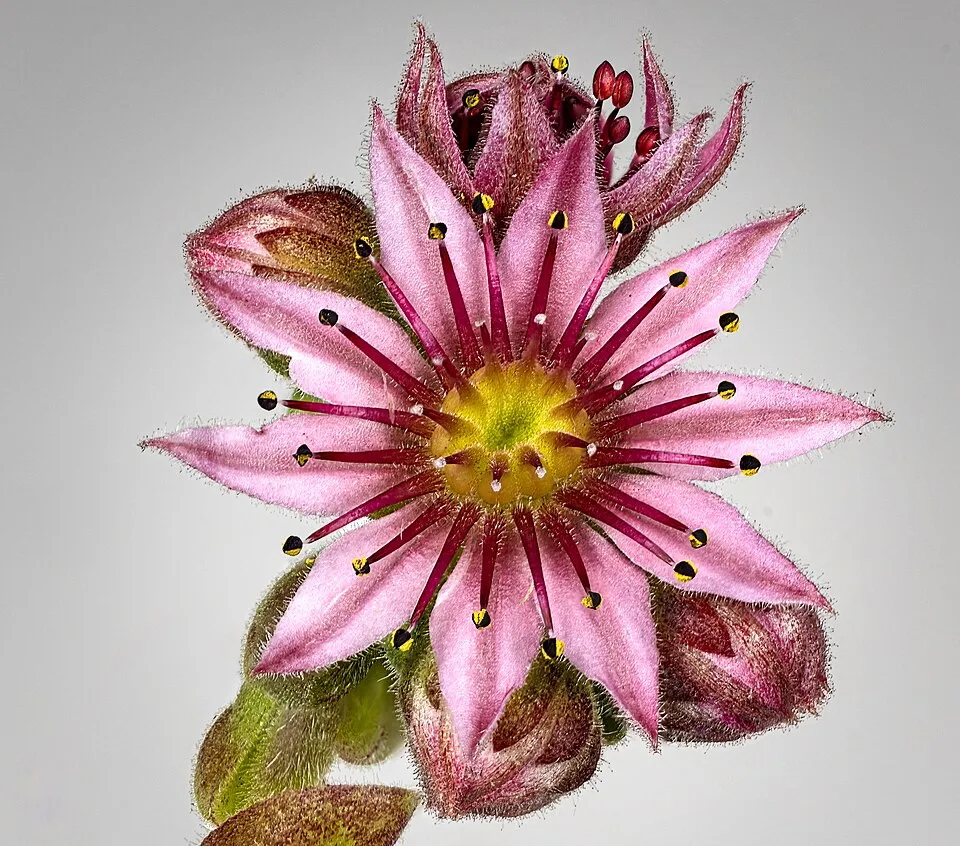
Sempervivum arachnoideum, commonly known as Cobweb Houseleek, is a captivating and remarkably resilient succulent perennial thriving in the challenging environments of southern and central European mountain ranges, including the Alps, Pyrenees, and Carpathians. A member of the Crassulaceae family, it forms compact rosettes, typically 1 to 5 cm in diameter, which aggregate into dense mats. Its most striking morphological feature is the intricate, silvery, web-like indumentum of fine hairs that interconnect the tips of its numerous, tightly packed leaves.
This distinctive 'cobweb' acts as a crucial adaptation, trapping atmospheric moisture from dew and significantly reducing water loss under harsh alpine conditions characterized by strong winds and intense solar radiation, thus enhancing its drought tolerance. The leaves themselves are fleshy, obovate to spatulate, often displaying a gradient of colors from reddish-green to purplish or bronze, especially when exposed to cold or high sun intensity, and feature ciliate margins.
Each individual rosette of Cobweb Houseleek exhibits a monocarpic life cycle, meaning it flowers only once before senescing, typically after several years of vegetative growth. However, the plant ensures its perpetuation by producing numerous small offsets, or 'chicks,' around the base of the mother rosette prior to flowering. In summer, an upright, leafy stalk emerges, reaching heights of 10-20 cm, bearing star-shaped flowers arranged in cymes.
These flowers are typically pink to reddish-purple, sometimes white, with sharply pointed petals and often contrasting yellow stamens. Interestingly, the flowering stalk often loses the characteristic 'cobweb' covering. Sempervivum arachnoideum prefers well-drained, gritty soils, often found nestled amongst rocks and stones, and shows adaptability to both siliceous and calcareous substrates, though it particularly dislikes winter wet conditions.
This species is known for its polymorphism, with some botanists recognizing various subspecies, and it readily hybridizes with other members of the Sempervivum genus.
Trusted Scientific References
1. Authoritative external sources for Sempervivum Arachnoideum
1.1 Wikipedia — Sempervivum Arachnoideum
1.2 Kew POWO (Plants of the World Online)
1.3 PubMed — peer-reviewed research
1.4 NCBI Taxonomy Browser
1.5 GBIF — Global Biodiversity
1.1.Sempervivum Arachnoideum — Key Features
- ✓ <strong>Distinctive web</strong> — like hairs covering rosettes.
- ✓ <strong>Succulent perennial forming</strong> — Succulent perennial forming dense mats.
- ✓ <strong>Native to European</strong> — Native to European mountainous regions.
- ✓ <strong>Monocarpic rosettes producing</strong> — Monocarpic rosettes producing numerous offsets.
- ✓ <strong>Pink to reddish</strong> — purple star-shaped flowers.
- ✓ <strong>Highly drought</strong> — tolerant and resilient.
- ✓ <strong>Traditionally used for</strong> — Traditionally used for skin ailments and pain relief.
- ✓ <strong>Rich in astringent</strong> — Rich in astringent tannins and soothing mucilage.
- ✓ <strong>Prefers full sun and well</strong> — drained, gritty soil.
- ✓ <strong>Adapts to various</strong> — Adapts to various soil pH, disliking winter wet.
1.2.Sempervivum Arachnoideum — Quick Summary
- ✓ Cobweb Houseleek is a resilient succulent native to European mountains, known for its distinctive web-like hairs.
- ✓ Traditionally used for its soothing, astringent, and anti-inflammatory properties, primarily for topical applications.
- ✓ Key medicinal uses include wound healing, treating boils, alleviating toothaches, and soothing skin irritations.
- ✓ Rich in flavonoids, tannins, and mucilage, contributing to its therapeutic effects.
- ✓ Easy to cultivate in well-drained soil and full sun, highly drought-tolerant.
- ✓ Generally considered safe for external use, with minimal known hazards.
2.Sempervivum Arachnoideum — Scientific Identity
3.Sempervivum Arachnoideum — Quick Facts
4.Sempervivum Arachnoideum — Appearance & Identification
5.Sempervivum Arachnoideum — Native Habitat
6.Sempervivum Arachnoideum — Water Requirements
- ✓ Soil Preference — Thrives in well-drained, gritty soil; ideal for rock gardens, crevices, and walls with sufficient humus.
- ✓ Light Requirements — Prefers full sun exposure for optimal growth and coloration.
- ✓ Water Management — Established plants are highly drought-tolerant; avoid excessive watering, especially in winter, as they strongly dislike winter wet.
- ✓ pH Tolerance — Succeeds on both acid and calcareous rocks, demonstrating adaptability to various soil pH levels.
- ✓ Propagation — Easily propagated by dividing offsets (chicks) in spring or early summer; seeds can be sown in early spring in a cold frame.
- ✓ Weed Control — Plants are not very tolerant of weed competition, so regular weeding around the rosettes is beneficial.
- ✓ Winter Care — Ensure excellent drainage during winter to prevent rot, as excess moisture is detrimental.
- ✓ Planting Location — Ideal for rock gardens, stone walls, containers, and green roofs where drainage is naturally excellent.
Reviewed by the Flora Medical Global Botanical Review Panel
Multi-disciplinary editorial group · Botany · Ethnobotany · Herbal-medicine literature
Who reviewed this: This page was checked by the Flora Medical Global Botanical Review Panel — an in-house editorial group of botany graduates, ethnobotany researchers, and horticulture practitioners who collectively maintain our 7,000+ plant encyclopedia. Meet the team.
Our 4-step verification process
1. Taxonomic verification
Scientific names and synonyms cross-checked against Kew POWO, World Flora Online, and The Plant List.
2. Phytochemical & medicinal cross-reference
Active compounds, traditional uses, and reported activities are cross-referenced with PubMed, USDA Dr. Duke's database, and peer-reviewed ethnobotanical literature.
3. Conservation & distribution check
Distribution, ecology, and conservation status confirmed against GBIF occurrence records and the IUCN Red List.
4. Editorial & safety review
Every entry passes an editorial pass for clarity, originality, and safety notices (toxicity, contraindications, dosage caveats) before publication.
Last reviewed:
Editorial Note: This page is for educational and plant care purposes only.
Written by: Flora Medical Global Editorial Team
Reviewed by: Flora Medical Global Botanical Review Panel
Last Updated: June 15, 2026







Sempervivum Arachnoideum — Comments & Community Reviews
Rate this plant