

Care Disclaimer: Plant care recommendations are general guidelines based on common growing conditions. Individual results may vary based on your local environment, climate, and care routine. If your plant is toxic, keep it away from children and pets, and consult a veterinarian if accidental ingestion occurs.
1.Senecio Cineraria — Overview
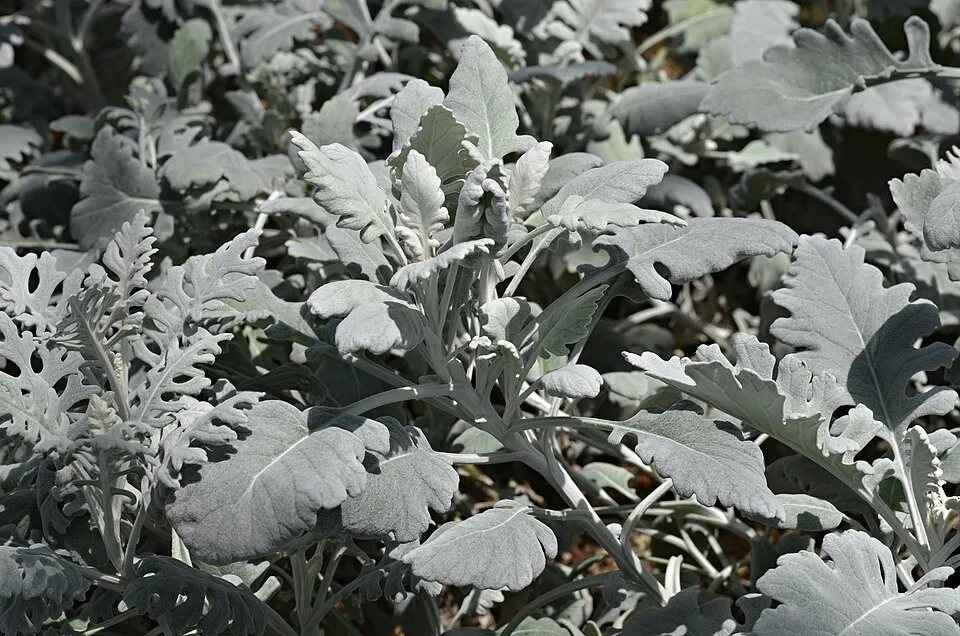
Senecio Cineraria, commonly known as Dusty Miller or Silver Groundsel, is a captivating subshrub celebrated for its distinctive silvery-white foliage. Native to the sun-drenched coastal regions of the Mediterranean, this plant thrives in maritime cliffs and well-drained, often limestone-rich soils. It typically grows to a height and spread of 0.6 to 1 meter (2-3 feet), forming a rounded, bushy habit.
The deeply lobed, almost fern-like leaves are densely covered in a fine, felt-like pubescence, which gives them their characteristic dusty or frosted appearance, a crucial adaptation for reflecting intense sunlight and conserving moisture in arid environments. While primarily cultivated for its striking foliage, Senecio Cineraria also produces small, bright yellow, daisy-like flowers in clusters during the summer months, though these are often removed in ornamental settings to maintain the pristine leaf display. Belonging to the vast Asteraceae (Compositae) family, its taxonomic classification has seen some synonyms, including S.
bicolor cineraria and Cineraria maritima. This hardy species is valued in garden design for its textural contrast and cooling visual effect amidst more colorful plantings, demonstrating remarkable tolerance to drought and maritime exposure.
Trusted Scientific References
1. Authoritative external sources for Senecio Cineraria
1.1 Wikipedia — Senecio Cineraria
1.2 Kew POWO (Plants of the World Online)
1.3 PubMed — peer-reviewed research
1.4 NCBI Taxonomy Browser
1.5 GBIF — Global Biodiversity
1.6Senecio Cineraria should be interpreted through verified botanical identity, practical care, and responsible safety language. This recovery note adds the missing context needed for a complete profile: match light to the plant's habit, use well-drained soil, water according to season, and avoid unsupported medicinal or edible claims. For publishing, the plant can be presented as a source-backed garden plant with clear care guidance, common problem diagnosis, and conservative safety wording.
1.1.Senecio Cineraria — Key Features
- ✓ <strong>Striking Silvery</strong> — White Foliage — Distinctive, deeply lobed leaves covered in fine, felt-like pubescence.
- ✓ <strong>Native to Mediterranean Coastal Regions</strong> — Adapted to harsh, sunny, and dry maritime environments.
- ✓ <strong>Contains Toxic Pyrrolizidine Alkaloids (PAs)</strong> — A critical safety concern for internal use.
- ✓ <strong>Historically Used for Eye Conditions</strong> — Traditional applications for cataracts, conjunctivitis, and corneal opacities.
- ✓ <strong>Hardy Ornamental Subshrub</strong> — Grows 0.6-1 meter tall, suitable for various garden designs.
- ✓ <strong>Tolerant of Maritime Exposure and Drought</strong> — Ideal for coastal gardens and xeriscaping.
- ✓ <strong>Produces Small Yellow Daisy</strong> — Like Flowers — Blooms in summer, though often pinched off for foliage display.
- ✓ <strong>Requires Full Sun and Well</strong> — Drained Soil — Thrives in bright conditions and avoids waterlogging.
- ✓ <strong>Provides Textural Contrast in Gardens</strong> — Adds a unique visual element and cooling effect.
- ✓ <strong>Low Maintenance (Ornamental Use)</strong> — Relatively easy to grow in appropriate conditions.
1.2.Senecio Cineraria — Quick Summary
- ✓ Ornamental subshrub with striking silvery foliage, native to the Mediterranean.
- ✓ Historically used for ophthalmic conditions, but contains highly toxic pyrrolizidine alkaloids (PAs).
- ✓ PAs cause severe and irreversible liver damage; absolutely no internal consumption is safe.
- ✓ Any traditional medicinal use, especially for eyes, requires extreme caution and strict professional supervision.
- ✓ Valued in landscaping for drought and maritime tolerance, primarily for its aesthetic appeal.
2.Senecio Cineraria — Scientific Identity
3.Senecio Cineraria — Quick Facts
4.Senecio Cineraria — Appearance & Identification
5.Senecio Cineraria — Native Habitat
6.Senecio Cineraria — Water Requirements
- ✓ Soil Preference — Thrives in well-drained, moderately fertile soils, including sandy, loamy, and heavy clay types, preferring mildly acid to basic pH.
- ✓ Sunlight Requirements — Requires a full sun position to flourish; it cannot tolerate shade and performs best with ample direct sunlight.
- ✓ Hardiness Zone — Hardy in USDA zones 8-10 and UK zone 8, tolerating temperatures down to approximately -10°C (14°F).
- ✓ Watering Regime — Established plants are drought-resistant, preferring dry to moist soil conditions and not tolerating waterlogging.
- ✓ Propagation from Seed — Sow seeds in spring in a greenhouse, covering lightly and keeping the compost consistently moist; prick out seedlings and grow on.
- ✓ Propagation from Cuttings — Take cuttings of half-ripe wood (5-8cm with a heel) in July/August, or mature wood in November, rooting in a frame or greenhouse.
- ✓ Maintenance and Pruning — Plants can become straggly if unpruned; regular pinching or pruning helps maintain a compact shape, and plants are often replaced every few years due to their relatively short lifespan.
- ✓ Special Uses — Excellent for borders, containers, ground cover, mass plantings, and as a dwarf windbreak hedge due to its tolerance of maritime exposure.
Reviewed by the Flora Medical Global Botanical Review Panel
Multi-disciplinary editorial group · Botany · Ethnobotany · Herbal-medicine literature
Who reviewed this: This page was checked by the Flora Medical Global Botanical Review Panel — an in-house editorial group of botany graduates, ethnobotany researchers, and horticulture practitioners who collectively maintain our 7,000+ plant encyclopedia. Meet the team.
Our 4-step verification process
1. Taxonomic verification
Scientific names and synonyms cross-checked against Kew POWO, World Flora Online, and The Plant List.
2. Phytochemical & medicinal cross-reference
Active compounds, traditional uses, and reported activities are cross-referenced with PubMed, USDA Dr. Duke's database, and peer-reviewed ethnobotanical literature.
3. Conservation & distribution check
Distribution, ecology, and conservation status confirmed against GBIF occurrence records and the IUCN Red List.
4. Editorial & safety review
Every entry passes an editorial pass for clarity, originality, and safety notices (toxicity, contraindications, dosage caveats) before publication.
Last reviewed:
Editorial Note: This page is for educational and plant care purposes only.
Written by: Flora Medical Global Editorial Team
Reviewed by: Flora Medical Global Botanical Review Panel
Last Updated: June 15, 2026







Senecio Cineraria — Comments & Community Reviews
Rate this plant