

Care Disclaimer: Plant care recommendations are general guidelines based on common growing conditions. Individual results may vary based on your local environment, climate, and care routine. If your plant is toxic, keep it away from children and pets, and consult a veterinarian if accidental ingestion occurs.
1.Skimmia Japonica — Overview
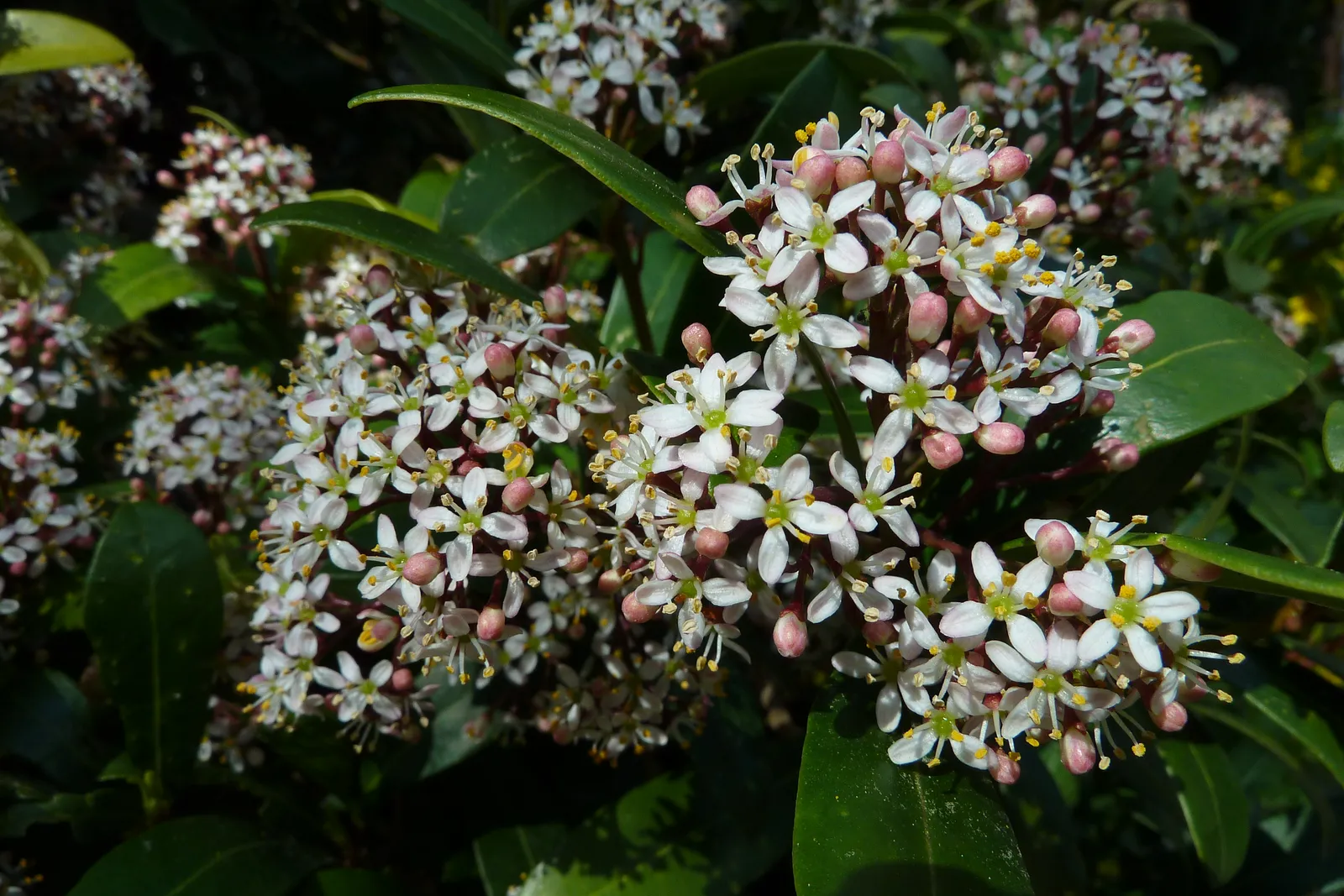
Skimmia japonica, commonly known as Japanese Skimmia, is a highly ornamental evergreen shrub native to the temperate forests of Japan, China, and Southeast Asia. Belonging to the Rutaceae family, it is characterized by its dense, compact growth habit, typically reaching 1 to 1.5 meters in both height and spread. The shrub features glossy, dark green, obovate to elliptic leaves, which are aromatic when crushed due to the presence of essential oils.
In spring, it produces clusters of small, highly fragrant white or pinkish-white flowers, which emerge from distinctive reddish buds. A notable feature of Skimmia japonica is its dioecious nature, meaning male and female flowers are borne on separate plants. For the production of its vibrant, persistent red berries, which provide striking winter interest and attract birds, both a male and a female plant are required.
This species thrives in shady, woodland environments, preferring moist, well-drained, and acidic soils, making it a popular choice for shaded borders, underplanting, or container cultivation in suitable climates. Its robust foliage and colorful berries offer year-round aesthetic appeal, despite its known toxicity.
Trusted Scientific References
1. Authoritative external sources for Skimmia japonica
1.1 Wikipedia — Skimmia japonica
1.2 Kew POWO (Plants of the World Online)
1.3 PubMed — peer-reviewed research
1.4 NCBI Taxonomy Browser
1.5 GBIF — Global Biodiversity
1.6Skimmia Japonica should be interpreted through verified botanical identity, practical care, and responsible safety language. This recovery note adds the missing context needed for a complete profile: match light to the plant's habit, use well-drained soil, water according to season, and avoid unsupported medicinal or edible claims. For publishing, the plant can be presented as a source-backed garden plant with clear care guidance, common problem diagnosis, and conservative safety wording.
1.7Skimmia Japonica (Skimmia japonica) is maintained in this recovery file as a complete garden profile with practical care, safety, and identification context. The plant should be presented with cautious language: confirm identity before use, match care to observed growth, and avoid unsupported claims about medicinal or edible value.
1.1.Skimmia Japonica — Key Features
- ✓ <strong>Evergreen Foliage</strong> — Retains glossy, dark green leaves year-round, providing consistent garden interest.
- ✓ <strong>Fragrant Flowers</strong> — Produces clusters of small, highly aromatic white or pinkish flowers in spring.
- ✓ <strong>Vibrant Red Berries</strong> — Female plants bear bright red berries that persist through winter, offering seasonal color.
- ✓ <strong>Dioecious Nature</strong> — Requires both male and female plants for berry production.
- ✓ <strong>Shade Tolerant</strong> — Thrives in partial to full shade, making it suitable for woodland and shaded garden areas.
- ✓ <strong>Aromatic Leaves</strong> — Leaves release a distinct aroma when crushed due to essential oils.
- ✓ <strong>High Toxicity</strong> — All parts of the plant are considered toxic if ingested, particularly the berries.
- ✓ <strong>Rich Phytochemistry</strong> — Contains a diverse array of alkaloids, coumarins, and limonoids.
- ✓ <strong>Compact Growth Habit</strong> — Typically grows to a manageable size of 1-1.5 meters in height and spread.
- ✓ <strong>Low Maintenance</strong> — Generally easy to care for once established, with good pest and disease resistance.
1.2.Skimmia Japonica — Quick Summary
- ✓ Skimmia japonica is a beautiful, aromatic evergreen shrub, prized for ornamental use.
- ✓ All parts of the plant, especially berries and leaves, are highly toxic if ingested.
- ✓ It is a rich source of secondary metabolites, including alkaloids and coumarins.
- ✓ While the Skimmia genus has some traditional external uses, Skimmia japonica is NOT safe for internal medicinal use.
- ✓ Research explores its compounds for potential in vitro activities, but not for direct human consumption.
- ✓ Emphasize ornamental value and extreme caution regarding its toxicity.
2.Skimmia Japonica — Scientific Identity
3.Skimmia Japonica — Quick Facts
4.Skimmia Japonica — Appearance & Identification
5.Skimmia Japonica — Native Habitat
6.Skimmia Japonica — Water Requirements
- ✓ Site Selection — Plant in partial to full shade, protected from harsh afternoon sun, which can scorch the leaves.
- ✓ Soil Requirements — Prefers moist, well-drained, humus-rich, acidic soil (pH 5.5-6.5); amend heavy clay with organic matter.
- ✓ Watering — Keep the soil consistently moist, especially during dry periods; avoid waterlogging, which can lead to root rot.
- ✓ Fertilization — Feed annually in spring with an acid-forming fertilizer formulated for evergreen shrubs, or a layer of compost.
- ✓ Pruning — Prune lightly after flowering to maintain shape and remove any dead or damaged branches; avoid heavy pruning.
- ✓ Propagation — Propagate from semi-hardwood cuttings taken in late summer, or by seed, though seed propagation is slower and variable.
- ✓ Pest and Disease — Generally resistant to most pests and diseases, but can be susceptible to spider mites or scale in dry conditions, and fungal issues in overly wet environments.
- ✓ Berries — To ensure berry production on female plants, a male pollinator must be planted nearby.
Reviewed by the Flora Medical Global Botanical Review Panel
Multi-disciplinary editorial group · Botany · Ethnobotany · Herbal-medicine literature
Who reviewed this: This page was checked by the Flora Medical Global Botanical Review Panel — an in-house editorial group of botany graduates, ethnobotany researchers, and horticulture practitioners who collectively maintain our 7,000+ plant encyclopedia. Meet the team.
Our 4-step verification process
1. Taxonomic verification
Scientific names and synonyms cross-checked against Kew POWO, World Flora Online, and The Plant List.
2. Phytochemical & medicinal cross-reference
Active compounds, traditional uses, and reported activities are cross-referenced with PubMed, USDA Dr. Duke's database, and peer-reviewed ethnobotanical literature.
3. Conservation & distribution check
Distribution, ecology, and conservation status confirmed against GBIF occurrence records and the IUCN Red List.
4. Editorial & safety review
Every entry passes an editorial pass for clarity, originality, and safety notices (toxicity, contraindications, dosage caveats) before publication.
Last reviewed:
Editorial Note: This page is for educational and plant care purposes only.
Written by: Flora Medical Global Editorial Team
Reviewed by: Flora Medical Global Botanical Review Panel
Last Updated: June 15, 2026







Skimmia Japonica — Comments & Community Reviews
Rate this plant