
Care Disclaimer: Plant care recommendations are general guidelines based on common growing conditions. Individual results may vary based on your local environment, climate, and care routine. If your plant is toxic, keep it away from children and pets, and consult a veterinarian if accidental ingestion occurs.
1.Sparaxis — Overview
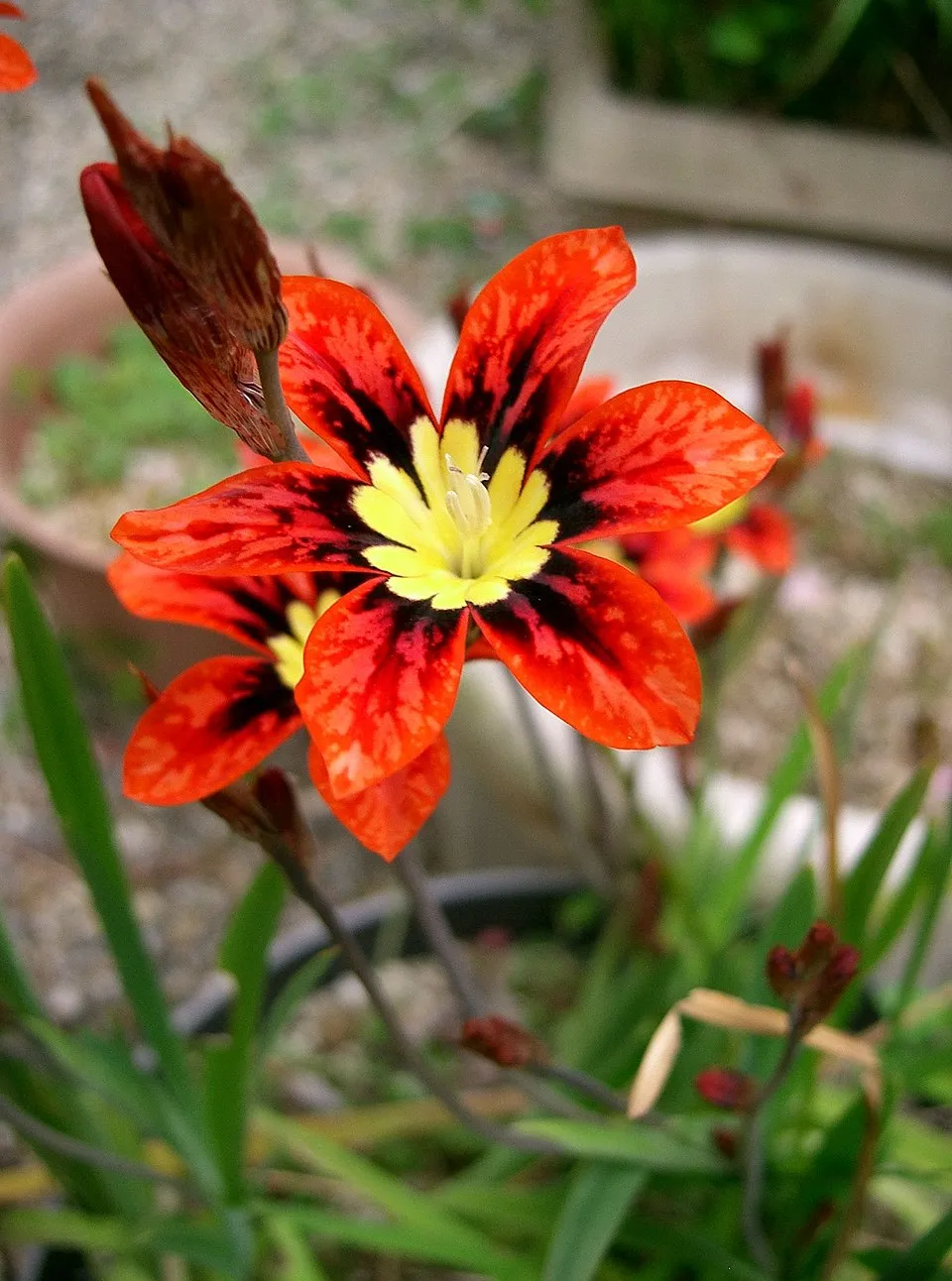
Sparaxis tricolor, commonly known as Wand Flower or Harlequin Flower, is a captivating cormous perennial belonging to the Iridaceae family, a diverse group of monocotyledonous flowering plants. Originating from the Cape Provinces of South Africa, this species is highly regarded for its strikingly vibrant and intricately patterned flowers that add dramatic color to gardens. The plant typically achieves a mature height of 30-60 cm (12-24 inches), presenting slender, sword-shaped leaves arranged in a distichous (two-ranked) fashion, emerging gracefully from its corm base. These leaves are generally a fresh green, occasionally displaying a slight glaucous tint, and can extend up to 15-30 cm in length.
The most distinguishing feature of Sparaxis tricolor is its inflorescence, which consists of several funnel-shaped blooms borne on delicate, wiry stems. Each individual flower, approximately 5-6 cm in diameter, showcases a mesmerizing tricolor arrangement, most often exhibiting brilliant scarlet or orange petals with a prominent yellow central throat, frequently encircled by a starkly contrasting dark purple or black ring. The perianth segments, where petals and sepals are morphologically indistinguishable, are broadly obovate to ovate. While individual flowers are ephemeral, typically lasting only a few days, successive blooms ensure a prolonged and spectacular flowering season from late spring into early summer.
The plant propagates through ovoid to globose corms, which multiply readily, facilitating its naturalization in climatically suitable regions. The fruit is a small capsule containing numerous minute, dark seeds. Its dramatic coloration, coupled with relatively straightforward cultivation requirements, has solidified its status as a popular ornamental plant in gardens globally, especially thriving in Mediterranean-type climates where it can form breathtaking drifts of color.
Trusted Scientific References
1. Authoritative external sources for Sparaxis tricolor
1.1 Wikipedia — Sparaxis tricolor
1.2 Kew POWO (Plants of the World Online)
1.3 PubMed — peer-reviewed research
1.4 NCBI Taxonomy Browser
1.5 GBIF — Global Biodiversity
1.1.Sparaxis — Key Features
- ✓ <strong>Striking Tricolor Flowers</strong> — Exhibits vivid scarlet/orange, yellow, and dark purple/black patterns.
- ✓ <strong>Cormous Perennial</strong> — Grows from underground corms, allowing for perennial growth and easy propagation.
- ✓ <strong>Native to South Africa</strong> — Thrives in Mediterranean-like climates.
- ✓ <strong>Member of Iridaceae Family</strong> — Related to plants like Iris and Gladiolus.
- ✓ <strong>Slender, Sword</strong> — Shaped Leaves — Distinctive foliage emerging from the base.
- ✓ <strong>Moderate Height</strong> — Typically grows 30-60 cm tall, suitable for borders and containers.
- ✓ <strong>Long Flowering Season</strong> — Produces successive blooms from late spring to early summer.
- ✓ <strong>Easy to Cultivate</strong> — Considered relatively simple to grow with proper conditions.
- ✓ <strong>Ornamental Value</strong> — Exclusively used for its aesthetic appeal in horticulture.
- ✓ <strong>Attracts Pollinators</strong> — Its bright flowers are appealing to bees and other beneficial insects.
1.2.Sparaxis — Quick Summary
- ✓ Sparaxis tricolor is an ornamental cormous perennial from South Africa.
- ✓ Known for its vibrant, tricolored, trumpet-shaped flowers.
- ✓ Prefers full sun and well-draining soil in USDA Zones 8-10.
- ✓ Primarily valued for its aesthetic appeal in gardens and as a cut flower.
- ✓ There are no documented traditional or modern medicinal uses.
- ✓ Requires minimal care, making it suitable for beginner gardeners.
2.Sparaxis — Scientific Identity
3.Sparaxis — Quick Facts
4.Sparaxis — Appearance & Identification
5.Sparaxis — Native Habitat
6.Sparaxis — Water Requirements
- ✓ Light Requirements — Sparaxis tricolor thrives in full sun, requiring at least 6 hours of direct sunlight daily for optimal blooming and robust growth.
- ✓ Soil Preference — Prefers well-draining soil, ideally a sandy loam, with a slightly acidic to neutral pH. Avoid heavy, waterlogged soils to prevent corm rot.
- ✓ Watering Schedule — Water regularly during the active growing season (late winter to late spring), keeping the soil consistently moist but never waterlogged. Reduce watering as foliage dies back for summer dormancy.
- ✓ Temperature and Hardiness — Best suited for USDA hardiness zones 8-10. It prefers warm temperatures during growth but can tolerate brief dips to 20°F (-7°C); however, it is not frost-hardy.
- ✓ Fertilization — Apply a balanced liquid fertilizer every 2-3 weeks during the active growing period. Avoid over-fertilizing, which can promote lush foliage at the expense of flowers.
- ✓ Pruning — Deadhead spent flowers to encourage continuous blooming throughout the season. Allow foliage to yellow and die back naturally before cutting to enable the corm to store energy.
- ✓ Planting — Plant corms in autumn in warmer climates or early spring after the last frost in cooler zones, typically 2-4 inches deep and 3-6 inches apart.
Reviewed by the Flora Medical Global Botanical Review Panel
Multi-disciplinary editorial group · Botany · Ethnobotany · Herbal-medicine literature
Who reviewed this: This page was checked by the Flora Medical Global Botanical Review Panel — an in-house editorial group of botany graduates, ethnobotany researchers, and horticulture practitioners who collectively maintain our 7,000+ plant encyclopedia. Meet the team.
Our 4-step verification process
1. Taxonomic verification
Scientific names and synonyms cross-checked against Kew POWO, World Flora Online, and The Plant List.
2. Phytochemical & medicinal cross-reference
Active compounds, traditional uses, and reported activities are cross-referenced with PubMed, USDA Dr. Duke's database, and peer-reviewed ethnobotanical literature.
3. Conservation & distribution check
Distribution, ecology, and conservation status confirmed against GBIF occurrence records and the IUCN Red List.
4. Editorial & safety review
Every entry passes an editorial pass for clarity, originality, and safety notices (toxicity, contraindications, dosage caveats) before publication.
Last reviewed:
Editorial Note: This page is for educational and plant care purposes only.
Written by: Flora Medical Global Editorial Team
Reviewed by: Flora Medical Global Botanical Review Panel
Last Updated: June 15, 2026







Sparaxis — Comments & Community Reviews
Rate this plant