

Care Disclaimer: Plant care recommendations are general guidelines based on common growing conditions. Individual results may vary based on your local environment, climate, and care routine. If your plant is toxic, keep it away from children and pets, and consult a veterinarian if accidental ingestion occurs.
1.Stachyurus Praecox — Overview
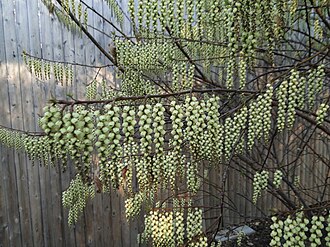
Stachyurus praecox, commonly known as early-flowering stachyurus or spring-flowering stachyurus, is a captivating deciduous shrub indigenous to the temperate regions of Japan. It is a distinguished member of the Stachyuraceae family, a small family of woody plants. This elegant shrub typically attains a height of 1.5 to 3 meters (5 to 10 feet) with a graceful, spreading, and often arching habit, making it a prominent feature in any landscape. Its foliage consists of alternate, simple leaves that are ovate to oblong in shape, measuring 5-12 cm (2-5 inches) long and 2-5 cm (1-2 inches) wide. The margins are distinctly serrated, and the venation is prominent, contributing to its textural appeal.
The most remarkable characteristic of Stachyurus praecox is its early spring floral display. In late winter to early spring, often before the emergence of new leaves, it produces striking pendulous racemes of flowers. These racemes are typically 5-10 cm (2-4 inches) in length and bear numerous small, bell-shaped flowers. The blossoms are usually a delicate pale yellow to greenish-yellow, sometimes subtly tinged with pink, providing a much-needed splash of color during the transition from winter to spring. Each flower possesses four petals and four sepals and is borne on slender pedicels.
Following the flowering period, small, ovoid capsule fruits develop, maturing in late summer or autumn. Stachyurus praecox is renowned for its robustness and adaptability, thriving in a range of conditions, though it exhibits a preference for moist, well-drained, acidic to neutral soil and partial shade. Its ornamental value is highly regarded, and its relative resistance to pests and diseases contributes to its ease of cultivation, making it a cherished choice for gardens and botanical collections worldwide.
Trusted Scientific References
1. Authoritative external sources for Stachyurus praecox
1.1 Wikipedia — Stachyurus praecox
1.2 Kew POWO (Plants of the World Online)
1.3 PubMed — peer-reviewed research
1.4 NCBI Taxonomy Browser
1.5 GBIF — Global Biodiversity
1.1.Stachyurus Praecox — Key Features
- ✓ <strong>Early Spring Blooms</strong> — Produces striking pendulous racemes of pale yellow flowers before leaves emerge.
- ✓ <strong>Deciduous Shrub</strong> — Offers attractive foliage with serrated, ovate-oblong leaves.
- ✓ <strong>Native to Japan</strong> — Thrives in temperate climates, adaptable to various garden settings.
- ✓ <strong>Low Maintenance</strong> — Generally resistant to pests and diseases, easy to grow.
- ✓ <strong>Unique Floral Display</strong> — Provides welcome color during the late winter to early spring.
- ✓ <strong>Moderate Size</strong> — Typically grows 1.5 to 3 meters (5-10 feet) tall and wide.
- ✓ <strong>Spreading Habit</strong> — Features graceful, arching branches.
- ✓ <strong>Partial Shade Tolerant</strong> — Prefers dappled sunlight but can adapt to full sun with adequate moisture.
- ✓ <strong>Horticultural Value</strong> — Highly prized for its ornamental appeal in gardens.
- ✓ <strong>Resilient Plant</strong> — Withstands a range of environmental conditions once established.
1.2.Stachyurus Praecox — Quick Summary
- ✓ Ornamental Shrub — Valued for its unique early spring floral display.
- ✓ Native to Japan — A deciduous plant with an elegant, spreading habit.
- ✓ Phytochemical Potential — Hypothetically rich in flavonoids, phenolic acids, and tannins.
- ✓ Research Gaps — Limited to no scientific studies on its medicinal efficacy.
- ✓ Primary Use — Exclusively for horticultural and landscape beauty.
- ✓ Safety Precaution — Not for internal medicinal use; specific side effects are unknown.
2.Stachyurus Praecox — Scientific Identity
3.Stachyurus Praecox — Quick Facts
4.Stachyurus Praecox — Appearance & Identification
5.Stachyurus Praecox — Native Habitat
6.Stachyurus Praecox — Water Requirements
- ✓ Climate Zone — Thrives best in USDA Hardiness Zones 6-9, tolerating moderate winter cold.
- ✓ Soil Preference — Prefers moist, well-drained, organically rich soil with an acidic to neutral pH (6.0-7.0).
- ✓ Light Requirements — Performs optimally in partial shade, especially in hotter climates, but can tolerate full sun with consistent moisture.
- ✓ Watering — Requires consistent moisture, particularly during dry spells and in its establishment phase; avoid waterlogging.
- ✓ Propagation — Can be propagated by seeds (requiring cold stratification) or semi-hardwood cuttings taken in summer.
- ✓ Pruning — Minimal pruning is needed, primarily to remove dead or crossing branches, best done immediately after flowering.
- ✓ Fertilization — Benefits from a balanced, slow-release granular fertilizer applied in early spring, especially if soil is poor.
Reviewed by the Flora Medical Global Botanical Review Panel
Multi-disciplinary editorial group · Botany · Ethnobotany · Herbal-medicine literature
Who reviewed this: This page was checked by the Flora Medical Global Botanical Review Panel — an in-house editorial group of botany graduates, ethnobotany researchers, and horticulture practitioners who collectively maintain our 7,000+ plant encyclopedia. Meet the team.
Our 4-step verification process
1. Taxonomic verification
Scientific names and synonyms cross-checked against Kew POWO, World Flora Online, and The Plant List.
2. Phytochemical & medicinal cross-reference
Active compounds, traditional uses, and reported activities are cross-referenced with PubMed, USDA Dr. Duke's database, and peer-reviewed ethnobotanical literature.
3. Conservation & distribution check
Distribution, ecology, and conservation status confirmed against GBIF occurrence records and the IUCN Red List.
4. Editorial & safety review
Every entry passes an editorial pass for clarity, originality, and safety notices (toxicity, contraindications, dosage caveats) before publication.
Last reviewed:
Editorial Note: This page is for educational and plant care purposes only.
Written by: Flora Medical Global Editorial Team
Reviewed by: Flora Medical Global Botanical Review Panel
Last Updated: June 15, 2026







Stachyurus Praecox — Comments & Community Reviews
Rate this plant