
Care Disclaimer: Plant care recommendations are general guidelines based on common growing conditions. Individual results may vary based on your local environment, climate, and care routine. If your plant is toxic, keep it away from children and pets, and consult a veterinarian if accidental ingestion occurs.
1.Stipa Tenuissima — Overview
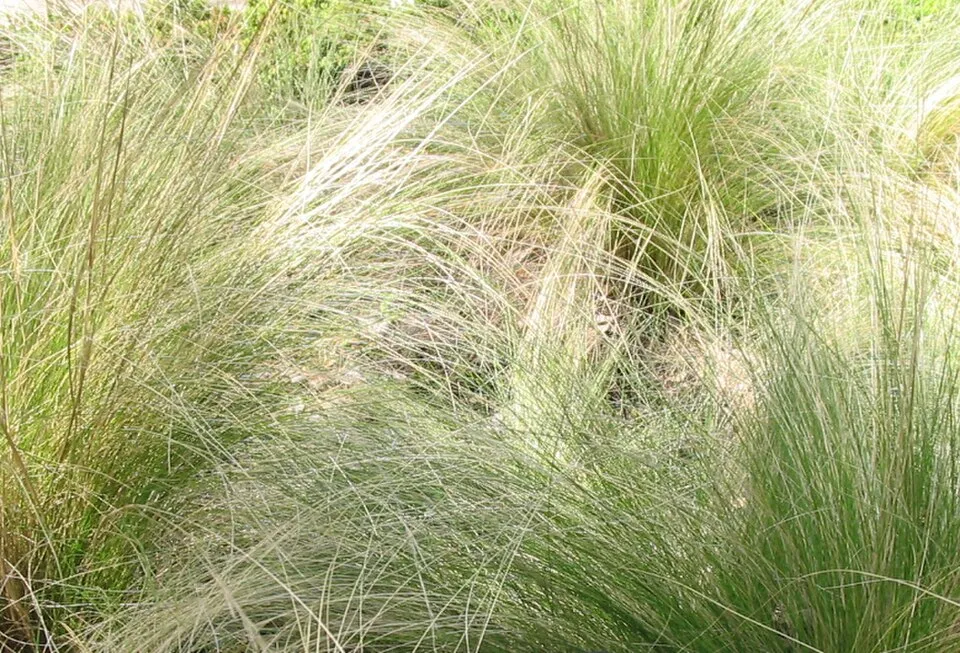
Stipa tenuissima, now more accurately classified as Nassella tenuissima, is a captivating perennial ornamental grass belonging to the Poaceae family, commonly known as Mexican Feather Grass, Mexican Wiregrass, or Pony Tails. This species is native to arid and semi-arid regions of the southwestern United States (such as New Mexico and Texas), Mexico, and parts of Central and South America. It typically forms dense, fountain-shaped clumps of exceedingly fine, hair-like foliage that exhibits a vibrant lime-green to silvery-green hue.
The plant generally reaches a mature height and width of 1 to 2 feet (30-60 cm), creating a soft, ethereal texture in the landscape. During the summer months, it produces an abundance of delicate, feathery flower plumes that emerge silvery-green and gradually mature into a golden-tan color. These panicles sway gracefully with the slightest breeze, imparting a dynamic and fluid element to garden designs.
Its growth habit is characterized by a vigorous, clump-forming nature, though its prolific self-seeding capacity can lead to invasive tendencies in certain favorable environments. The plant's exceptionally fine texture and graceful movement make it a popular choice for softening hardscape elements, providing contrast to broader-leaved plants, and establishing a naturalistic aesthetic in various garden styles, from cottage to xeriscape designs.
Trusted Scientific References
1. Authoritative external sources for Stipa tenuissima
1.1 Wikipedia — Stipa tenuissima
1.2 Kew POWO (Plants of the World Online)
1.3 PubMed — peer-reviewed research
1.4 NCBI Taxonomy Browser
1.5 GBIF — Global Biodiversity
1.6Stipa Tenuissima should be interpreted through verified botanical identity, practical care, and responsible safety language. This recovery note adds the missing context needed for a complete profile: match light to the plant's habit, use well-drained soil, water according to season, and avoid unsupported medicinal or edible claims. For publishing, the plant can be presented as a source-backed garden plant with clear care guidance, common problem diagnosis, and conservative safety wording.
1.1.Stipa Tenuissima — Key Features
- ✓ <strong>Botanical Name</strong> — Nassella tenuissima (formerly Stipa tenuissima).
- ✓ <strong>Common Names</strong> — Mexican Feather Grass, Mexican Wiregrass, Pony Tails.
- ✓ <strong>Family</strong> — Poaceae (Grass Family).
- ✓ <strong>Growth Habit</strong> — Dense, fountain-shaped clumps of fine, hair-like foliage.
- ✓ <strong>Mature Size</strong> — Typically 1-2 feet (30-60 cm) tall and wide.
- ✓ <strong>Foliage</strong> — Bright lime-green to silvery-green, exceptionally fine texture.
- ✓ <strong>Flowers</strong> — Silvery-green feathery plumes maturing to golden-tan in summer.
- ✓ <strong>Sun Preference</strong> — Thrives in full sun, tolerates partial shade.
- ✓ <strong>Drought Tolerance</strong> — Highly drought-tolerant once established.
- ✓ <strong>Invasive Potential</strong> — Can be invasive due to prolific self-seeding in favorable climates.
1.2.Stipa Tenuissima — Quick Summary
- ✓ Mexican Feather Grass (Nassella tenuissima) is a popular ornamental perennial grass.
- ✓ Valued for its fine texture, graceful movement, and drought tolerance in landscaping.
- ✓ Known for its prolific self-seeding, which can lead to invasive behavior in some regions.
- ✓ Requires full sun and well-drained soil; low maintenance once established.
- ✓ Primarily an aesthetic plant with no recognized traditional or modern medicinal uses.
- ✓ Important to check local invasive species lists before planting.
2.Stipa Tenuissima — Scientific Identity
3.Stipa Tenuissima — Quick Facts
4.Stipa Tenuissima — Appearance & Identification
5.Stipa Tenuissima — Native Habitat
6.Stipa Tenuissima — Water Requirements
- ✓ Sun Exposure — Thrives best in full sun, tolerating partial shade but with reduced vigor and flowering.
- ✓ Soil Requirements — Prefers well-drained, loamy soil; amend heavy clay soils with sand and organic matter to improve drainage.
- ✓ Watering — Drought-tolerant once established, requiring low to average water; avoid overwatering, especially in containers.
- ✓ Hardiness Zones — Perennial in USDA zones 7-10; can be grown as an annual in colder climates or overwintered indoors in containers.
- ✓ Fertilization — Fertilize annually in spring with a light layer of compost; excessive nitrogen can cause lodging (falling flat).
- ✓ Pruning — Cut back old foliage in late winter or early spring (before new growth) to about 4-6 inches (10-15 cm) to maintain a tidy appearance.
- ✓ Propagation — Easily propagated by seed (start indoors in early spring) or by division of clumps in spring before new growth emerges.
- ✓ Invasive Potential — Monitor closely for self-seeding, especially in ideal conditions; consider sterile cultivars or containment to prevent overgrowth.
Reviewed by the Flora Medical Global Botanical Review Panel
Multi-disciplinary editorial group · Botany · Ethnobotany · Herbal-medicine literature
Who reviewed this: This page was checked by the Flora Medical Global Botanical Review Panel — an in-house editorial group of botany graduates, ethnobotany researchers, and horticulture practitioners who collectively maintain our 7,000+ plant encyclopedia. Meet the team.
Our 4-step verification process
1. Taxonomic verification
Scientific names and synonyms cross-checked against Kew POWO, World Flora Online, and The Plant List.
2. Phytochemical & medicinal cross-reference
Active compounds, traditional uses, and reported activities are cross-referenced with PubMed, USDA Dr. Duke's database, and peer-reviewed ethnobotanical literature.
3. Conservation & distribution check
Distribution, ecology, and conservation status confirmed against GBIF occurrence records and the IUCN Red List.
4. Editorial & safety review
Every entry passes an editorial pass for clarity, originality, and safety notices (toxicity, contraindications, dosage caveats) before publication.
Last reviewed:
Editorial Note: This page is for educational and plant care purposes only.
Written by: Flora Medical Global Editorial Team
Reviewed by: Flora Medical Global Botanical Review Panel
Last Updated: June 15, 2026







Stipa Tenuissima — Comments & Community Reviews
Rate this plant