
Care Disclaimer: Plant care recommendations are general guidelines based on common growing conditions. Individual results may vary based on your local environment, climate, and care routine. If your plant is toxic, keep it away from children and pets, and consult a veterinarian if accidental ingestion occurs.
1.Switchgrass — Overview
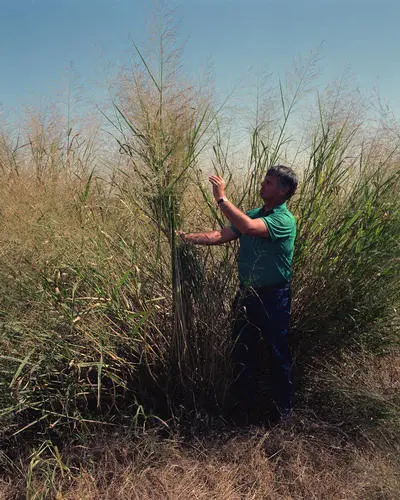
Switchgrass (Panicum virgatum) is a robust, warm-season perennial grass native to the expansive tallgrass prairies of North America, where it once formed a dominant component of these vital ecosystems. This distinctive member of the Poaceae family exhibits a strong, clumping growth habit, typically reaching impressive heights of 1.5 to 3 meters (5-10 feet). Its defining characteristic is a deep, extensive fibrous root system, which can penetrate soils to depths exceeding 3 meters, granting it exceptional resilience against drought and aiding in soil stabilization.
Morphologically, Switchgrass features sturdy, upright stems adorned with long, flat, blade-like leaves that range in color from olive green to blue-green, often developing attractive bronze or reddish hues in the autumn before fading to a tawny brown in winter. The plant produces airy, open panicles of delicate flowers in mid to late summer, which mature into small, hard seeds, providing a crucial food source for various wildlife. Panicum virgatum is remarkably adaptable, thriving across a wide spectrum of soil types, from sandy to heavy clay, and tolerating diverse environmental conditions including both drought and periods of excessive moisture, as well as a broad pH range.
Its resilience and ecological significance make it a cornerstone species in prairie restoration and a promising candidate for sustainable agriculture and bioenergy initiatives.
Trusted Scientific References
1. Authoritative external sources for Panicum virgatum
1.1 Wikipedia — Panicum virgatum
1.2 Kew POWO (Plants of the World Online)
1.3 PubMed — peer-reviewed research
1.4 NCBI Taxonomy Browser
1.5 GBIF — Global Biodiversity
1.6Switchgrass should be interpreted through verified botanical identity, practical care, and responsible safety language. This recovery note adds the missing context needed for a complete profile: match light to the plant's habit, use well-drained soil, water according to season, and avoid unsupported medicinal or edible claims. For publishing, the plant can be presented as a source-backed garden plant with clear care guidance, common problem diagnosis, and conservative safety wording.
1.1.Switchgrass — Key Features
- ✓ <strong>Warm</strong> — Season Perennial — Thrives in warmer temperatures, emerging in late spring.
- ✓ <strong>North American Native</strong> — Indigenous to the tallgrass prairies of the continent.
- ✓ <strong>Deep Fibrous Root System</strong> — Provides exceptional drought tolerance and soil stabilization.
- ✓ <strong>High Biomass Production</strong> — Excellent candidate for cellulosic biofuel production.
- ✓ <strong>Phytoremediation Capabilities</strong> — Effective in cleaning contaminated soils.
- ✓ <strong>Ecological Restoration Plant</strong> — Used for erosion control and habitat creation.
- ✓ <strong>Low Maintenance</strong> — Requires minimal care once established, pest and disease resistant.
- ✓ <strong>Ornamental Value</strong> — Offers aesthetic appeal with changing foliage colors and airy seed heads.
- ✓ <strong>Wildlife Habitat</strong> — Provides shelter and food (seeds) for various birds and small animals.
- ✓ <strong>Adaptable to Diverse Soils</strong> — Tolerates a wide range of soil types and pH levels.
1.2.Switchgrass — Quick Summary
- ✓ North American native warm-season perennial grass, vital for prairie ecosystems.
- ✓ Primarily known for biofuel potential, phytoremediation, and ecological restoration.
- ✓ Rich in structural carbohydrates (cellulose, hemicellulose, lignin) and secondary metabolites like phenolics and flavonoids.
- ✓ Exhibits high drought tolerance, adaptable to various soils, and low maintenance.
- ✓ Not recognized for direct human medicinal benefits; toxic to horses, goats, and sheep.
- ✓ Offers potential for sustainable bioenergy and environmental improvement.
2.Switchgrass — Scientific Identity
3.Switchgrass — Quick Facts
4.Switchgrass — Appearance & Identification
5.Switchgrass — Native Habitat
6.Switchgrass — Water Requirements
- ✓ Warm-Season Perennial — Best planted in late spring or early summer after the last frost, as it thrives in warm soil temperatures, ideally above 15°C (59°F).
- ✓ Soil Adaptability — Highly tolerant of a wide range of soil types, from sandy to heavy clay, and performs well in poor to moderately fertile soils with a pH of 4.5 to 8.0, but prefers well-drained conditions.
- ✓ Sunlight Requirement — Requires full sun exposure, meaning at least 6-8 hours of direct sunlight daily, for optimal growth, robust biomass production, and efficient seed development.
- ✓ Propagation — Primarily propagated by direct sowing of seeds in a prepared seedbed, typically at a depth of 0.5-1 cm (0.2-0.4 inches) in late spring. Can also be established from transplants or rhizome division for faster establishment.
- ✓ Water Needs — Extremely drought-tolerant once established due to its deep, fibrous root system, requiring minimal supplemental irrigation even in prolonged dry periods. Young plants need consistent moisture until roots develop.
- ✓ Fertilization — Has low nutrient requirements; excessive nitrogen can lead to lodging (falling over). A light application of balanced fertilizer may be beneficial in very poor soils during establishment, but generally, it thrives without heavy feeding.
- ✓ Pest and Disease Resistance — Generally robust and resistant to most common pests and diseases, which contributes significantly to its low-input cultivation profile and suitability for large-scale ecological projects.
- ✓ Harvesting — For biomass or ornamental purposes, it is typically harvested annually after dormancy in late winter or early spring before new growth emerges, or in late summer once the plant has senesced.
Reviewed by the Flora Medical Global Botanical Review Panel
Multi-disciplinary editorial group · Botany · Ethnobotany · Herbal-medicine literature
Who reviewed this: This page was checked by the Flora Medical Global Botanical Review Panel — an in-house editorial group of botany graduates, ethnobotany researchers, and horticulture practitioners who collectively maintain our 7,000+ plant encyclopedia. Meet the team.
Our 4-step verification process
1. Taxonomic verification
Scientific names and synonyms cross-checked against Kew POWO, World Flora Online, and The Plant List.
2. Phytochemical & medicinal cross-reference
Active compounds, traditional uses, and reported activities are cross-referenced with PubMed, USDA Dr. Duke's database, and peer-reviewed ethnobotanical literature.
3. Conservation & distribution check
Distribution, ecology, and conservation status confirmed against GBIF occurrence records and the IUCN Red List.
4. Editorial & safety review
Every entry passes an editorial pass for clarity, originality, and safety notices (toxicity, contraindications, dosage caveats) before publication.
Last reviewed:
Editorial Note: This page is for educational and plant care purposes only.
Written by: Flora Medical Global Editorial Team
Reviewed by: Flora Medical Global Botanical Review Panel
Last Updated: June 15, 2026







Switchgrass — Comments & Community Reviews
Rate this plant