
Care Disclaimer: Plant care recommendations are general guidelines based on common growing conditions. Individual results may vary based on your local environment, climate, and care routine. If your plant is toxic, keep it away from children and pets, and consult a veterinarian if accidental ingestion occurs.
1.Tanacetum Coccineum — Overview
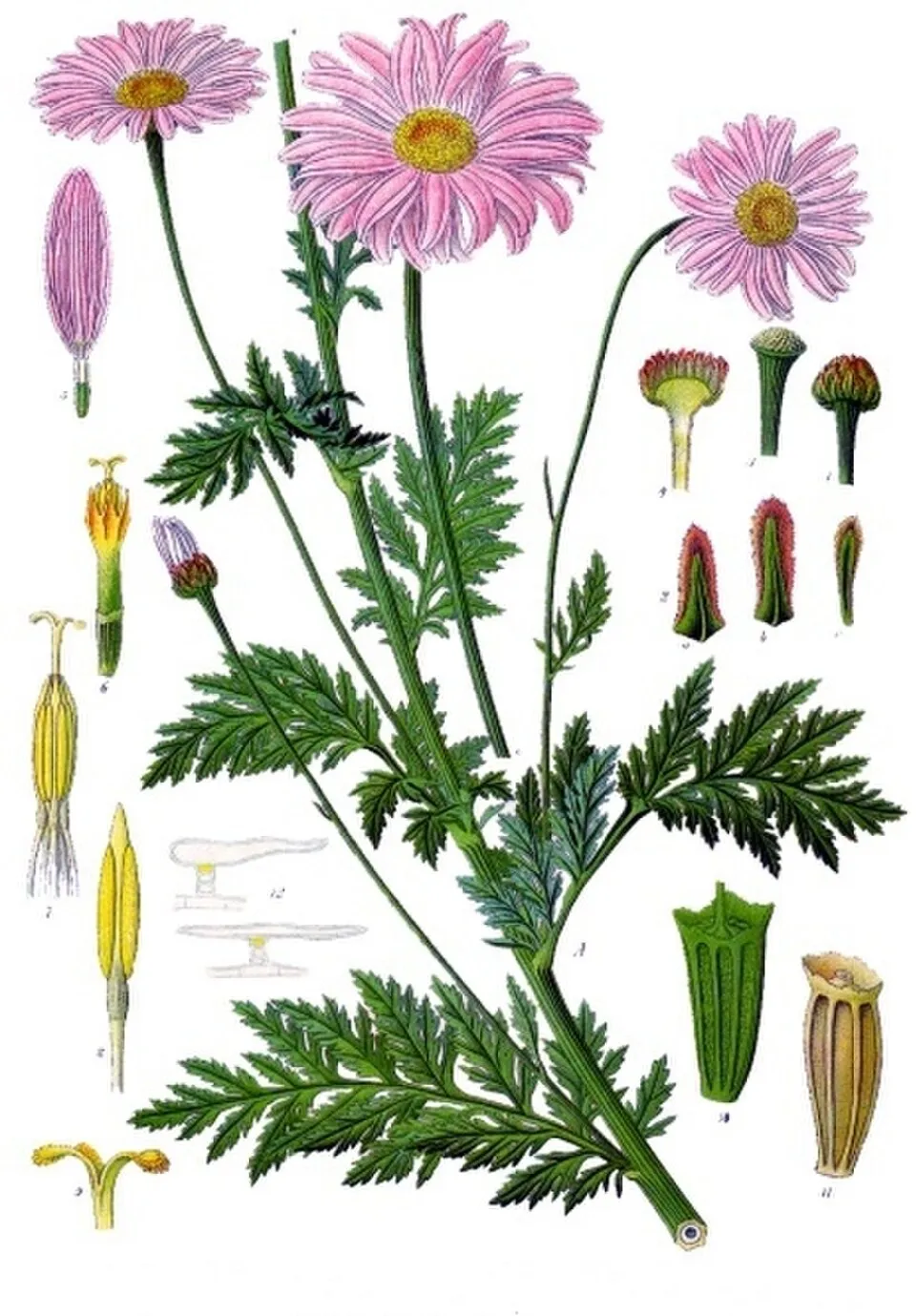
Tanacetum coccineum, commonly known as Painted Daisy or Pyrethrum Daisy, is a striking herbaceous perennial belonging to the extensive Asteraceae family. This species is native to the Caucasus region and parts of Central Asia, thriving in mountainous and sub-alpine meadows. Morphologically, it presents as an upright plant, typically reaching heights of 30 to 60 cm (1 to 2 feet), occasionally up to 1 meter under optimal conditions.
Its foliage is finely dissected, appearing fern-like and a vibrant green, forming a dense basal clump. The plant produces solitary or loosely clustered daisy-like capitula, characterized by a prominent yellow central disc florets encircled by numerous ray florets. These ray florets display a vivid spectrum of colors, including white, various shades of pink, and deep reds, making Tanacetum coccineum a popular ornamental in temperate gardens.
Its robust root system allows it to persist for many years, dying back to the ground in colder climates and re-emerging in spring. Beyond its aesthetic appeal, the plant is globally recognized for its potent natural insecticidal properties, which are concentrated within its flower heads, making it a valuable resource in organic pest management.
Trusted Scientific References
1. Authoritative external sources for Tanacetum Coccineum
1.1 Wikipedia — Tanacetum Coccineum
1.2 Kew POWO (Plants of the World Online)
1.3 PubMed — peer-reviewed research
1.4 NCBI Taxonomy Browser
1.5 GBIF — Global Biodiversity
1.6Tanacetum Coccineum should be interpreted through verified botanical identity, practical care, and responsible safety language. This recovery note adds the missing context needed for a complete profile: match light to the plant's habit, use well-drained soil, water according to season, and avoid unsupported medicinal or edible claims. For publishing, the plant can be presented as a source-backed garden plant with clear care guidance, common problem diagnosis, and conservative safety wording.
1.1.Tanacetum Coccineum — Key Features
- ✓ <strong>Potent Natural Insecticide</strong> — Maintained for its pyrethrin content.
- ✓ <strong>Ornamental Value</strong> — Features vibrant, daisy-like flowers in various colors.
- ✓ <strong>Herbaceous Perennial</strong> — Dies back in winter, regrows in spring.
- ✓ <strong>Finely Dissected Foliage</strong> — Distinctive fern-like leaves.
- ✓ <strong>Rapid Degradation</strong> — Pyrethrins break down quickly in sunlight.
- ✓ <strong>Low Mammalian Toxicity (Relative)</strong> — Safer for use around pets and humans than many synthetics.
- ✓ <strong>Wide Pest Spectrum</strong> — Effective against many common garden and household insects.
- ✓ <strong>Native to Caucasus</strong> — Thrives in temperate mountain regions.
- ✓ <strong>Easy to Cultivate</strong> — Adaptable to various garden conditions with proper care.
- ✓ <strong>Non</strong> — Medicinal for Internal Human Use — Emphasized for safety.
1.2.Tanacetum Coccineum — Quick Summary
- ✓ Painted Daisy (Tanacetum coccineum) is a vibrant ornamental and natural insecticide.
- ✓ Its flowers contain pyrethrins, potent compounds for organic pest control.
- ✓ Primarily used externally for insect and ectoparasite management; not for internal human consumption.
- ✓ Offers rapid 'knockdown' effect on pests and degrades quickly in the environment.
- ✓ Requires full sun, well-drained soil, and moderate watering for optimal growth.
- ✓ Users should exercise caution due to potential skin/respiratory irritation and high toxicity to aquatic life.
2.Tanacetum Coccineum — Scientific Identity
3.Tanacetum Coccineum — Quick Facts
4.Tanacetum Coccineum — Appearance & Identification
5.Tanacetum Coccineum — Native Habitat
6.Tanacetum Coccineum — Water Requirements
- ✓ Site Selection — Plant Painted Daisy in full sun to partial shade, ensuring at least 6 hours of direct sunlight daily for optimal flowering.
- ✓ Soil Requirements — Prefers well-drained, fertile soil enriched with organic matter. A pH range of 6.0 to 7.0 is ideal.
- ✓ Watering — Requires moderate, consistent watering, especially during dry spells. Keep the soil evenly moist but avoid waterlogging to prevent root rot.
- ✓ Propagation — Can be propagated from seeds sown in spring or autumn, or by dividing mature clumps every 3-4 years in early spring.
- ✓ Fertilization — Apply a balanced, all-purpose liquid fertilizer monthly during the active growing season to support robust growth and abundant blooms.
- ✓ Maintenance — Deadhead spent blooms regularly to encourage continuous flowering and prevent unwanted self-seeding. Provide good air circulation to deter fungal issues.
- ✓ Hardiness — Hardy in USDA zones 3-7, tolerating winter temperatures down to approximately -40°C (-40°F) when established.
- ✓ Pest & Disease Management — Generally resistant to major pests due to its natural compounds; ensure good drainage and air circulation to prevent common fungal diseases like root rot.
Reviewed by the Flora Medical Global Botanical Review Panel
Multi-disciplinary editorial group · Botany · Ethnobotany · Herbal-medicine literature
Who reviewed this: This page was checked by the Flora Medical Global Botanical Review Panel — an in-house editorial group of botany graduates, ethnobotany researchers, and horticulture practitioners who collectively maintain our 7,000+ plant encyclopedia. Meet the team.
Our 4-step verification process
1. Taxonomic verification
Scientific names and synonyms cross-checked against Kew POWO, World Flora Online, and The Plant List.
2. Phytochemical & medicinal cross-reference
Active compounds, traditional uses, and reported activities are cross-referenced with PubMed, USDA Dr. Duke's database, and peer-reviewed ethnobotanical literature.
3. Conservation & distribution check
Distribution, ecology, and conservation status confirmed against GBIF occurrence records and the IUCN Red List.
4. Editorial & safety review
Every entry passes an editorial pass for clarity, originality, and safety notices (toxicity, contraindications, dosage caveats) before publication.
Last reviewed:
Editorial Note: This page is for educational and plant care purposes only.
Written by: Flora Medical Global Editorial Team
Reviewed by: Flora Medical Global Botanical Review Panel
Last Updated: June 15, 2026







Tanacetum Coccineum — Comments & Community Reviews
Rate this plant