

Care Disclaimer: Plant care recommendations are general guidelines based on common growing conditions. Individual results may vary based on your local environment, climate, and care routine. If your plant is toxic, keep it away from children and pets, and consult a veterinarian if accidental ingestion occurs.
1.Thunbergia Erecta — Overview
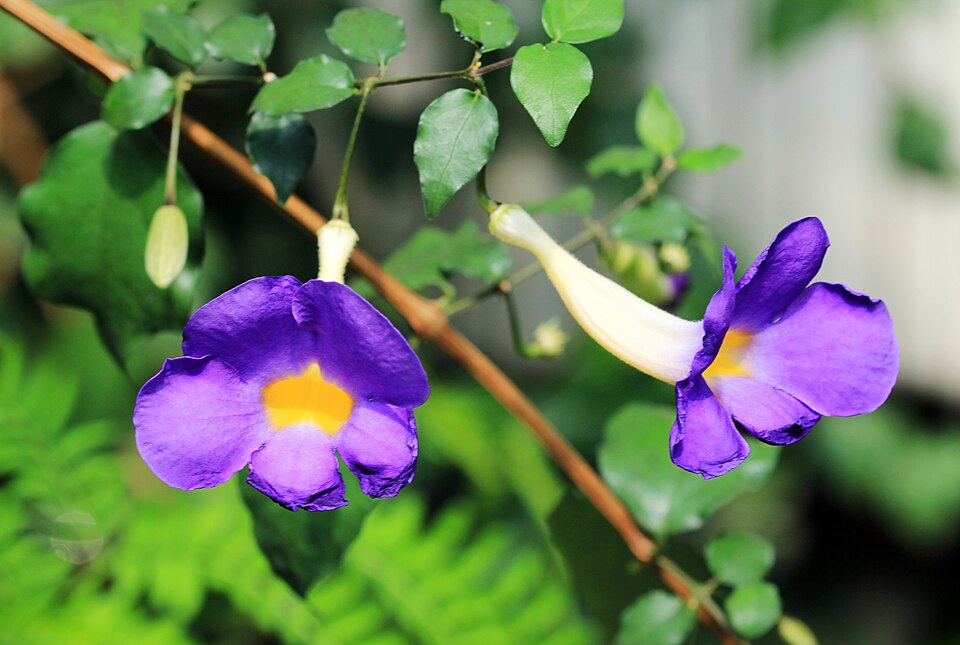
Thunbergia erecta, commonly known as the Bush Clockvine, King's Mantle, or Potato Bush, is a captivating evergreen shrub belonging to the Acanthaceae family. Native to the lush tropical regions of West Africa, this ornamental plant has gained global popularity for its striking aesthetic appeal and robust growth habit. Morphologically, it presents as a dense, upright to slightly sprawling shrub, typically reaching heights of 1 to 3 meters, though it can be trained as a climber or pruned to maintain a more compact form.
Its leaves are ovate to lanceolate, glossy dark green, and arranged oppositely along the stems, providing a verdant backdrop for its prolific blooms. The most distinctive feature of Thunbergia erecta is its vibrant, trumpet-shaped flowers, which emerge profusely throughout the year in warm climates. These exquisite blossoms typically display rich shades of deep purple or royal blue, often with a contrasting bright yellow throat, creating a visually stunning spectacle.
Each flower measures approximately 5-7 cm in diameter and possesses five broad petals that flare outwards. The plant's adaptability to various pruning styles makes it an excellent choice for hedges, borders, specimen planting, or container cultivation in suitable subtropical and tropical environments worldwide.
Trusted Scientific References
1. Authoritative external sources for Thunbergia Erecta
1.1 Wikipedia — Thunbergia Erecta
1.2 Kew POWO (Plants of the World Online)
1.3 PubMed — peer-reviewed research
1.4 NCBI Taxonomy Browser
1.5 GBIF — Global Biodiversity
1.6Thunbergia Erecta should be interpreted through verified botanical identity, practical care, and responsible safety language. This recovery note adds the missing context needed for a complete profile: match light to the plant's habit, use well-drained soil, water according to season, and avoid unsupported medicinal or edible claims. For publishing, the plant can be presented as a source-backed garden plant with clear care guidance, common problem diagnosis, and conservative safety wording.
1.1.Thunbergia Erecta — Key Features
- ✓ <strong>Striking deep purple to blue trumpet</strong> — shaped flowers with a contrasting yellow throat.
- ✓ <strong>Evergreen shrub native</strong> — Evergreen shrub native to tropical West Africa, adaptable to various climates.
- ✓ <strong>Prolific bloomer, producing</strong> — Prolific bloomer, producing flowers almost continuously throughout the year in warm regions.
- ✓ <strong>Contains a rich</strong> — Contains a rich array of phytochemicals, including flavonoids, alkaloids, and phenolic compounds.
- ✓ <strong>Traditionally valued for its anti</strong> — inflammatory, analgesic, and wound-healing properties.
- ✓ <strong>Popular ornamental plant</strong> — Popular ornamental plant for hedges, borders, and specimen planting due to its dense growth.
- ✓ <strong>Relatively low</strong> — maintenance once established, requiring well-draining soil and ample sunlight.
- ✓ <strong>Can be pruned</strong> — Can be pruned into a bush or trained as a climbing vine, offering versatility in landscaping.
- ✓ <strong>Attracts pollinators like</strong> — Attracts pollinators like butterflies and bees, enhancing garden biodiversity.
- ✓ <strong>Resilient to many</strong> — Resilient to many common pests and diseases, contributing to its ease of cultivation.
1.2.Thunbergia Erecta — Quick Summary
- ✓ Thunbergia erecta, known as Bush Clockvine or King's Mantle, is a vibrant ornamental shrub from tropical Africa.
- ✓ Traditionally used for anti-inflammatory, analgesic, and wound-healing purposes.
- ✓ Rich in flavonoids, alkaloids, saponins, and phenolic compounds.
- ✓ Thrives in warm, humid climates with well-draining soil and regular pruning.
- ✓ Primary traditional uses include topical poultices and internal infusions for various ailments.
- ✓ Safety concerns include potential allergic reactions, gastrointestinal upset, and interactions with medications, especially for pregnant women and children.
2.Thunbergia Erecta — Scientific Identity
3.Thunbergia Erecta — Quick Facts
4.Thunbergia Erecta — Appearance & Identification
5.Thunbergia Erecta — Native Habitat
6.Thunbergia Erecta — Water Requirements
- ✓ Soil Requirements — Thrives in well-draining, fertile soil rich in organic matter, with a slightly acidic to neutral pH (6.0-7.0); avoid heavy clay soils that retain too much moisture.
- ✓ Light Conditions — Prefers full sun to partial shade for optimal flowering; too much shade can reduce bloom production, while intense, scorching sun might stress the plant in very hot climates.
- ✓ Watering Regimen — Requires regular watering to keep the soil consistently moist, especially during dry periods and its active growing season; ensure good drainage to prevent waterlogging.
- ✓ Temperature and Humidity — Best suited for warm, humid tropical and subtropical climates, thriving in temperatures between 18-30°C (65-85°F); it is sensitive to frost and cold.
- ✓ Fertilization — Benefits from regular feeding with a balanced, all-purpose fertilizer during the growing season (spring and summer) to support vigorous growth and abundant flowering.
- ✓ Pruning — Regular pruning is essential to maintain its bushy shape, encourage more prolific flowering, and prevent it from becoming leggy; prune after a flush of blooms or in late winter/early spring.
- ✓ Propagation — Can be easily propagated from semi-hardwood stem cuttings taken in spring or summer, or from seeds sown in warm, moist conditions.
- ✓ Pest and Disease Control — Generally hardy, but can occasionally be susceptible to common pests like spider mites, mealybugs, or whiteflies; ensure good air circulation and timely treatment if needed.
Reviewed by the Flora Medical Global Botanical Review Panel
Multi-disciplinary editorial group · Botany · Ethnobotany · Herbal-medicine literature
Who reviewed this: This page was checked by the Flora Medical Global Botanical Review Panel — an in-house editorial group of botany graduates, ethnobotany researchers, and horticulture practitioners who collectively maintain our 7,000+ plant encyclopedia. Meet the team.
Our 4-step verification process
1. Taxonomic verification
Scientific names and synonyms cross-checked against Kew POWO, World Flora Online, and The Plant List.
2. Phytochemical & medicinal cross-reference
Active compounds, traditional uses, and reported activities are cross-referenced with PubMed, USDA Dr. Duke's database, and peer-reviewed ethnobotanical literature.
3. Conservation & distribution check
Distribution, ecology, and conservation status confirmed against GBIF occurrence records and the IUCN Red List.
4. Editorial & safety review
Every entry passes an editorial pass for clarity, originality, and safety notices (toxicity, contraindications, dosage caveats) before publication.
Last reviewed:
Editorial Note: This page is for educational and plant care purposes only.
Written by: Flora Medical Global Editorial Team
Reviewed by: Flora Medical Global Botanical Review Panel
Last Updated: June 15, 2026







Thunbergia Erecta — Comments & Community Reviews
Rate this plant