
Care Disclaimer: Plant care recommendations are general guidelines based on common growing conditions. Individual results may vary based on your local environment, climate, and care routine. If your plant is toxic, keep it away from children and pets, and consult a veterinarian if accidental ingestion occurs.
1.Thyme — Overview
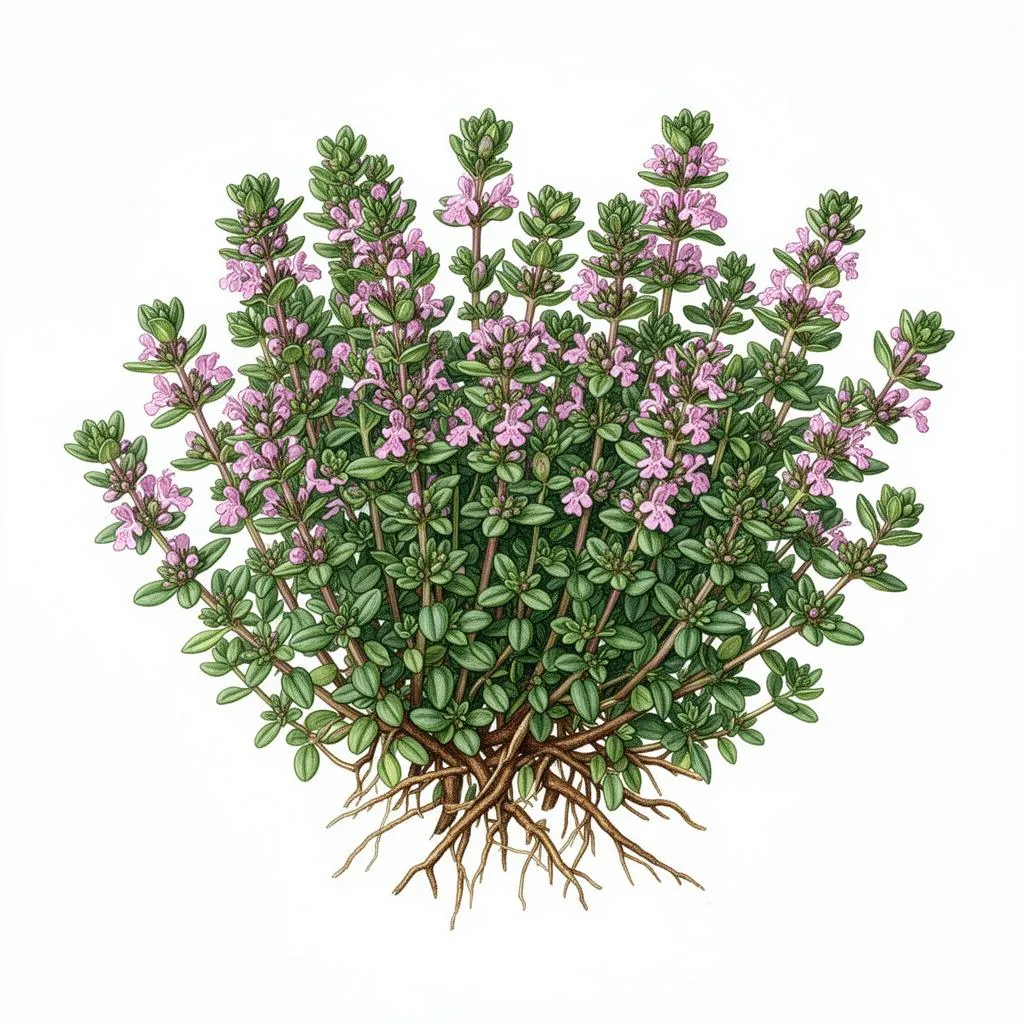
Thyme, scientifically known as Thymus vulgaris L., is an aromatic, perennial subshrub belonging to the expansive Lamiaceae family, which is renowned for its many fragrant and medicinally potent members. This resilient herb is primarily indigenous to the sun-drenched, rocky landscapes of the Mediterranean basin, including Southern Europe and North Africa, where it thrives in well-drained, often calcareous soils and warm, arid climates. Its adaptability has facilitated its naturalization and widespread cultivation across temperate regions globally. Typically growing to a modest height of 15-30 cm (6-12 inches), Thymus vulgaris forms dense, low-lying mats or small, woody mounds.
Its distinctive morphology includes slender, often reddish-brown, lignified stems that branch profusely. The leaves are small, typically 4-10 mm long, sessile or short-petioled, ovate-lanceolate to elliptical in shape, and possess an appealing grey-green coloration due to a dense covering of fine, short hairs on the underside. These leaves are densely packed along the stems, giving the plant a bushy appearance. During late spring to early summer, Thyme produces tiny, tubular, bilabiate flowers, ranging in color from pale pink to a delicate lavender-purple, which are borne in terminal, often dense, capitate or spicate clusters.
These blossoms are highly attractive to pollinators, particularly honey bees, making Thyme a valuable melliferous plant. The plant's characteristic robust, pungent, and earthy aroma, coupled with its distinctive flavor, is attributed to its abundant essential oil content, primarily composed of phenolic monoterpenes such as thymol and carvacrol. Historically, Thyme’s significance transcends its culinary use; ancient civilizations, from the Egyptians using it in embalming rituals to the Greeks and Romans valuing it for its fragrance, antiseptic qualities, and as a symbol of courage and vitality, have long recognized its multifaceted properties. This rich heritage, combined with modern scientific validation, underscores Thyme’s enduring importance in both traditional and contemporary healing practices.
Trusted Scientific References
1. Authoritative external sources for Thymus vulgaris L.
1.1 Wikipedia — Thymus vulgaris L.
1.2 Kew POWO (Plants of the World Online)
1.3 PubMed — peer-reviewed research
1.4 NCBI Taxonomy Browser
1.5 GBIF — Global Biodiversity
1.1.Thyme — Key Features
- ✓ <strong>Aromatic perennial subshrub.</strong> — Aromatic perennial subshrub.
- ✓ <strong>Member of the</strong> — Member of the Lamiaceae (mint) family.
- ✓ <strong>Small, ovate</strong> — lanceolate, grey-green leaves.
- ✓ <strong>Tiny, pale pink</strong> — Tiny, pale pink to purple tubular flowers.
- ✓ <strong>Indigenous to the</strong> — Indigenous to the Mediterranean basin.
- ✓ <strong>Rich in essential</strong> — Rich in essential oil, particularly thymol and carvacrol.
- ✓ <strong>Possesses potent antimicrobial</strong> — Possesses potent antimicrobial and antioxidant properties.
- ✓ <strong>Traditional uses span</strong> — Traditional uses span ancient Egyptian, Greek, and Roman cultures.
- ✓ <strong>Widely used in</strong> — Widely used in culinary and medicinal applications worldwide.
- ✓ <strong>Drought</strong> — tolerant and relatively easy to cultivate.
1.2.Thyme — Quick Summary
- ✓ Versatile Mediterranean herb with a rich history in culinary and medicinal applications.
- ✓ Key active compounds are thymol and carvacrol, imparting potent antimicrobial and antioxidant properties.
- ✓ Widely recognized for its efficacy in treating respiratory ailments, coughs, and digestive issues.
- ✓ Possesses significant anti-inflammatory, expectorant, and antispasmodic actions.
- ✓ Essential oil requires careful dilution and cautious use due to its potent nature and potential for irritation.
- ✓ Culinary use is generally safe, but therapeutic doses warrant consultation with a healthcare professional, especially during pregnancy or with existing health conditions.
2.Thyme — Scientific Identity
3.Thyme — Quick Facts
4.Thyme — Appearance & Identification
5.Thyme — Native Habitat
6.Thyme — Water Requirements
- ✓ Climate — Thrives in full sun and warm, Mediterranean-like climates; tolerates some frost but prefers mild winters.
- ✓ Soil Requirements — Prefers well-drained, sandy, or gravelly soil with a neutral to alkaline pH (6.0-8.0); avoid heavy, waterlogged clay soils.
- ✓ Propagation — Easily propagated from seeds (sow indoors 6-8 weeks before last frost), stem cuttings (in spring or summer), or by dividing mature plants.
- ✓ Watering — Drought-tolerant once established; water sparingly, allowing soil to dry out completely between waterings to prevent root rot.
- ✓ Pruning — Prune lightly after flowering to maintain shape and encourage new growth; a harder prune in early spring can rejuvenate older plants.
- ✓ Harvesting — Harvest leaves and tender stems before flowering for optimal essential oil content and flavor; can be harvested multiple times throughout the growing season.
- ✓ Pests and Diseases — Generally robust and resistant to most pests and diseases, though susceptible to root rot in overly wet conditions.
- ✓ Container Growing — Excellent choice for containers and rock gardens due to its compact size and preference for well-drained conditions.
Reviewed by the Flora Medical Global Botanical Review Panel
Multi-disciplinary editorial group · Botany · Ethnobotany · Herbal-medicine literature
Who reviewed this: This page was checked by the Flora Medical Global Botanical Review Panel — an in-house editorial group of botany graduates, ethnobotany researchers, and horticulture practitioners who collectively maintain our 7,000+ plant encyclopedia. Meet the team.
Our 4-step verification process
1. Taxonomic verification
Scientific names and synonyms cross-checked against Kew POWO, World Flora Online, and The Plant List.
2. Phytochemical & medicinal cross-reference
Active compounds, traditional uses, and reported activities are cross-referenced with PubMed, USDA Dr. Duke's database, and peer-reviewed ethnobotanical literature.
3. Conservation & distribution check
Distribution, ecology, and conservation status confirmed against GBIF occurrence records and the IUCN Red List.
4. Editorial & safety review
Every entry passes an editorial pass for clarity, originality, and safety notices (toxicity, contraindications, dosage caveats) before publication.
Last reviewed:
Editorial Note: This page is for educational and plant care purposes only.
Written by: Flora Medical Global Editorial Team
Reviewed by: Flora Medical Global Botanical Review Panel
Last Updated: June 15, 2026







Thyme — Comments & Community Reviews
Rate this plant