


Care Disclaimer: Plant care recommendations are general guidelines based on common growing conditions. Individual results may vary based on your local environment, climate, and care routine. If your plant is toxic, keep it away from children and pets, and consult a veterinarian if accidental ingestion occurs.
1.Trillium — Overview
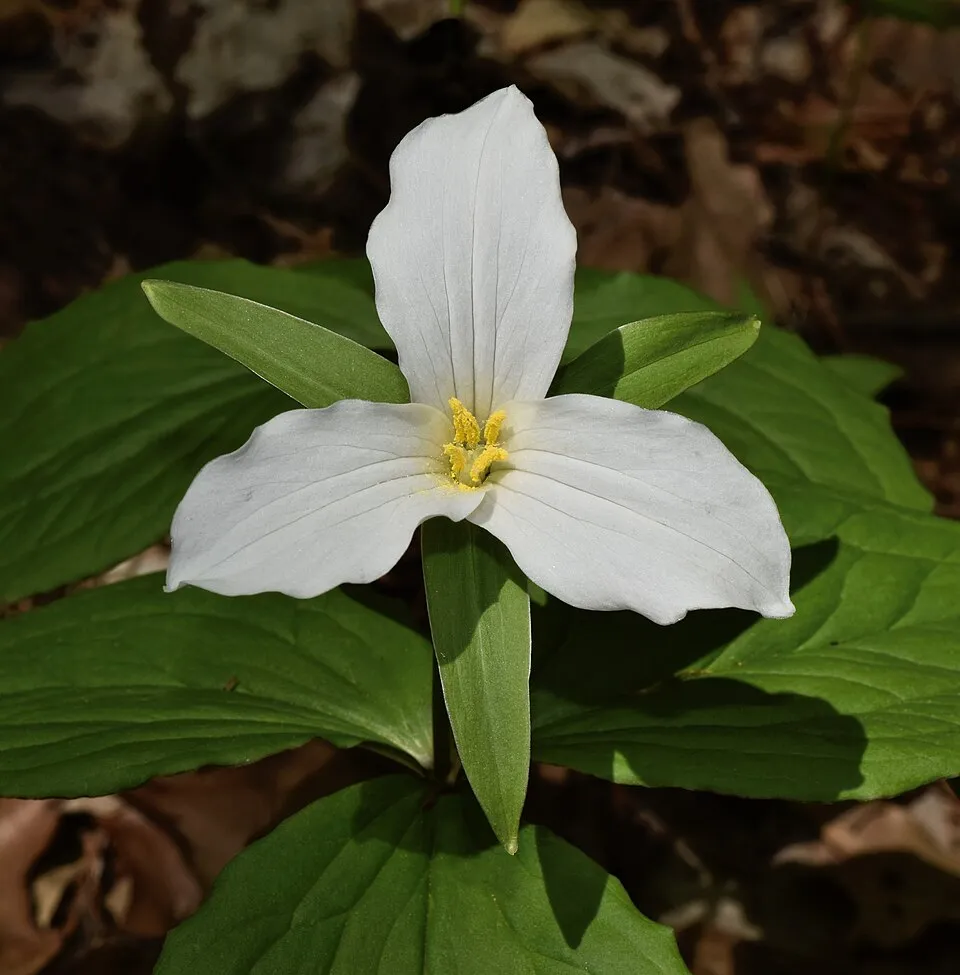
Trillium grandiflorum, commonly known as the Great White Trillium or Wake-robin, is a captivating perennial herbaceous plant indigenous to the verdant, moist, and shaded deciduous woodlands across Eastern North America. As a distinguished member of the Melanthiaceae family, this species is celebrated for its remarkable three-part symmetry, evident in its leaves, petals, and sepals. It typically grows from a robust, subterranean rhizome, sending up a single, unbranched stem that generally reaches heights of 30 to 60 cm (1 to 2 feet). At the apex of this stem, a distinctive whorl of three broad, ovate to elliptical leaves, each spanning 10 to 20 cm (4 to 8 inches) in length, forms a striking platform for its solitary flower.
The pristine white, three-petaled flower, a true herald of spring, unfurls between April and June, often measuring 5 to 10 cm (2 to 4 inches) across. These elegant petals gradually transition to a delicate pink hue as they age, enhancing the plant’s visual charm. The flower is further characterized by three prominent green sepals and a central cluster of bright yellow anthers. Trillium grandiflorum thrives in rich, well-drained soils abundant in organic matter, typically flourishing beneath the protective canopy of mature forest ecosystems.
Ecologically, its early spring flowers provide vital nectar and pollen for various native pollinators, while its seeds, equipped with lipid-rich elaiosomes, are efficiently dispersed by ants through myrmecochory, aiding its slow natural spread. However, this magnificent species faces considerable threats from habitat degradation, unsustainable collection for horticulture, and browsing by deer, underscoring the critical importance of its conservation.
Trusted Scientific References
1. Authoritative external sources for Trillium grandiflorum
1.1 Wikipedia — Trillium grandiflorum
1.2 Kew POWO (Plants of the World Online)
1.3 PubMed — peer-reviewed research
1.4 NCBI Taxonomy Browser
1.5 GBIF — Global Biodiversity
1.6Trillium should be interpreted through verified botanical identity, practical care, and responsible safety language. This recovery note adds the missing context needed for a complete profile: match light to the plant's habit, use well-drained soil, water according to season, and avoid unsupported medicinal or edible claims. For publishing, the plant can be presented as a source-backed garden plant with clear care guidance, common problem diagnosis, and conservative safety wording.
1.1.Trillium — Key Features
- ✓ <strong>Three</strong> — part symmetrical morphology in leaves, petals, and sepals.
- ✓ <strong>Striking white flowers</strong> — Striking white flowers that mature to a delicate pink hue.
- ✓ <strong>Native to moist,</strong> — Native to moist, shaded deciduous woodlands of Eastern North America.
- ✓ <strong>Perennial plant growing</strong> — Perennial plant growing from a stout, underground rhizome.
- ✓ <strong>Historically revered in</strong> — Historically revered in traditional Indigenous North American medicine for various ailments.
- ✓ <strong>Rich in bioactive</strong> — Rich in bioactive steroidal saponins and potent tannins.
- ✓ <strong>Seeds dispersed by</strong> — Seeds dispersed by ants (myrmecochory), indicating a unique ecological interaction.
- ✓ <strong>Faces significant conservation</strong> — Faces significant conservation concerns due to habitat loss and over-collection.
- ✓ <strong>Flowers bloom in</strong> — Flowers bloom in early spring, signaling the start of the growing season.
- ✓ <strong>Adaptable to rich, well</strong> — drained, organic soils with a preference for slightly acidic conditions.
1.2.Trillium — Quick Summary
- ✓ Trillium grandiflorum is a beautiful, three-part symmetrical perennial native to Eastern North American woodlands.
- ✓ Traditionally valued for its anti-inflammatory, astringent, diuretic, and uterine tonic properties by Indigenous peoples.
- ✓ Rich in steroidal saponins (e.g., diosgenin, trillin) and tannins, which underpin its medicinal actions.
- ✓ Faces significant conservation threats; ethical sourcing from reputable nurseries is crucial, never wild-harvest.
- ✓ Must be used with extreme caution under professional guidance due to potential toxicity, especially during pregnancy.
- ✓ Cultivation requires moist, well-drained, organic-rich soil in shaded environments, mimicking its natural habitat.
2.Trillium — Scientific Identity
3.Trillium — Quick Facts
4.Trillium — Appearance & Identification
5.Trillium — Native Habitat
6.Trillium — Water Requirements
- ✓ Site Selection — Plant Trillium grandiflorum in a partly-shaded, deciduous woodland habitat or a shade garden that mimics these conditions, ensuring protection from intense afternoon sun.
- ✓ Soil Preparation — Requires fertile, moist, and well-drained soil rich in organic matter; amend heavy clay soils with compost, leaf mulch, or peat moss to improve structure and fertility.
- ✓ Planting Depth & Spacing — Plant rhizomes 5-10 cm (2-4 inches) deep and 15-30 cm (6-12 inches) apart to allow for natural clumping and spread over several years.
- ✓ Watering — Keep soil consistently moist, especially during dry periods and after planting; established plants are more tolerant but prefer steady moisture.
- ✓ Fertilization — Annually apply a 1-2 inch layer of leaf mulch or compost in the fall to provide slow-release nutrients and maintain a slightly acidic pH.
- ✓ Dormancy Care — Allow foliage to yellow and die back naturally by midsummer; avoid cutting back until fully dormant to ensure energy is stored in the rhizome.
- ✓ Ethical Sourcing — Always purchase Trillium rhizomes or plants from reputable nurseries to avoid contributing to the depletion of wild populations, as many species are protected.
Reviewed by the Flora Medical Global Botanical Review Panel
Multi-disciplinary editorial group · Botany · Ethnobotany · Herbal-medicine literature
Who reviewed this: This page was checked by the Flora Medical Global Botanical Review Panel — an in-house editorial group of botany graduates, ethnobotany researchers, and horticulture practitioners who collectively maintain our 7,000+ plant encyclopedia. Meet the team.
Our 4-step verification process
1. Taxonomic verification
Scientific names and synonyms cross-checked against Kew POWO, World Flora Online, and The Plant List.
2. Phytochemical & medicinal cross-reference
Active compounds, traditional uses, and reported activities are cross-referenced with PubMed, USDA Dr. Duke's database, and peer-reviewed ethnobotanical literature.
3. Conservation & distribution check
Distribution, ecology, and conservation status confirmed against GBIF occurrence records and the IUCN Red List.
4. Editorial & safety review
Every entry passes an editorial pass for clarity, originality, and safety notices (toxicity, contraindications, dosage caveats) before publication.
Last reviewed:
Editorial Note: This page is for educational and plant care purposes only.
Written by: Flora Medical Global Editorial Team
Reviewed by: Flora Medical Global Botanical Review Panel
Last Updated: June 15, 2026







Trillium — Comments & Community Reviews
Rate this plant