
Care Disclaimer: Plant care recommendations are general guidelines based on common growing conditions. Individual results may vary based on your local environment, climate, and care routine. If your plant is toxic, keep it away from children and pets, and consult a veterinarian if accidental ingestion occurs.
1.Ursinia Anthemoides — Overview
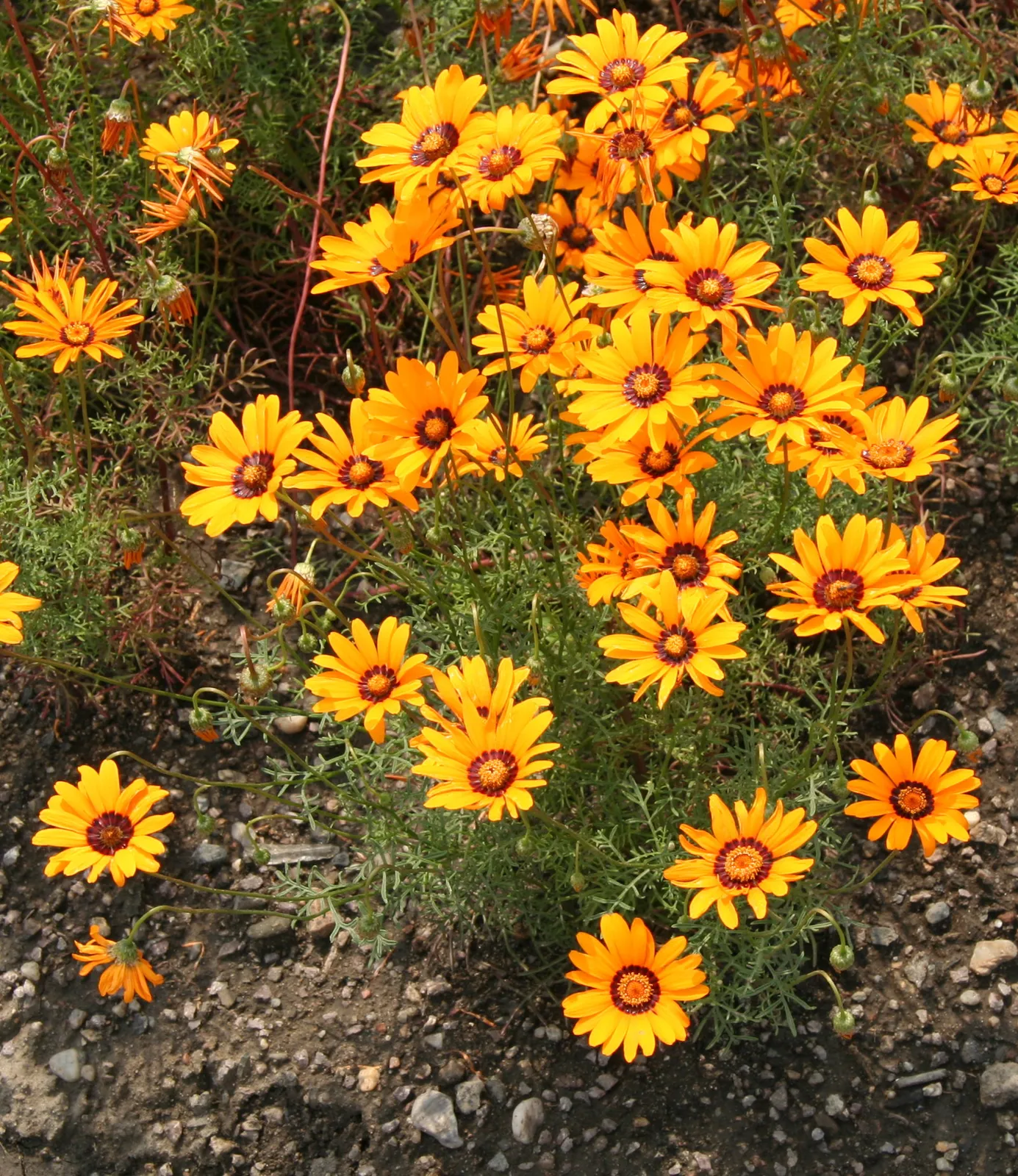
Ursinia anthemoides, commonly known as Cape Marigold or Gousblom, is an exquisite annual flowering plant indigenous to the biodiverse Western Cape region of South Africa. As a proud member of the expansive Asteraceae family, it shares kinship with well-known species like daisies and sunflowers, exhibiting characteristic floral structures. This resilient species is highly valued for its profusion of cheerful, daisy-like blossoms, which typically burst forth in vivid hues of orange, yellow, or pristine white.
Each flower often features a striking dark central disc, frequently encircled by a contrasting ring, adding to its visual appeal. The plant’s delicate, finely divided, fern-like foliage creates an elegant backdrop, beautifully complementing the abundant blooms.
Reaching a modest height of 30 to 60 cm, Ursinia anthemoides thrives in conditions of full sun and prefers well-drained, often dry, sandy, or gravelly soils, reflecting its adaptation to its native arid and semi-arid landscapes. These preferences make it an outstanding choice for various garden settings, including rock gardens, borders, containers, or naturalized areas, where it consistently delivers a bright splash of color from spring through summer.
Beyond its aesthetic charm, Ursinia anthemoides is particularly esteemed for its remarkable drought tolerance once established, significantly reducing water requirements, and its valuable ecological role in attracting a diverse array of pollinators, such as bees and butterflies, thereby supporting local ecosystems.
Trusted Scientific References
1. Authoritative external sources for Ursinia Anthemoides
1.1 Wikipedia — Ursinia Anthemoides
1.2 Kew POWO (Plants of the World Online)
1.3 PubMed — peer-reviewed research
1.4 NCBI Taxonomy Browser
1.5 GBIF — Global Biodiversity
1.6Ursinia Anthemoides should be interpreted through verified botanical identity, practical care, and responsible safety language. This recovery note adds the missing context needed for a complete profile: match light to the plant's habit, use well-drained soil, water according to season, and avoid unsupported medicinal or edible claims. For publishing, the plant can be presented as a source-backed garden plant with clear care guidance, common problem diagnosis, and conservative safety wording.
1.1.Ursinia Anthemoides — Key Features
- ✓ <strong>Native to the</strong> — Native to the Western Cape of South Africa.
- ✓ <strong>Member of the</strong> — Member of the Asteraceae (Daisy) family.
- ✓ <strong>Produces vibrant orange, yellow, or white daisy</strong> — like flowers.
- ✓ <strong>Features a distinctive</strong> — Features a distinctive dark central disc, often with a contrasting ring.
- ✓ <strong>Has delicate, finely divided, fern</strong> — like foliage.
- ✓ <strong>Grows to a height of 30</strong> — 60 cm.
- ✓ <strong>Highly drought</strong> — tolerant once established.
- ✓ <strong>Excellent pollinator attractor</strong> — Excellent pollinator attractor (bees and butterflies).
- ✓ <strong>Deer resistant and</strong> — Deer resistant and low maintenance.
- ✓ <strong>Primarily cultivated for</strong> — Primarily cultivated for ornamental beauty in gardens.
1.2.Ursinia Anthemoides — Quick Summary
- ✓ Ursinia anthemoides, or Cape Marigold, is an annual flowering plant native to South Africa.
- ✓ It is prized for its vibrant, daisy-like flowers in shades of orange, yellow, or white.
- ✓ A member of the Asteraceae family, it is primarily cultivated as an ornamental garden plant.
- ✓ Known for its drought tolerance, deer resistance, and ability to attract pollinators.
- ✓ Contains phytochemicals like flavonoids and phenolic acids, typical of its family.
- ✓ No widely documented or scientifically validated medicinal uses for human consumption.
2.Ursinia Anthemoides — Scientific Identity
3.Ursinia Anthemoides — Quick Facts
4.Ursinia Anthemoides — Appearance & Identification
5.Ursinia Anthemoides — Native Habitat
6.Ursinia Anthemoides — Water Requirements
- ✓ Seed Sowing — Sow Ursinia anthemoides seeds directly outdoors in March or April after the last frost, or start indoors 4-6 weeks prior to the last frost date.
- ✓ Pre-soaking — Enhance germination rates by pre-soaking seeds overnight before planting 2-3 seeds per cell or directly into the garden.
- ✓ Planting Depth & Spacing — Plant seeds at a shallow depth of 1/8 inch and thin seedlings to achieve a final spacing of approximately 12 inches apart in the garden.
- ✓ Light Requirements — Ensure seedlings receive ample light; if grown indoors, provide 16 hours of fluorescent plant light daily, followed by 8 hours of darkness.
- ✓ Soil & Location — Choose a full sun location with well-drained, preferably dry, sandy, or gravelly soil, mimicking its native habitat conditions.
- ✓ Hardening Off — Prior to transplanting outdoor, acclimate indoor-started seedlings by gradually exposing them to outdoor conditions over about a week to reduce transplant shock.
- ✓ Watering & Weeding — Maintain consistent moisture until young plants are well-established, then water about once a week. Control weeds diligently to minimize competition for resources.
- ✓ Mulching — Apply organic mulch around plants, keeping it away from stems, to conserve soil moisture, regulate soil temperature, and suppress weed growth.
Reviewed by the Flora Medical Global Botanical Review Panel
Multi-disciplinary editorial group · Botany · Ethnobotany · Herbal-medicine literature
Who reviewed this: This page was checked by the Flora Medical Global Botanical Review Panel — an in-house editorial group of botany graduates, ethnobotany researchers, and horticulture practitioners who collectively maintain our 7,000+ plant encyclopedia. Meet the team.
Our 4-step verification process
1. Taxonomic verification
Scientific names and synonyms cross-checked against Kew POWO, World Flora Online, and The Plant List.
2. Phytochemical & medicinal cross-reference
Active compounds, traditional uses, and reported activities are cross-referenced with PubMed, USDA Dr. Duke's database, and peer-reviewed ethnobotanical literature.
3. Conservation & distribution check
Distribution, ecology, and conservation status confirmed against GBIF occurrence records and the IUCN Red List.
4. Editorial & safety review
Every entry passes an editorial pass for clarity, originality, and safety notices (toxicity, contraindications, dosage caveats) before publication.
Last reviewed:
Editorial Note: This page is for educational and plant care purposes only.
Written by: Flora Medical Global Editorial Team
Reviewed by: Flora Medical Global Botanical Review Panel
Last Updated: June 15, 2026







Ursinia Anthemoides — Comments & Community Reviews
Rate this plant