
Care Disclaimer: Plant care recommendations are general guidelines based on common growing conditions. Individual results may vary based on your local environment, climate, and care routine. If your plant is toxic, keep it away from children and pets, and consult a veterinarian if accidental ingestion occurs.
1.Uvularia — Overview
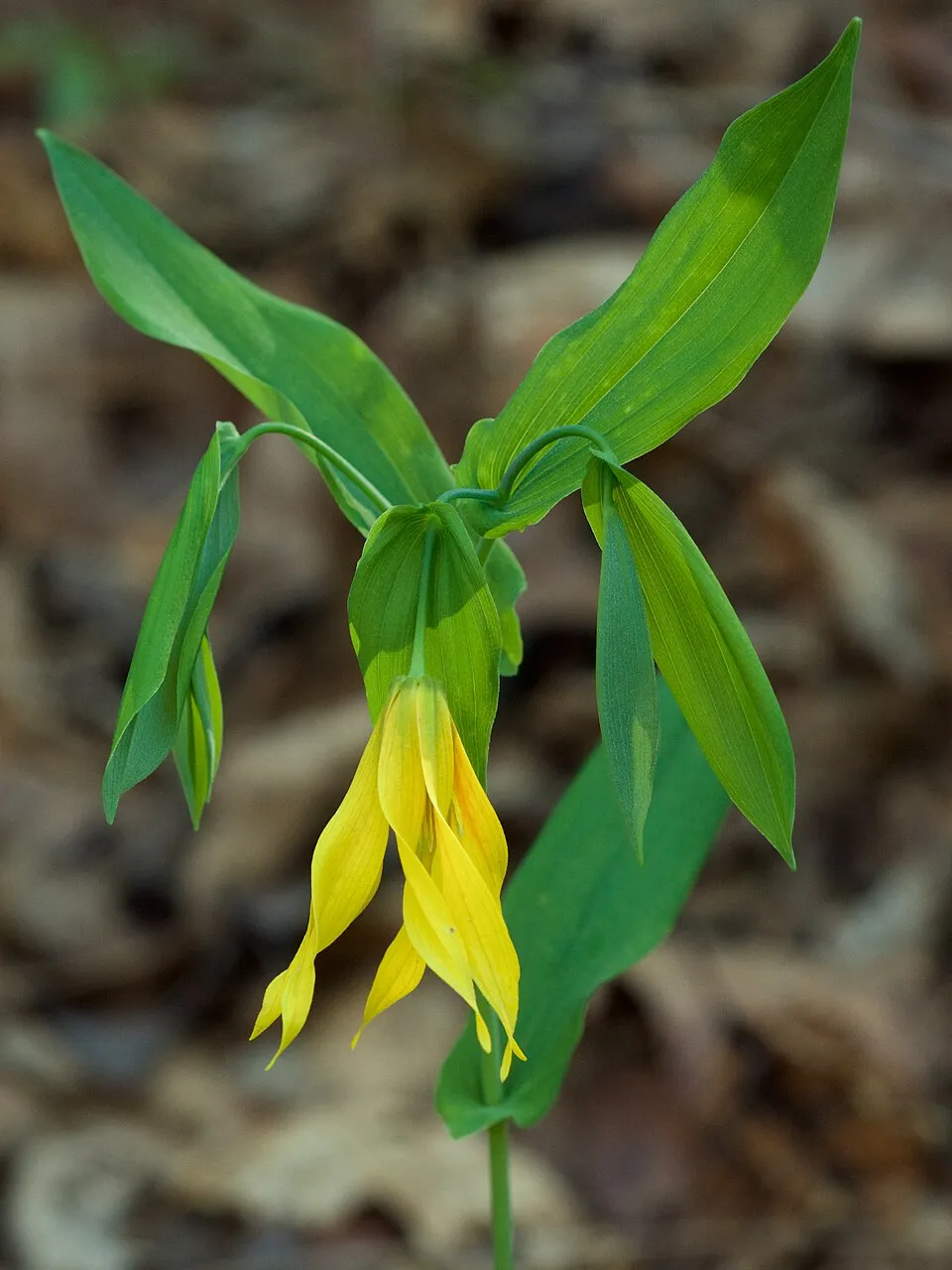
Uvularia grandiflora, commonly known as Large-flowered Bellwort or Merrybells, is an enchanting herbaceous perennial belonging to the Colchicaceae family, native to the rich deciduous woodlands of eastern and central North America. This species is characterized by its unique morphological features, standing approximately 1 to 2 feet (30-60 cm) tall. A distinctive characteristic is its perfoliate leaves, where the stem appears to pierce through the leaf blade, creating a visually striking effect.
In early spring, Uvularia grandiflora unfurls delicate, nodding, bell-shaped flowers of a vibrant yellow hue, gracefully suspended from the upper leaf axils. These solitary blooms add a touch of elegance to the woodland understory. The plant propagates slowly through rhizomes, gradually forming modest clumps, making it an ideal choice for shaded garden areas, naturalized settings, and woodland gardens where its subtle beauty can be appreciated.
Its ecological role includes providing early spring nectar for pollinators. Taxonomically, it sits within the order Liliales, a group known for many geophytes and plants with prominent flowers. Its distribution spans from the Great Lakes region south to Georgia and west to Oklahoma, thriving in habitats rich in organic matter and consistent moisture.
Trusted Scientific References
1. Authoritative external sources for Uvularia grandiflora
1.1 Wikipedia — Uvularia grandiflora
1.2 Kew POWO (Plants of the World Online)
1.3 PubMed — peer-reviewed research
1.4 NCBI Taxonomy Browser
1.5 GBIF — Global Biodiversity
1.6Uvularia should be interpreted through verified botanical identity, practical care, and responsible safety language. This recovery note adds the missing context needed for a complete profile: match light to the plant's habit, use well-drained soil, water according to season, and avoid unsupported medicinal or edible claims. For publishing, the plant can be presented as a source-backed garden plant with clear care guidance, common problem diagnosis, and conservative safety wording.
1.1.Uvularia — Key Features
- ✓ <strong>Native to Eastern and Central North America</strong> — Indigenous woodland plant.
- ✓ <strong>Perfoliate Leaves</strong> — Unique stem-piercing leaf morphology.
- ✓ <strong>Bell</strong> — Shaped Yellow Flowers — Distinctive nodding spring blooms.
- ✓ <strong>Rhizomatous Spread</strong> — Forms slow-growing clumps.
- ✓ <strong>Traditional Native American Medicine</strong> — Historical ethnobotanical uses.
- ✓ <strong>Contains Saponins and Alkaloids</strong> — Active phytochemical compounds.
- ✓ <strong>Anti</strong> — inflammatory and Analgesic Properties — Key traditional actions.
- ✓ <strong>Shade</strong> — Loving Woodland Plant — Ideal for dappled light environments.
- ✓ <strong>Low Maintenance Once Established</strong> — Resilient in suitable conditions.
- ✓ <strong>Ornamental and Medicinal Value</strong> — Valued for both beauty and historical use.
1.2.Uvularia — Quick Summary
- ✓ Uvularia grandiflora is a native North American perennial known for its distinctive perfoliate leaves and bell-shaped yellow flowers.
- ✓ Traditionally used by Native Americans for anti-inflammatory, pain-relieving, and febrifuge properties.
- ✓ Contains saponins and alkaloids, including uvularine, which contribute to its medicinal effects but also potential toxicity.
- ✓ Primarily used for ailments such as sore throats, coughs, rheumatism, and topical skin irritations.
- ✓ Cultivation requires shade, moist, well-drained soil, and slow propagation via rhizomes.
- ✓ Not recommended for self-medication due to limited modern research and potential adverse effects.
2.Uvularia — Scientific Identity
3.Uvularia — Quick Facts
4.Uvularia — Appearance & Identification
5.Uvularia — Native Habitat
6.Uvularia — Water Requirements
- ✓ Site Selection — Prefers partial to full shade, mimicking its natural woodland habitat, making it ideal for understory planting.
- ✓ Soil Requirements — Thrives in moist, well-drained, organically rich soil with a neutral to slightly acidic pH for optimal growth.
- ✓ Watering — Requires regular watering, especially during dry periods, to keep the soil consistently moist but never waterlogged.
- ✓ Propagation — Can be propagated by planting rhizomes or divisions in early spring or fall, or by seed, though seed germination can be slow.
- ✓ Fertilization — Benefits from an annual application of compost or a balanced slow-release fertilizer in spring to support robust growth.
- ✓ Mulching — Applying a layer of organic mulch helps retain soil moisture, regulate soil temperature, and suppress weed growth.
- ✓ Hardiness — Hardy in USDA Zones 3-8, tolerating temperatures down to approximately -40°F (-40°C), though minimum tolerance is often cited around 27°F (-3°C) for optimal health.
- ✓ Growth Habit — Spreads slowly by rhizomes, forming attractive, manageable clumps over time, suitable for naturalized areas.
Reviewed by the Flora Medical Global Botanical Review Panel
Multi-disciplinary editorial group · Botany · Ethnobotany · Herbal-medicine literature
Who reviewed this: This page was checked by the Flora Medical Global Botanical Review Panel — an in-house editorial group of botany graduates, ethnobotany researchers, and horticulture practitioners who collectively maintain our 7,000+ plant encyclopedia. Meet the team.
Our 4-step verification process
1. Taxonomic verification
Scientific names and synonyms cross-checked against Kew POWO, World Flora Online, and The Plant List.
2. Phytochemical & medicinal cross-reference
Active compounds, traditional uses, and reported activities are cross-referenced with PubMed, USDA Dr. Duke's database, and peer-reviewed ethnobotanical literature.
3. Conservation & distribution check
Distribution, ecology, and conservation status confirmed against GBIF occurrence records and the IUCN Red List.
4. Editorial & safety review
Every entry passes an editorial pass for clarity, originality, and safety notices (toxicity, contraindications, dosage caveats) before publication.
Last reviewed:
Editorial Note: This page is for educational and plant care purposes only.
Written by: Flora Medical Global Editorial Team
Reviewed by: Flora Medical Global Botanical Review Panel
Last Updated: June 15, 2026







Uvularia — Comments & Community Reviews
Rate this plant