
Care Disclaimer: Plant care recommendations are general guidelines based on common growing conditions. Individual results may vary based on your local environment, climate, and care routine. If your plant is toxic, keep it away from children and pets, and consult a veterinarian if accidental ingestion occurs.
1.Vernonia Noveboracensis — Overview
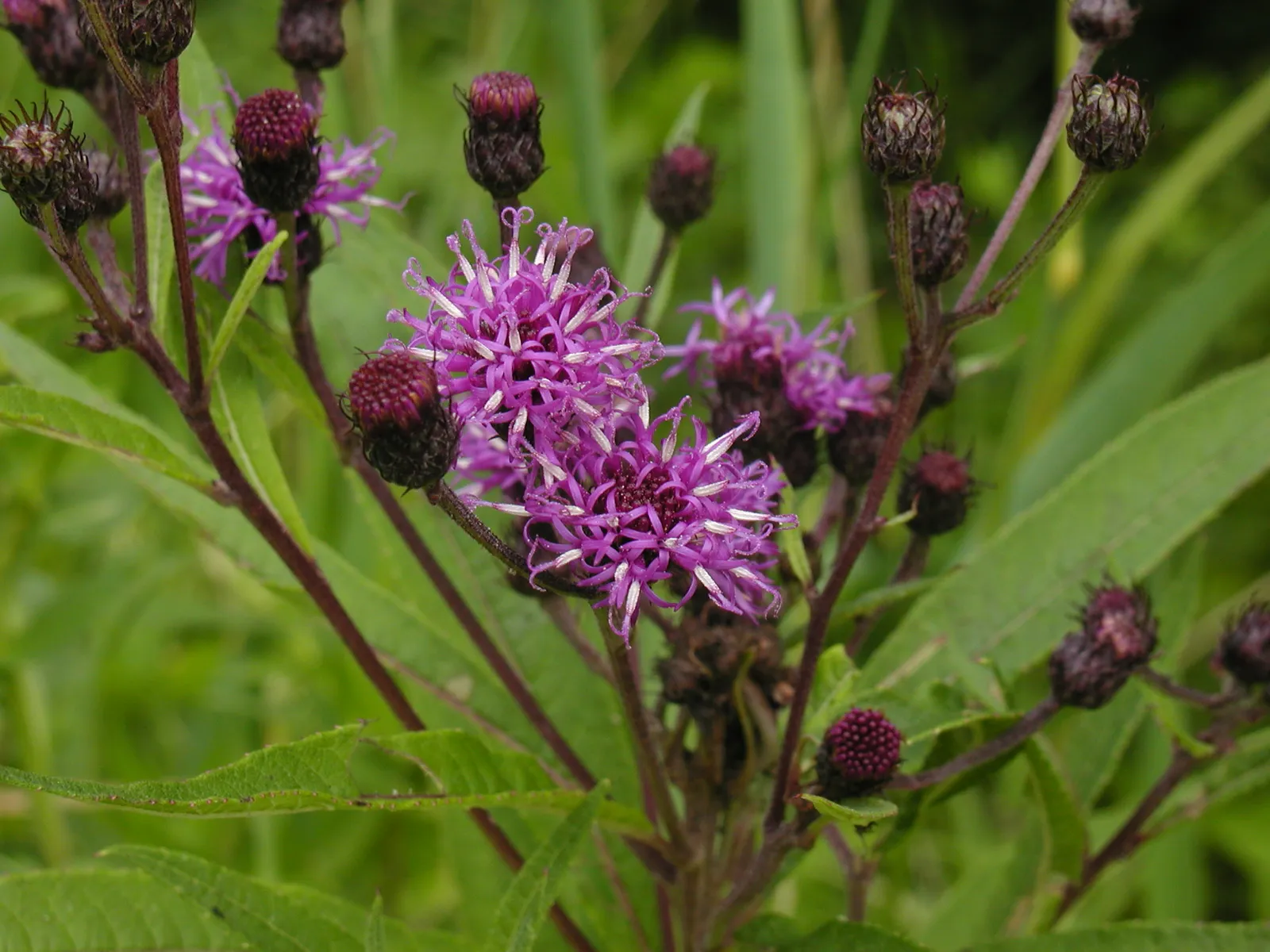
Vernonia noveboracensis, widely known as New York Ironweed, is a striking and robust perennial herbaceous plant indigenous to the eastern and central regions of the United States. It is a proud member of the Asteraceae family, establishing its botanical kinship with familiar species like sunflowers and asters. This species is characterized by its impressively tall, sturdy, and often unbranched stems, which can ascend to heights of 4 to 8 feet (1.2 to 2.4 meters) or even more, asserting a commanding presence within its natural habitats of moist meadows, open woodlands, and along stream banks. Its leaves are typically lance-shaped to elliptical, a rich dark green, and arranged alternately along the stem, featuring finely toothed margins.
The most distinguishing characteristic of Vernonia noveboracensis is its vibrant, intense purple to reddish-purple flowers, which burst into bloom in late summer through early fall. These captivating flowers are organized into dense, flat-topped to somewhat rounded clusters, known as corymbs, positioned at the apex of the stems. Each individual flower head is composed entirely of disc florets, lending them a thistle-like appearance, though notably lacking the sharp spines. The deep violet florets are a magnet for a diverse array of pollinators, particularly butterflies, bees, and other beneficial insects, playing a crucial ecological role.
Following the flowering period, the plant produces small, ribbed achenes—dry, single-seeded fruits—each crowned with a reddish-brown pappus, which facilitates wind dispersal. The common name 'Ironweed' aptly describes its tough, resilient stems and the rust-like hue of its drying seed heads, underscoring its hardy nature and remarkable adaptability to various environmental conditions.
Trusted Scientific References
1. Authoritative external sources for Vernonia Noveboracensis
1.1 Wikipedia — Vernonia Noveboracensis
1.2 Kew POWO (Plants of the World Online)
1.3 PubMed — peer-reviewed research
1.4 NCBI Taxonomy Browser
1.5 GBIF — Global Biodiversity
1.1.Vernonia Noveboracensis — Key Features
- ✓ <strong>Tall Perennial Herb</strong> — Reaches heights of 4-8 feet, providing significant vertical interest in gardens and natural landscapes.
- ✓ <strong>Vibrant Purple Blooms</strong> — Showcases intense purple to reddish-purple flowers in dense clusters from late summer to fall.
- ✓ <strong>Pollinator Magnet</strong> — Highly attractive to butterflies, bees, and other beneficial insects, supporting biodiversity.
- ✓ <strong>Resilient and Hardy</strong> — Nicknamed 'Ironweed' for its tough stems and ability to thrive in diverse conditions, including moist soils.
- ✓ <strong>Deer and Rabbit Resistant</strong> — Its bitter leaves are generally unpalatable to common garden pests like deer and rabbits.
- ✓ <strong>Lance</strong> — shaped Leaves — Features dark green, lance-shaped to elliptical leaves with finely toothed margins.
- ✓ <strong>Native Distribution</strong> — Naturally found across the eastern and central United States, making it an excellent native plant choice.
- ✓ <strong>Ecological Importance</strong> — Plays a crucial role in local ecosystems by providing late-season nectar for pollinators.
- ✓ <strong>Medicinal Potential</strong> — Valued for its traditional uses and studied for anti-inflammatory, antioxidant, and other bioactive compounds.
- ✓ <strong>Adaptable Growth</strong> — Thrives in full sun to part sun and a range of soil types, from slightly acidic to neutral.
1.2.Vernonia Noveboracensis — Quick Summary
- ✓ Native to Eastern/Central US, member of Asteraceae family.
- ✓ Known for tall, sturdy stems and vibrant purple late-summer flowers.
- ✓ Possesses anti-inflammatory, antioxidant, and potential hepatoprotective properties.
- ✓ Attracts a wide array of pollinators, vital for ecosystem health.
- ✓ Hardy and adaptable, thriving in moist, sunny conditions.
- ✓ Used traditionally for various ailments, primarily digestive and inflammatory issues.
2.Vernonia Noveboracensis — Scientific Identity
3.Vernonia Noveboracensis — Quick Facts
4.Vernonia Noveboracensis — Appearance & Identification
5.Vernonia Noveboracensis — Native Habitat
6.Vernonia Noveboracensis — Water Requirements
- ✓ USDA Zones — Thrives in USDA Hardiness Zones 4 through 8, demonstrating excellent cold hardiness.
- ✓ Sun Exposure — Prefers full sun (6-8 hours direct light daily) but tolerates light afternoon shade, especially in hotter climates.
- ✓ Soil Requirements — Adaptable to slightly acidic to neutral soil pH, ideally moist but well-draining; tolerates poorly draining or moderately damp spots.
- ✓ Watering — Requires consistent moisture, especially when establishing; established plants benefit from about 1 inch of water per week, particularly during dry spells.
- ✓ Planting — Can be grown from seed (requires cold stratification, best sown in late fall or winter) or potted plants (transplant after last spring frost), spaced approximately 2 feet apart.
- ✓ Fertilization — Generally does not require fertilization; excessive feeding can lead to floppy stems. A light layer of compost in spring or fall can be beneficial if plants appear to need a boost.
- ✓ Pest and Disease Resistance — Naturally robust and resistant to most pests and diseases; deer and rabbits typically avoid its bitter leaves.
- ✓ Propagation and Maintenance — Divide plants every 3-4 years in early spring to rejuvenate growth; allows for natural self-sowing if old flower heads are left intact.
Reviewed by the Flora Medical Global Botanical Review Panel
Multi-disciplinary editorial group · Botany · Ethnobotany · Herbal-medicine literature
Who reviewed this: This page was checked by the Flora Medical Global Botanical Review Panel — an in-house editorial group of botany graduates, ethnobotany researchers, and horticulture practitioners who collectively maintain our 7,000+ plant encyclopedia. Meet the team.
Our 4-step verification process
1. Taxonomic verification
Scientific names and synonyms cross-checked against Kew POWO, World Flora Online, and The Plant List.
2. Phytochemical & medicinal cross-reference
Active compounds, traditional uses, and reported activities are cross-referenced with PubMed, USDA Dr. Duke's database, and peer-reviewed ethnobotanical literature.
3. Conservation & distribution check
Distribution, ecology, and conservation status confirmed against GBIF occurrence records and the IUCN Red List.
4. Editorial & safety review
Every entry passes an editorial pass for clarity, originality, and safety notices (toxicity, contraindications, dosage caveats) before publication.
Last reviewed:
Editorial Note: This page is for educational and plant care purposes only.
Written by: Flora Medical Global Editorial Team
Reviewed by: Flora Medical Global Botanical Review Panel
Last Updated: June 15, 2026







Vernonia Noveboracensis — Comments & Community Reviews
Rate this plant