
Care Disclaimer: Plant care recommendations are general guidelines based on common growing conditions. Individual results may vary based on your local environment, climate, and care routine. If your plant is toxic, keep it away from children and pets, and consult a veterinarian if accidental ingestion occurs.
1.Viburnum Snowball — Overview
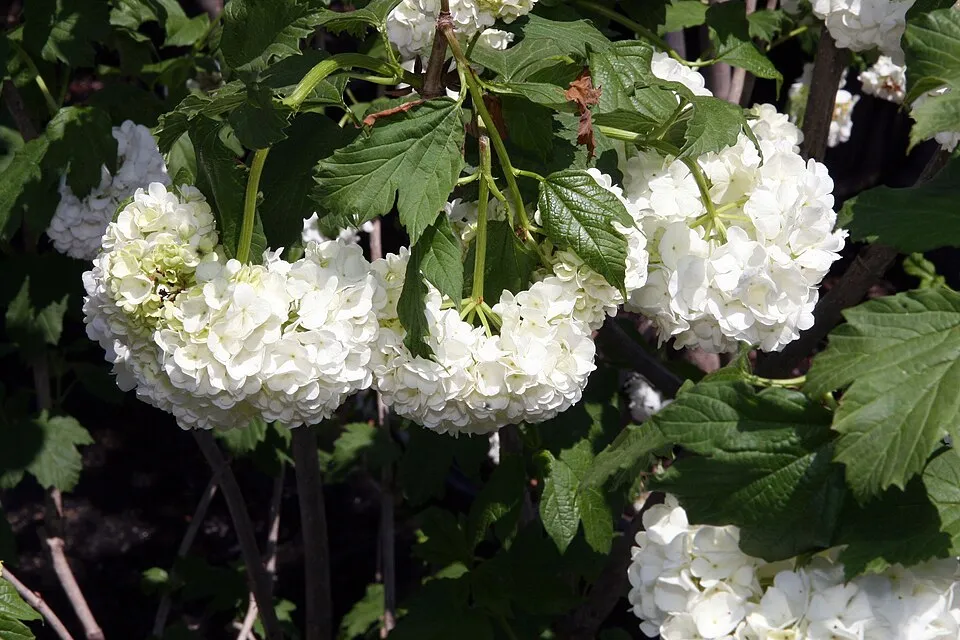
Viburnum opulus 'Roseum', widely recognized as the Snowball Viburnum or European Cranberrybush, is a captivating deciduous shrub belonging to the family Viburnaceae. This cultivar is particularly celebrated for its striking ornamental appeal, characterized by the prolific production of large, dense, globe-shaped clusters of sterile white flowers in late spring, which indeed resemble pristine snowballs. Unlike its species counterpart, 'Roseum' does not typically produce berries, dedicating its energy primarily to these spectacular floral displays.
The plant generally achieves a moderate to large size, often reaching heights and widths of 8 to 10 feet, forming a rounded, multi-stemmed bush. Its attractive, lobed foliage provides seasonal interest, transitioning from vibrant green in spring and summer to rich shades of reddish-orange, burgundy, and purple in the autumn, adding a dramatic visual element to any landscape. Native to Europe, North Africa, and Central Asia, the broader species Viburnum opulus thrives in temperate regions, often found in woodlands, hedgerows, and along riverbanks.
The 'Roseum' cultivar adapts well to a range of environmental conditions, preferring full sun to partial shade and well-drained, fertile soil, demonstrating excellent cold hardiness across USDA Zones 4 to 8. Its robust nature and stunning blooms make it a popular choice for garden enthusiasts and landscape designers seeking a low-maintenance yet high-impact shrub.
Trusted Scientific References
1. Authoritative external sources for Viburnum opulus Roseum
1.1 Wikipedia — Viburnum opulus Roseum
1.2 Kew POWO (Plants of the World Online)
1.3 PubMed — peer-reviewed research
1.4 NCBI Taxonomy Browser
1.5 GBIF — Global Biodiversity
1.6Viburnum Snowball should be interpreted through verified botanical identity, practical care, and responsible safety language. This recovery note adds the missing context needed for a complete profile: match light to the plant's habit, use well-drained soil, water according to season, and avoid unsupported medicinal or edible claims. For publishing, the plant can be presented as a source-backed garden plant with clear care guidance, common problem diagnosis, and conservative safety wording.
1.1.Viburnum Snowball — Key Features
- ✓ <strong>Showy White Snowball Flowers</strong> — Produces large, sterile, globe-shaped white flower clusters.
- ✓ <strong>Deciduous Shrub</strong> — Offers seasonal interest with changing foliage.
- ✓ <strong>Autumn Foliage Color</strong> — Leaves turn vibrant reddish-orange, burgundy, or purple in fall.
- ✓ <strong>Cold</strong> — Hardy — Resilient in USDA Plant Hardiness Zones 4-8.
- ✓ <strong>Ornamental Value</strong> — Highly prized for landscape and garden aesthetics.
- ✓ <strong>Adaptable to Various Soils</strong> — Tolerates a range of well-drained soil types.
- ✓ <strong>Moderate to Large Size</strong> — Typically grows 8-10 feet tall and wide.
- ✓ <strong>No Fruit Production</strong> — 'Roseum' cultivar focuses energy on flowers, not berries.
- ✓ <strong>Attracts Bees and Butterflies</strong> — While sterile, the flowers can still attract some pollinators to the garden environment.
- ✓ <strong>Cut Flower Potential</strong> — Blooms are excellent for floral arrangements.
1.2.Viburnum Snowball — Quick Summary
- ✓ Viburnum opulus 'Roseum' is an ornamental shrub known for its 'snowball' flowers.
- ✓ Traditionally, the bark of *V. opulus* species is used for antispasmodic effects, particularly for cramps.
- ✓ Rich in therapeutic compounds like coumarins (scopoletin, aesculetin) and tannins.
- ✓ Cultivation requires full sun to partial shade and well-drained soil, hardy in zones 4-8.
- ✓ Potentially contraindicated in pregnancy and may interact with certain medications.
- ✓ Offers natural relief for menstrual pain, muscle spasms, and coughs.
2.Viburnum Snowball — Scientific Identity
3.Viburnum Snowball — Quick Facts
4.Viburnum Snowball — Appearance & Identification
5.Viburnum Snowball — Native Habitat
6.Viburnum Snowball — Water Requirements
- ✓ Sun Exposure — Thrives in full sun to partial shade, with at least half a day of direct sunlight for optimal blooming.
- ✓ Soil Conditions — Prefers well-drained soil but is adaptable to a range of soil types, including normal, clay/heavy, and even moderately wet conditions; enrich with organic matter for best results.
- ✓ Watering — Requires regular watering, especially during dry spells, to maintain consistent soil moisture and support vigorous growth.
- ✓ Pruning — Prune in late spring or early summer after flowering (April and July are suitable) to shape the shrub and remove dead or weak branches; light trimming of shoots can be done in early spring.
- ✓ Planting Time — Bare root plants are best planted in spring or fall when the ground is workable; containerized plants can be planted from March through November.
- ✓ Hardiness Zones — Highly cold-hardy, suitable for growing in USDA Plant Hardiness Zones 4 through 8, demonstrating resilience to winter conditions.
- ✓ Mulching — Apply a layer of moisture-conserving, bulky organic mulch around the base in spring to keep roots cool, retain soil moisture, and suppress weeds.
- ✓ Wind Protection — For large-flowering varieties like 'Roseum', shielding from harsh cold winds can protect delicate blooms and foliage.
Reviewed by the Flora Medical Global Botanical Review Panel
Multi-disciplinary editorial group · Botany · Ethnobotany · Herbal-medicine literature
Who reviewed this: This page was checked by the Flora Medical Global Botanical Review Panel — an in-house editorial group of botany graduates, ethnobotany researchers, and horticulture practitioners who collectively maintain our 7,000+ plant encyclopedia. Meet the team.
Our 4-step verification process
1. Taxonomic verification
Scientific names and synonyms cross-checked against Kew POWO, World Flora Online, and The Plant List.
2. Phytochemical & medicinal cross-reference
Active compounds, traditional uses, and reported activities are cross-referenced with PubMed, USDA Dr. Duke's database, and peer-reviewed ethnobotanical literature.
3. Conservation & distribution check
Distribution, ecology, and conservation status confirmed against GBIF occurrence records and the IUCN Red List.
4. Editorial & safety review
Every entry passes an editorial pass for clarity, originality, and safety notices (toxicity, contraindications, dosage caveats) before publication.
Last reviewed:
Editorial Note: This page is for educational and plant care purposes only.
Written by: Flora Medical Global Editorial Team
Reviewed by: Flora Medical Global Botanical Review Panel
Last Updated: June 15, 2026







Viburnum Snowball — Comments & Community Reviews
Rate this plant