
Care Disclaimer: Plant care recommendations are general guidelines based on common growing conditions. Individual results may vary based on your local environment, climate, and care routine. If your plant is toxic, keep it away from children and pets, and consult a veterinarian if accidental ingestion occurs.
1.Vinca Minor — Overview
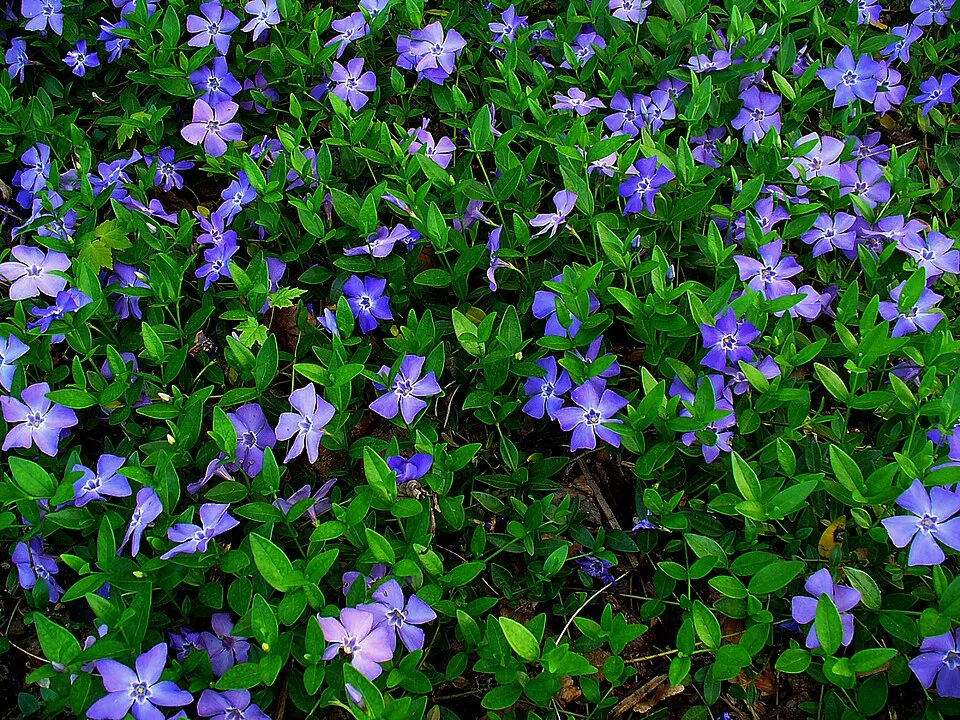
Vinca minor, commonly known as lesser periwinkle or dwarf periwinkle, is a resilient and ornamental evergreen subshrub belonging to the Apocynaceae family. Native to vast regions of Europe and parts of western Asia, this low-growing perennial is distinguished by its trailing, herbaceous stems that readily root upon contact with soil, enabling it to form dense, expansive mats. Its foliage consists of opposite, simple, oblong to ovate leaves, typically ½ to 2 inches long, which are a glossy, dark green and persist throughout the year, providing continuous groundcover.
In early spring, typically from March to April, and occasionally reblooming in the fall, Vinca minor produces solitary, charming, five-petaled, funnel-shaped flowers. These blossoms commonly appear in shades of violet-blue, purple, or white, depending on the cultivar, adding a delicate splash of color to shaded garden areas. The plant thrives in partial to full shade and prefers moist, well-drained soils rich in organic matter but demonstrates considerable adaptability to various soil conditions.
Its robust growth habit makes it a popular choice for erosion control on slopes, under trees and shrubs, or as a cascading element in containers. The milky sap exuded when stems are broken is characteristic of the Apocynaceae family.
Trusted Scientific References
1. Authoritative external sources for Vinca Minor
1.1 Wikipedia — Vinca Minor
1.2 Kew POWO (Plants of the World Online)
1.3 PubMed — peer-reviewed research
1.4 NCBI Taxonomy Browser
1.5 GBIF — Global Biodiversity
1.6Vinca Minor should be interpreted through verified botanical identity, practical care, and responsible safety language. This recovery note adds the missing context needed for a complete profile: match light to the plant's habit, use well-drained soil, water according to season, and avoid unsupported medicinal or edible claims. For publishing, the plant can be presented as a source-backed garden plant with clear care guidance, common problem diagnosis, and conservative safety wording.
1.1.Vinca Minor — Key Features
- ✓ <strong>Evergreen Groundcover</strong> — Provides year-round dark green foliage.
- ✓ <strong>Trailing Stems</strong> — Roots readily, forming dense mats and spreading rapidly.
- ✓ <strong>Violet</strong> — Blue Flowers — Charming, star-shaped blossoms in spring and often fall.
- ✓ <strong>Cognitive Enhancer</strong> — Contains vincamine, known for improving cerebral blood flow.
- ✓ <strong>Traditional Medicinal Plant</strong> — Historically used for circulatory and cognitive benefits.
- ✓ <strong>Astringent Properties</strong> — Useful for wound healing and reducing inflammation.
- ✓ <strong>Low Maintenance</strong> — Easy to cultivate in shaded areas.
- ✓ <strong>Adaptable</strong> — Tolerant of various soil conditions once established.
- ✓ <strong>Erosion Control</strong> — Excellent for stabilizing slopes and understory areas.
- ✓ <strong>Potent Alkaloids</strong> — Contains compounds with significant pharmacological activity.
1.2.Vinca Minor — Quick Summary
- ✓ Vinca minor is an evergreen groundcover with historical medicinal uses.
- ✓ Known for cognitive and circulatory support, primarily due to vincamine.
- ✓ Contains potent alkaloids, including reserpine, and traditionally vinblastine/vincristine.
- ✓ Traditionally used for wound healing, as an astringent, and a mild sedative.
- ✓ Cultivated for its ornamental value and ease of spread.
- ✓ Requires careful use due to potential side effects and drug interactions.
2.Vinca Minor — Scientific Identity
3.Vinca Minor — Quick Facts
4.Vinca Minor — Appearance & Identification
5.Vinca Minor — Native Habitat
6.Vinca Minor — Water Requirements
- ✓ Site Selection — Prefers partial to full shade; tolerates full sun but foliage color is richer in shade.
- ✓ Soil Requirements — Thrives in moist, well-drained soil rich in organic matter, but adaptable to a wide range of soil types.
- ✓ Planting — Plant rooted cuttings or established plants 12 to 18 inches apart for groundcover; 6-inch spacing ensures full coverage within one year.
- ✓ Watering — Requires sufficient water, especially during establishment and dry periods; avoid waterlogging.
- ✓ Fertilization — Fertilize only when necessary, typically in spring, with a balanced fertilizer (e.g., 10-10-10) at 6-8 pounds per 1,000 square feet.
- ✓ Pruning — Shear plants close to the ground occasionally to encourage dense new growth and manage spread.
- ✓ Propagation — Easily propagated by taking tip cuttings of non-flowering stems in late spring or by division throughout the growing season.
- ✓ Weed Control — Regular weeding and mulching are crucial until the groundcover fully establishes and covers the area.
Reviewed by the Flora Medical Global Botanical Review Panel
Multi-disciplinary editorial group · Botany · Ethnobotany · Herbal-medicine literature
Who reviewed this: This page was checked by the Flora Medical Global Botanical Review Panel — an in-house editorial group of botany graduates, ethnobotany researchers, and horticulture practitioners who collectively maintain our 7,000+ plant encyclopedia. Meet the team.
Our 4-step verification process
1. Taxonomic verification
Scientific names and synonyms cross-checked against Kew POWO, World Flora Online, and The Plant List.
2. Phytochemical & medicinal cross-reference
Active compounds, traditional uses, and reported activities are cross-referenced with PubMed, USDA Dr. Duke's database, and peer-reviewed ethnobotanical literature.
3. Conservation & distribution check
Distribution, ecology, and conservation status confirmed against GBIF occurrence records and the IUCN Red List.
4. Editorial & safety review
Every entry passes an editorial pass for clarity, originality, and safety notices (toxicity, contraindications, dosage caveats) before publication.
Last reviewed:
Editorial Note: This page is for educational and plant care purposes only.
Written by: Flora Medical Global Editorial Team
Reviewed by: Flora Medical Global Botanical Review Panel
Last Updated: June 15, 2026







Vinca Minor — Comments & Community Reviews
Rate this plant