
Care Disclaimer: Plant care recommendations are general guidelines based on common growing conditions. Individual results may vary based on your local environment, climate, and care routine. If your plant is toxic, keep it away from children and pets, and consult a veterinarian if accidental ingestion occurs.
1.Virginia Bluebell — Overview
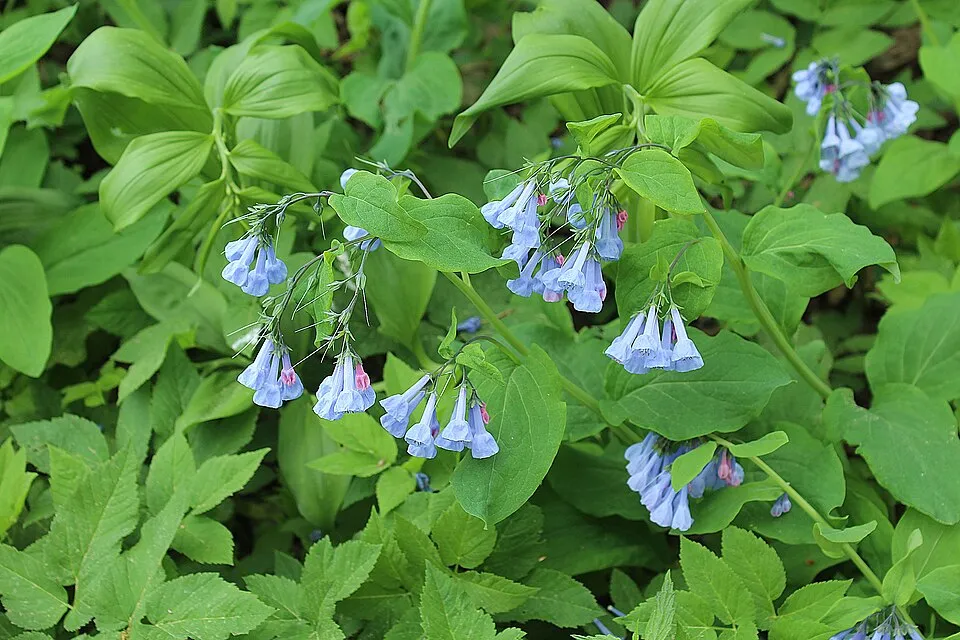
The Virginia Bluebell, or Mertensia virginica, is an enchanting native woodland perennial, celebrated for its ephemeral beauty and distinctive floral display. This herbaceous plant is indigenous to moist woodlands and river flood plains across eastern North America, spanning from New York to Minnesota, and extending south to Kansas and Alabama, as well as into Ontario and Quebec. A member of the Boraginaceae family, it typically forms erect clumps, growing up to 2 feet tall and about a foot wide. In early spring, deep purple emerging foliage quickly transitions to smooth, oval, blue- to gray-green leaves with prominent veins. The leaves, which can be 2-8 inches long, are petiolate at the base and become sessile higher up the stem.
Its succulent-like stems are fragile, mostly green but sometimes tinged with purple. The plant's most captivating feature is its mid-spring bloom (typically mid-April to mid-May), producing loose clusters of nodding, bell-shaped flowers. These blossoms emerge as purplish-pink buds and unfurl into stunning sky-blue flowers, though pink or white variants exist. Each flower features five fused petals, five white stamens, and a slender white pistil, exuding a delicate, sweet fragrance. After a bloom period of about three weeks, the fertilized flowers yield wrinkled nuts containing four seeds.
By early summer, the entire plant gracefully yellows and dies back to the ground, entering a dormant phase until the following spring. This ephemeral nature makes it a crucial early-season nectar source for pollinators like bumblebees and hummingbirds, and an ideal companion for later-season perennials. Hardy in USDA zones 3-9, Mertensia virginica is unfortunately considered threatened in parts of its native range due to habitat destruction and altered natural flood cycles.
Trusted Scientific References
1. Authoritative external sources for Mertensia virginica
1.1 Wikipedia — Mertensia virginica
1.2 Kew POWO (Plants of the World Online)
1.3 PubMed — peer-reviewed research
1.4 NCBI Taxonomy Browser
1.5 GBIF — Global Biodiversity
1.1.Virginia Bluebell — Key Features
- ✓ <strong>Native Woodland Perennial</strong> — Indigenous to moist woodlands and river flood plains of eastern North America.
- ✓ <strong>Ephemeral Spring Bloom</strong> — Emerges in early spring, blooms for 3-4 weeks, then goes dormant by early summer.
- ✓ <strong>Bell</strong> — shaped Blue Flowers — Distinctive nodding flowers that open pink and mature to a vibrant sky-blue.
- ✓ <strong>Ornamental Value</strong> — Highly cherished for its aesthetic appeal in naturalized and shade gardens.
- ✓ <strong>Pollinator Attractor</strong> — Flowers are a valuable early spring nectar source for bumblebees, butterflies, and hummingbirds.
- ✓ <strong>Deer Resistant</strong> — Generally unpalatable to deer, making it a good choice for gardens prone to browsing.
- ✓ <strong>Habitat Indicator</strong> — Its presence often indicates healthy, undisturbed, moist woodland ecosystems.
- ✓ <strong>Low Maintenance</strong> — Once established, requires minimal care, especially when allowed to naturalize and self-seed.
- ✓ <strong>Self</strong> — seeding Colonies — Readily propagates itself under ideal conditions, forming dense, beautiful colonies over time.
- ✓ <strong>Conservation Concern</strong> — Considered threatened in parts of its native range due to habitat loss and environmental changes.
1.2.Virginia Bluebell — Quick Summary
- ✓ Ephemeral spring bloomer native to Eastern North America.
- ✓ Known for beautiful bell-shaped flowers transitioning from pink buds to sky-blue.
- ✓ Primarily valued for ornamental use in shaded woodland gardens.
- ✓ Traditional Native American uses for coughs, fevers, and as a diuretic exist for certain Mertensia species, not specifically M. virginica.
- ✓ Lacks scientific substantiation for modern medicinal consumption, primarily ornamental.
- ✓ Precautionary concerns for pyrrolizidine alkaloids (PAs) due to Boraginaceae family membership.
2.Virginia Bluebell — Scientific Identity
3.Virginia Bluebell — Quick Facts
4.Virginia Bluebell — Appearance & Identification
5.Virginia Bluebell — Native Habitat
6.Virginia Bluebell — Water Requirements
- ✓ Site Selection — Choose a location with partial to full shade, mimicking its native woodland habitat, and protect from harsh afternoon sun to prevent foliage scorch.
- ✓ Soil Requirements — Plant in well-drained, humus-rich soil, ideally amended with compost or leaf mold to ensure consistent moisture retention without becoming waterlogged.
- ✓ Planting Depth and Spacing — Space plants 10-18 inches apart to allow for natural spread and colony formation, planting dormant roots or potted plants at the same depth as their original container.
- ✓ Watering Regime — Provide consistent moisture, especially during the active growth phase in spring; the plant is sensitive to dry soil and will decline rapidly without adequate hydration.
- ✓ Propagation Techniques — Propagate Virginia Bluebells from fresh seeds, which often require a period of cold stratification, or by carefully dividing established clumps in late summer or early fall when dormant.
- ✓ Dormancy Care — Mark the plant's location as it goes dormant by early summer; avoid disturbing the long, fragile taproot, and consider interplanting with later-season perennials to fill the resulting bare space.
- ✓ Pest and Disease Resistance — This species generally exhibits good resistance to common garden pests and diseases, and it is largely unpalatable to deer, making it a low-maintenance and reliable choice for native gardens.
Reviewed by the Flora Medical Global Botanical Review Panel
Multi-disciplinary editorial group · Botany · Ethnobotany · Herbal-medicine literature
Who reviewed this: This page was checked by the Flora Medical Global Botanical Review Panel — an in-house editorial group of botany graduates, ethnobotany researchers, and horticulture practitioners who collectively maintain our 7,000+ plant encyclopedia. Meet the team.
Our 4-step verification process
1. Taxonomic verification
Scientific names and synonyms cross-checked against Kew POWO, World Flora Online, and The Plant List.
2. Phytochemical & medicinal cross-reference
Active compounds, traditional uses, and reported activities are cross-referenced with PubMed, USDA Dr. Duke's database, and peer-reviewed ethnobotanical literature.
3. Conservation & distribution check
Distribution, ecology, and conservation status confirmed against GBIF occurrence records and the IUCN Red List.
4. Editorial & safety review
Every entry passes an editorial pass for clarity, originality, and safety notices (toxicity, contraindications, dosage caveats) before publication.
Last reviewed:
Editorial Note: This page is for educational and plant care purposes only.
Written by: Flora Medical Global Editorial Team
Reviewed by: Flora Medical Global Botanical Review Panel
Last Updated: June 15, 2026







Virginia Bluebell — Comments & Community Reviews
Rate this plant