

Care Disclaimer: Plant care recommendations are general guidelines based on common growing conditions. Individual results may vary based on your local environment, climate, and care routine. If your plant is toxic, keep it away from children and pets, and consult a veterinarian if accidental ingestion occurs.
1.Virginia Creeper — Overview
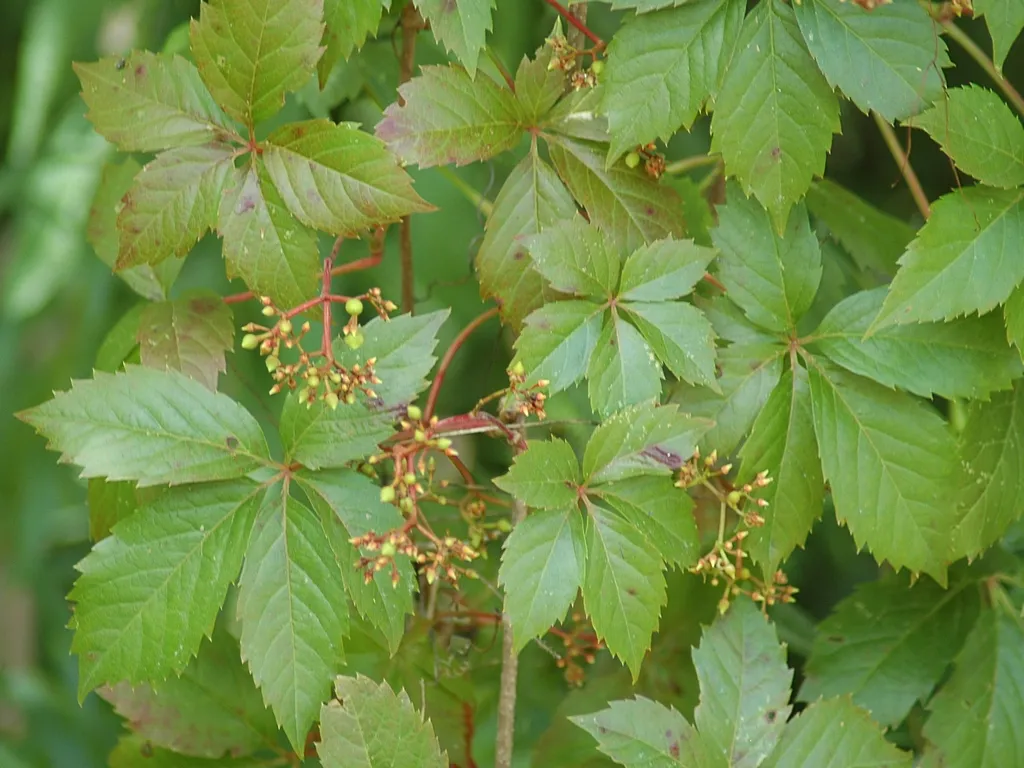
Virginia Creeper, scientifically known as Parthenocissus quinquefolia, is a robust, deciduous woody vine belonging to the Vitaceae family, native to a vast region spanning eastern and central North America, extending southward into Mexico and Guatemala. This vigorous climber is celebrated for its dramatic autumnal display, where its typically green foliage transitions into spectacular hues of crimson, scarlet, and deep purple. It employs specialized adhesive holdfasts on its tendrils, enabling it to cling firmly to various surfaces such as tree trunks, rock faces, and building walls, often reaching impressive lengths of up to 20-30 meters, and even up to 50 feet in optimal conditions.
The plant's distinctive palmate leaves are a key identifying feature, usually comprising five oval leaflets, though young vines or specific conditions may present three or seven, which helps differentiate it from the similarly appearing but unrelated poison ivy (Toxicodendron radicans). Inconspicuous greenish flowers emerge in late spring or early summer, developing into clusters of dark blue-black berries by late summer. While these berries are a vital food source for numerous bird species, they are highly toxic to humans and many pets upon ingestion, containing harmful calcium oxalate crystals and other irritants.
Parthenocissus quinquefolia is notably resilient, adapting to a wide range of soil types and light conditions, from full sun to heavy shade, and is hardier than related ornamental vines like Boston ivy.
Trusted Scientific References
1. Authoritative external sources for Parthenocissus quinquefolia
1.1 Wikipedia — Parthenocissus quinquefolia
1.2 Kew POWO (Plants of the World Online)
1.3 PubMed — peer-reviewed research
1.4 NCBI Taxonomy Browser
1.5 GBIF — Global Biodiversity
1.6Virginia Creeper should be interpreted through verified botanical identity, practical care, and responsible safety language. This recovery note adds the missing context needed for a complete profile: match light to the plant's habit, use well-drained soil, water according to season, and avoid unsupported medicinal or edible claims. For publishing, the plant can be presented as a source-backed garden plant with clear care guidance, common problem diagnosis, and conservative safety wording.
1.1.Virginia Creeper — Key Features
- ✓ <strong>Striking Fall Foliage</strong> — Known for its vibrant crimson, red, and purple leaves in autumn.
- ✓ <strong>Vigorous Climbing Vine</strong> — Reaches significant lengths, adhering to surfaces via adhesive tendrils.
- ✓ <strong>Palmate Leaves with Five Leaflets</strong> — Distinctive five-fingered leaf structure.
- ✓ <strong>Native to North America</strong> — Found extensively across eastern and central regions.
- ✓ <strong>Highly Toxic Berries</strong> — Dark blue-black berries are poisonous to humans and many animals.
- ✓ <strong>Contains Calcium Oxalate Raphides</strong> — Primary cause of irritation and toxicity.
- ✓ <strong>Traditional External Uses</strong> — Historically applied topically for inflammation and skin issues.
- ✓ <strong>Hardy and Adaptable</strong> — Tolerates various light and soil conditions.
- ✓ <strong>Ornamental Value</strong> — Widely planted for aesthetic appeal on walls, fences, and as groundcover.
- ✓ <strong>Fast</strong> — Growing — Can grow up to 20 feet in a single year, requiring management.
1.2.Virginia Creeper — Quick Summary
- ✓ Virginia Creeper is a toxic North American vine, famed for its brilliant red fall foliage.
- ✓ Contains calcium oxalate raphides, causing severe irritation upon contact or ingestion.
- ✓ Historically, Native Americans used it externally for inflammation and skin conditions.
- ✓ Internal use is strictly contraindicated due to high toxicity, especially from berries.
- ✓ Primarily valued today for its ornamental beauty and vigorous climbing habit.
- ✓ Requires careful handling; keep away from children and pets.
2.Virginia Creeper — Scientific Identity
3.Virginia Creeper — Quick Facts
4.Virginia Creeper — Appearance & Identification
5.Virginia Creeper — Native Habitat
6.Virginia Creeper — Water Requirements
- ✓ Hardiness Zones — Thrives in USDA Hardiness Zones 3-9, demonstrating remarkable cold tolerance and adaptability.
- ✓ Light Requirements — Grows vigorously in full sun, but also tolerates partial shade and even heavy shade, though fall color may be less vibrant in deep shade.
- ✓ Soil Preference — Highly adaptable to almost any soil type, including poor, rocky, or clay soils, as long as it is well-drained.
- ✓ Watering Needs — Drought-tolerant once established, requiring minimal supplemental irrigation; young plants benefit from consistent moisture.
- ✓ Propagation — Easily propagated from seeds (sown in fall or spring after moist stratification), softwood, semi-hardwood, or hardwood stem cuttings, root cuttings, or by layering.
- ✓ Pruning — Very tolerant of pruning; best done in spring to manage its vigorous growth or to remove unwanted tendrils from structures. Can be cut back to the base if necessary.
- ✓ Growth Habit — Can be grown as a climbing vine on trellises, arbors, or walls (non-damaging to masonry), or as a dense groundcover for erosion control or disguising unsightly areas.
- ✓ Pest and Disease Resistance — Generally robust with few serious pests, though adult Japanese beetles and some native caterpillars may feed on foliage.
Reviewed by the Flora Medical Global Botanical Review Panel
Multi-disciplinary editorial group · Botany · Ethnobotany · Herbal-medicine literature
Who reviewed this: This page was checked by the Flora Medical Global Botanical Review Panel — an in-house editorial group of botany graduates, ethnobotany researchers, and horticulture practitioners who collectively maintain our 7,000+ plant encyclopedia. Meet the team.
Our 4-step verification process
1. Taxonomic verification
Scientific names and synonyms cross-checked against Kew POWO, World Flora Online, and The Plant List.
2. Phytochemical & medicinal cross-reference
Active compounds, traditional uses, and reported activities are cross-referenced with PubMed, USDA Dr. Duke's database, and peer-reviewed ethnobotanical literature.
3. Conservation & distribution check
Distribution, ecology, and conservation status confirmed against GBIF occurrence records and the IUCN Red List.
4. Editorial & safety review
Every entry passes an editorial pass for clarity, originality, and safety notices (toxicity, contraindications, dosage caveats) before publication.
Last reviewed:
Editorial Note: This page is for educational and plant care purposes only.
Written by: Flora Medical Global Editorial Team
Reviewed by: Flora Medical Global Botanical Review Panel
Last Updated: June 15, 2026







Virginia Creeper — Comments & Community Reviews
Rate this plant