
Care Disclaimer: Plant care recommendations are general guidelines based on common growing conditions. Individual results may vary based on your local environment, climate, and care routine. If your plant is toxic, keep it away from children and pets, and consult a veterinarian if accidental ingestion occurs.
1.Walnut Tree — Overview
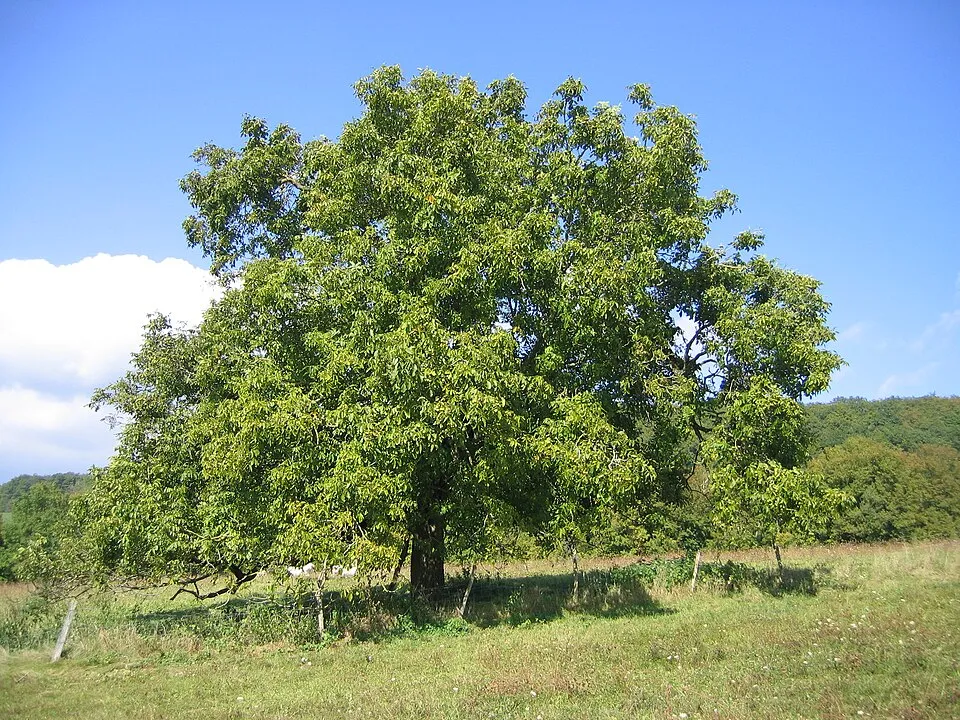
The Walnut Tree, scientifically known as Juglans regia and a member of the Juglandaceae family, is a majestic deciduous tree native to a vast region spanning the Balkan Peninsula, Central Asia, and the Himalayas. This species is highly valued globally not only for its superior timber and ornamental beauty but also, most famously, for its nutritious nuts. Growing up to 35 meters in height, Juglans regia develops a broad, spreading crown that offers significant shade.
Its distinctive bark transitions from a smooth, silvery-grey in youth to a deeply fissured texture with age. The leaves are pinnately compound, characterized by their aromatic quality and a striking transformation to golden-yellow hues in autumn. The tree produces large, spherical fruits encased in a thick, green husk.
Upon ripening, this husk naturally splits open to reveal the hard-shelled walnut, which is a prized culinary ingredient and a powerhouse of nutrients. Beyond the edible nuts, various parts of the walnut tree, including its leaves, bark, and green husks, have a rich history of traditional use in medicine and for natural dyeing. Notably, Juglans regia exhibits allelopathic properties due to the compound juglone, though typically in lower concentrations compared to its relative, the black walnut.
Trusted Scientific References
1. Authoritative external sources for Juglans regia
1.1 Wikipedia — Juglans regia
1.2 Kew POWO (Plants of the World Online)
1.3 PubMed — peer-reviewed research
1.4 NCBI Taxonomy Browser
1.5 GBIF — Global Biodiversity
1.6Walnut Tree should be interpreted through verified botanical identity, practical care, and responsible safety language. This recovery note adds the missing context needed for a complete profile: match light to the plant's habit, use well-drained soil, water according to season, and avoid unsupported medicinal or edible claims. For publishing, the plant can be presented as a source-backed garden plant with clear care guidance, common problem diagnosis, and conservative safety wording.
1.1.Walnut Tree — Key Features
- ✓ <strong>Large, deciduous tree</strong> — Large, deciduous tree reaching up to 35 meters with a broad crown.
- ✓ <strong>Produces highly nutritious</strong> — Produces highly nutritious and economically significant edible nuts.
- ✓ <strong>Exceptionally rich source of omega</strong> — 3 alpha-linolenic acid (ALA).
- ✓ <strong>Contains a diverse</strong> — Contains a diverse array of potent antioxidants, including polyphenols and Vitamin E.
- ✓ <strong>Traditional uses span</strong> — Traditional uses span across various cultures for its astringent, antiseptic, and dyeing properties.
- ✓ <strong>All parts of the tree</strong> — nuts, leaves, bark, and green husks—hold medicinal or practical value.
- ✓ <strong>Valued globally for its high</strong> — quality timber and ornamental appeal in landscapes.
- ✓ <strong>Exhibits allelopathic properties</strong> — Exhibits allelopathic properties due to the natural production of juglone.
- ✓ <strong>Thrives in temperate</strong> — Thrives in temperate climates with full sun and deep, fertile, well-drained soils.
- ✓ <strong>An important global</strong> — An important global agricultural crop and subject of ongoing phytopharmacological research.
1.2.Walnut Tree — Quick Summary
- ✓ Juglans regia, the Walnut Tree, is a versatile species valued for its edible nuts, timber, and traditional medicinal uses.
- ✓ Its nuts are a powerhouse of nutrition, rich in omega-3 fatty acids, antioxidants, and essential minerals.
- ✓ Walnut leaves, bark, and green husks possess astringent, antiseptic, and anti-inflammatory properties for various health applications.
- ✓ The plant supports cardiovascular, brain, and skin health, and has potential anti-cancer and blood sugar regulating effects.
- ✓ Cultivation requires full sun, deep, well-drained soil, and temperate climates, with attention to specific pests and diseases.
- ✓ Important safety considerations include potential nut allergies, interactions with medications, and skin irritation from fresh husks.
2.Walnut Tree — Scientific Identity
3.Walnut Tree — Quick Facts
4.Walnut Tree — Appearance & Identification
5.Walnut Tree — Native Habitat
6.Walnut Tree — Water Requirements
- Sun Exposure — English walnut trees require full sun exposure, meaning at least six hours of direct sunlight daily for optimal growth and nut production.
- Soil Requirements — They thrive in deep, fertile, well-drained loamy soils with a slightly acidic to neutral pH range of 6.0 to 6.5.
- Watering — Newly planted trees need consistent weekly watering throughout their first two growing seasons, especially during spring and summer; established trees benefit from biweekly irrigation.
- Temperature and Humidity — Juglans regia prefers cooler, temperate climates and is hardy in USDA zones 3-7, generally avoiding hot and excessively humid conditions.
- Fertilization — Annual application of a slow-release, high-nitrogen fertilizer in the spring helps support vigorous growth and nut yield.
- Propagation — While young trees are the easiest starting point, propagation from seed requires a cold stratification period of 90-120 days to mimic winter conditions.
- Pruning — Annual winter pruning is recommended to establish a strong central leader, encourage a rounded crown, and remove any dead, diseased, or weak branches.
- Pest and Disease Management — Watch for the walnut husk fly, which can be managed with landscape fabric and prompt nut removal, and the serious fungal disease 'thousand cankers' spread by the walnut twig beetle.
Reviewed by the Flora Medical Global Botanical Review Panel
Multi-disciplinary editorial group · Botany · Ethnobotany · Herbal-medicine literature
Who reviewed this: This page was checked by the Flora Medical Global Botanical Review Panel — an in-house editorial group of botany graduates, ethnobotany researchers, and horticulture practitioners who collectively maintain our 7,000+ plant encyclopedia. Meet the team.
Our 4-step verification process
1. Taxonomic verification
Scientific names and synonyms cross-checked against Kew POWO, World Flora Online, and The Plant List.
2. Phytochemical & medicinal cross-reference
Active compounds, traditional uses, and reported activities are cross-referenced with PubMed, USDA Dr. Duke's database, and peer-reviewed ethnobotanical literature.
3. Conservation & distribution check
Distribution, ecology, and conservation status confirmed against GBIF occurrence records and the IUCN Red List.
4. Editorial & safety review
Every entry passes an editorial pass for clarity, originality, and safety notices (toxicity, contraindications, dosage caveats) before publication.
Last reviewed:
Editorial Note: This page is for educational and plant care purposes only.
Written by: Flora Medical Global Editorial Team
Reviewed by: Flora Medical Global Botanical Review Panel
Last Updated: June 15, 2026







Walnut Tree — Comments & Community Reviews
Rate this plant